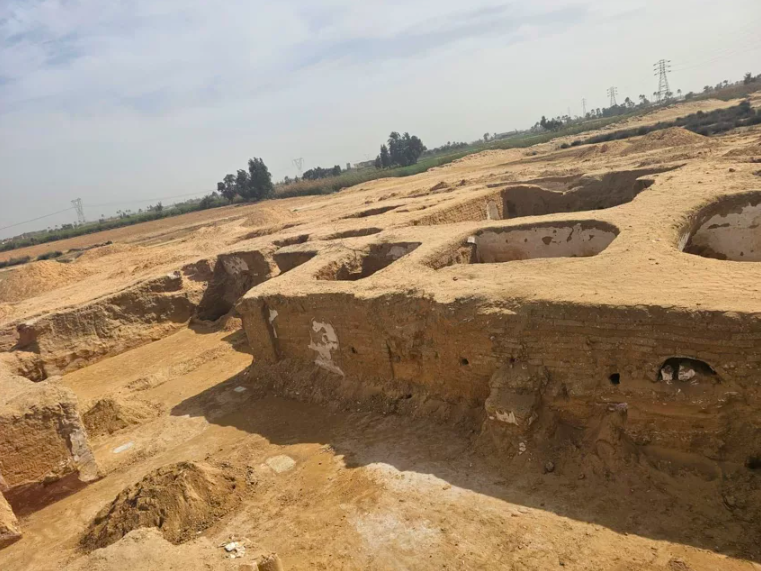
Significant Archaeological Find: Ancient Monastic Complex Discovered in Egypt’s Nile Delta
(Photo: Egypt Ministry of Tourism and Archives)
A remarkable archaeological discovery has emerged from Egypt’s Nile Delta, where a team of Egyptian archaeologists has uncovered a 1,500-year-old monastic complex. This significant find, announced by Egypt’s Ministry of Tourism and Antiquities, provides critical insights into the early days of organized monastic life.
The excavation, part of an ongoing project by the Egyptian mission from the Supreme Council of Antiquities, has been active since 2023 at the Al-Qalāyā site in Beheira Governorate. For more details, see the official announcement.
The newly discovered complex includes a fifth-century structure believed to have served pilgrims, featuring 13 rooms with various functions, such as monastic cells, hospitality areas, educational spaces, a kitchen, and storerooms.
Over time, the site underwent modifications, reflecting its adaptation through different historical phases. Notably, a large hall to the north displays stone benches with botanical motifs, likely serving as a reception area for notable visitors and those studying monastic life. The building, oriented along a north-south axis, contains a prayer room facing east, marked by a limestone cross on its eastern wall.
According to Hisham El-Leithy, secretary-general of the Supreme Council of Antiquities, the Al-Qalāyā site ranks as the second-largest known monastic gathering place in Christian monastic history. El-Leithy noted that the site’s architecture showcases “the earliest nucleus of monastery establishment.”
The complex’s decorative elements are crucial for understanding early Coptic art, offering invaluable insights into the historical and artistic development of monastic life. The site illustrates the progression from solitary monastic living to communal organizations capable of accommodating visitors.
Recovered wall paintings depict monks and feature geometric and plant-based designs, such as braided ornaments and an eight-petaled flower, highlighting the rich symbolic nature of early Coptic art. A notable mural shows two gazelles encircled by vegetal motifs, a design believed to hold symbolic significance, as reported by the Basilica News Agency.
The site provides evidence of a shift from isolated monastic practices to a more organized communal structure, a development distinct from the desert origins of early monasticism in southern Egypt.
Among the artifacts uncovered are a complete marble column, column capitals and bases, pottery with vegetal and geometric motifs, ceramic pieces with Coptic inscriptions, bird and animal bones, and oyster shells—indicative of daily life and food preparation at the complex.
Samir Razaq Abdul-Hafiz, head of the excavation mission, highlighted the discovery of a limestone piece with a Coptic inscription at the entrance to one chamber. The inscription, believed to be a funerary stele, mentions “Apa Kyr, son of Shenouda,” providing evidence of continued activity at the site during a period of monastic expansion.
Since the excavation began, multiple clusters of monastic cells, known as manshubiyyat, and auxiliary service buildings have been uncovered, further indicating the site’s role as a significant monastic center.
Research at the site continues to reveal more about this important chapter in monastic history.
This article was originally written by www.christiantoday.com