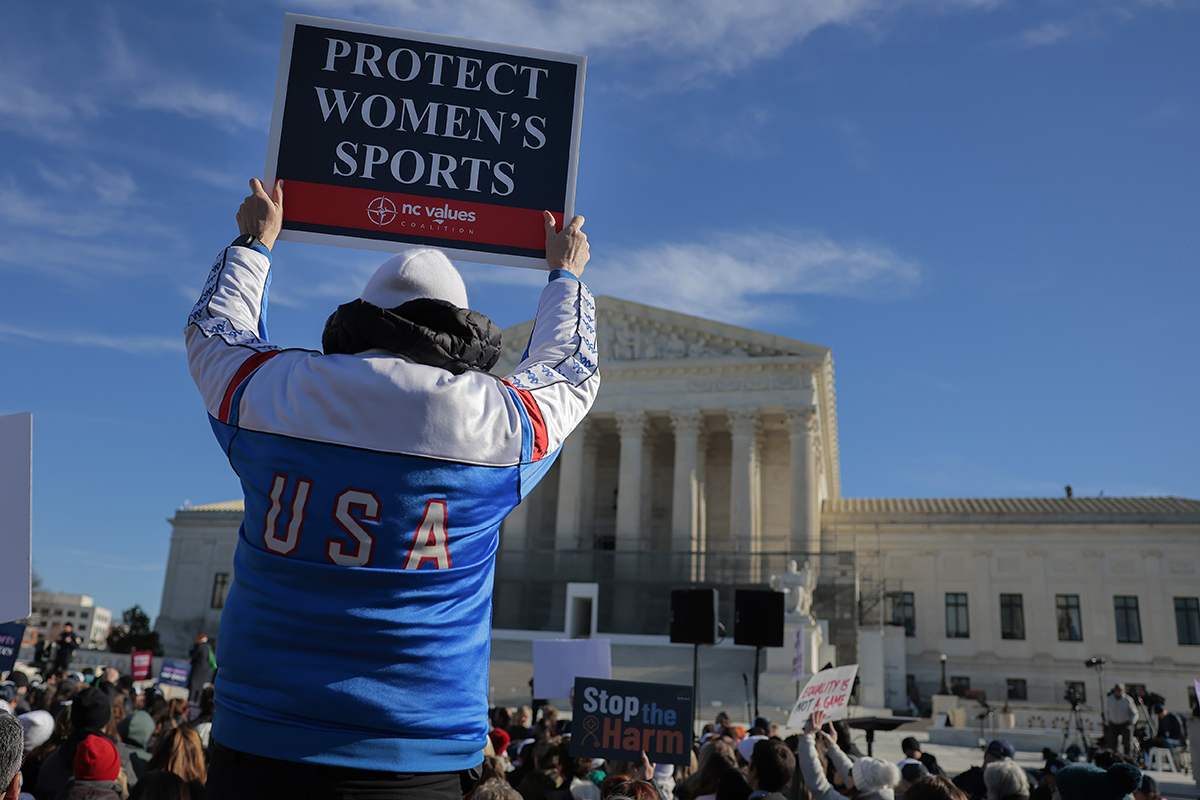
The debate over who gets to compete in women’s sports reached the United States Supreme Court, spotlighting two pivotal cases. The justices grappled with the question of whether state laws barring male athletes from girls’ sporting events violate constitutional rights, while attorneys shied away from providing a clear definition of “sex” during discussions.
Supreme Court Examines Key Cases
The Supreme Court was presented with oral arguments concerning state laws in Idaho and West Virginia that prevent trans-identified males from participating in female sports. These cases, Lindsay Hecox et al. v. Bradley Little, et al. and State of West Virginia v. B.P.J., could significantly impact the future of gender classification in athletics.
In Idaho, the Fairness in Women’s Sports Act faced scrutiny after a Ninth Circuit Court of Appeals panel blocked the law, backing a previous court injunction. West Virginia’s Save Women’s Sports Act of 2021 was similarly challenged, with a Fourth Circuit Court panel reinstating a lower court’s decision to block the law.
Unclear Definitions Amidst Legal Arguments
Representing Lindsay Hecox, attorney Kathleen Hartnett encountered questions from Justice Samuel Alito regarding the criteria for classifying athletes as boys or girls. While acknowledging the necessity of such classifications for equal protection, Hartnett did not provide a definitive answer, leading to a dialogue about whether the term “sex” needed a precise definition for judicial decisions.
Hartnett argued that the Idaho law unfairly excluded Hecox, a trans-identified male athlete, from competing on girls’ teams. She noted, “We do not have a definition for the court,” and emphasized that the exclusion based on “birth-sex” did not align with state interests.
Joshua Block, representing the minor “B.P.J.,” contended that West Virginia’s use of “sex” as a definition was discriminatory. He stated, “Our argument is it’s using this definition to inflict discrimination in denial [of] equal athletic opportunity.” However, he did not oppose the state’s definition of sex.
Justices Probe the Meaning of “Sex”
Justice Brett Kavanaugh questioned whether Title IX of federal law permits states to interpret “sex” differently in sports leagues. Block affirmed, “I think the purpose is to make sure that sex isn’t being used to discriminate by denying opportunities.”
Chief Justice John Roberts pressed Block on whether the Supreme Court should establish a consistent definition of sex under Title IX. Block responded, “We’re not trying to police the accuracy of the terminology. All I am saying is that what’s being prohibited is using this classification to discriminate.”
State Laws and Their Implications
The discussion occurs amidst a backdrop of state laws enacted to prevent male students who identify as female from joining girls-only teams, driven by fairness concerns. According to The Christian Post, male athletes identifying as female have secured over 1,900 gold medals in women’s sports, highlighting the contentious nature of the issue.
These legislative efforts are often met with challenges from groups advocating for trans inclusion, claiming such laws are discriminatory. The editorial board of The Washington Post defended the state measures, noting that the laws recognized biological differences and ensured fair play in women’s athletics.
This article was originally written by www.christianpost.com