
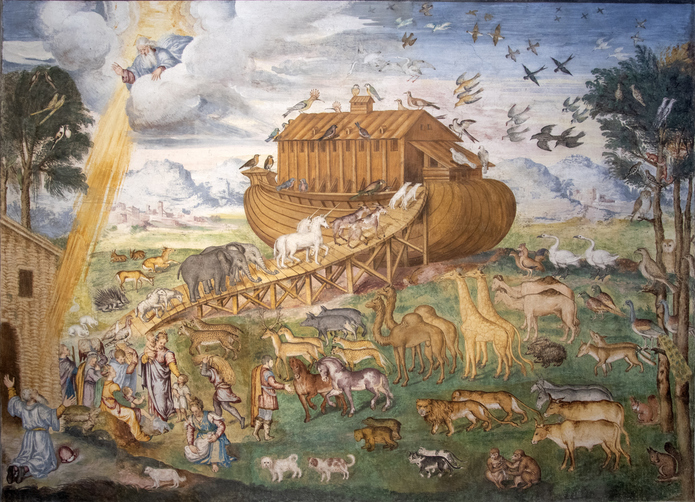
The Enigma of Noah’s Ark: New Perspectives on an Ancient Tale
The story of Noah’s Ark has captured imaginations for centuries, appearing in a myriad of formats from children’s books to epic films. Despite its widespread recognition, numerous uncertainties about the narrative persist, leaving much to the realm of speculation.
Understanding the Ark
In the biblical account of Genesis, the term “ark” is derived from the Latin word “arca,” signifying a container or chest, rather than a ship. This term is similarly applied to describe the basket that carried Moses and the Ark of the Covenant, suggesting a function beyond that of a mere vessel.
The Flood’s Origins
Various theories attempt to explain the flood, from natural phenomena like tsunamis and melting glaciers to the breaking of the Black Sea through the Bosphorus. Genesis 7:11 describes a deluge resulting from both subterranean springs and torrential rain, portraying a comprehensive inundation.
Dating the Deluge
The flood’s timing is enigmatic. Genesis 7:11 dates it to the “six hundredth year of Noah’s life,” with traditional estimates placing it in 2348 BC. Other theories suggest dates as early as 5500 BC, indicating a significant uncertainty about its exact chronology.
Construction Materials
Genesis 6:14 mentions “gopher wood” as the ark’s material, though its exact nature remains unknown. Some translations speculate it as cedar or cypress, while others suggest it might have been reeds, akin to the Marsh Arabs’ boat-building techniques.
Dimensions and Design
Genesis provides the ark’s dimensions but not its design, leaving interpretations ranging from a box-like structure to a more streamlined vessel. The cubit, used to measure the ark, is itself a variable measurement, resulting in further ambiguity about its true size.
Resting Place of the Ark
Genesis 8:4 asserts that the ark came to rest on the mountains of Ararat, sparking debates about its precise location. While tradition often points to Mount Ararat, volcanic activity in the range suggests alternative possibilities, including Mount Judi, as proposed by historical figures like Josephus.
The Ark’s Passengers
Contrary to popular depictions, the Bible describes more than just pairs of animals boarding the ark. Genesis 7:2–3 indicates that clean animals entered in sevens, hinting at a more complex passenger list than traditionally imagined.
Extent of the Flood
The language in Genesis suggests a worldwide flood, yet biblical hyperbole indicates it might have been regional. Evangelicals often emphasize consistent interpretation, acknowledging that “earth” frequently means land or ground, not the entire planet.
The Evolutionary Challenge
A global flood implies a massive repopulation effort post-deluge, demanding rapid biological diversification. This notion challenges current evolutionary understanding, suggesting an accelerated form of natural selection not widely supported by science.
The Ark’s Fate
There is no indication that Noah’s ark survived. Natural decay or volcanic destruction could explain its absence, and the Bible makes no mention of its enduring presence, unlike other significant landmarks.
Throughout history, attempts to reconstruct Noah’s Ark have taken various forms, reflecting diverse interpretations. While tradition often fills biblical gaps, the story’s factual elements remain elusive, prompting ongoing exploration and debate. Recent interest focuses on a geographical structure in southeastern Türkiye, speculated to be the ark’s remains, though evidence remains inconclusive. For more, visit this article.
This article was originally written by www.christiantoday.com




