
Foreign Funding in U.S. Colleges: A Transparent Look into Global Contributions
In an effort to increase transparency around foreign contributions to American higher education institutions, the U.S. Department of Education has launched a new website detailing over $5 billion in foreign gifts and contracts received by colleges in 2025. This initiative is part of the Trump administration’s broader strategy to illuminate foreign influence on U.S. universities.
Major beneficiaries of these funds include top-tier institutions such as Carnegie Mellon University, Harvard University, the Massachusetts Institute of Technology (MIT), and Stanford University.
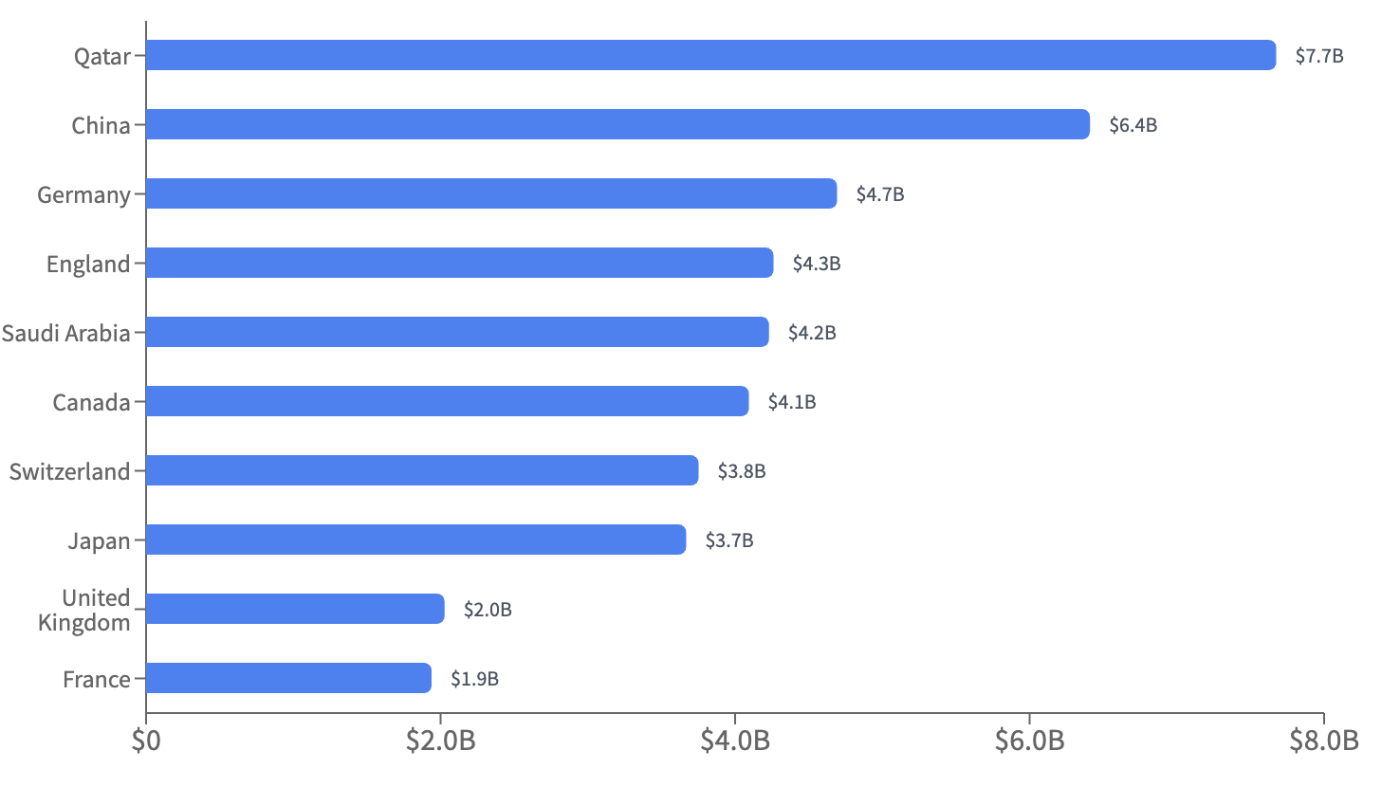
The top 10 countries that gave contracts and gifts to U.S. colleges and universities as of December 16, 2025. Screenshot by NPR/The U.S. Department of Education
Qatar emerges as the leading foreign contributor, accounting for over $1.1 billion, more than 20% of the total foreign funds. Other significant contributors include the United Kingdom, China, Switzerland, and Japan.
Education Secretary Linda McMahon emphasized the importance of this data, stating that it offers “unprecedented visibility into funding” from countries that may pose a threat to “America’s national security.”
Federal regulations require institutions to disclose foreign gifts or contracts exceeding $250,000, but concerns about underreporting have been raised, prompting calls for enhanced transparency and reporting. The current administration has conducted investigations into institutions like Harvard University and the University of California, Berkeley for potential non-compliance.
Ian Oxnevad, a senior fellow at the National Association of Scholars, praised the initiative as a “step in the right direction,” highlighting the newfound transparency regarding foreign donations. He remarked that it clarifies “specific countries, what universities they donate to, and the amounts.” Notably, “Qatar and China are among the top countries that donate to our universities, and not our allies or neighbors.”
The newly launched website also features data on what McMahon referred to as “countries of concern,” such as China, Russia, and Iran, with Harvard, New York University, and MIT being major recipients of their funds.
Oxnevad stressed the importance of understanding foreign funding in shaping public policy, particularly at prestigious institutions like Harvard.
Universities maintain they adhere to legal requirements, with MIT asserting in a statement that all research is “open and publishable,” emphasizing their compliance with “all federal laws in accepting and reporting any such gifts or contracts.”
The American Council on Education, representing colleges and universities, echoed this sentiment. Sarah Spreitzer, the council’s vice president and chief of staff, stated, “This demonstrates that our institutions are doing a good job reporting this information.”
Both Spreitzer and Oxnevad pointed out that the data lacks details and comparative tools, making trend analysis challenging. Despite these limitations, Spreitzer expressed concern about the administration’s potential use of this data, saying, “I worry that [the administration] is trying to send a message to taxpayers that our institutions are taking a lot of money from foreign donors.” Nonetheless, she advocated for increased transparency.




