Metropolitan Police Officer Recognized for Upholding Free Speech in London
In a notable development, a senior officer from the Metropolitan Police lauded a constable for her defense of a Christian street preacher’s freedom of speech in Whitechapel, East London. However, some campaigners for free speech caution that such recognition may not signal an immediate transformation within the police culture.
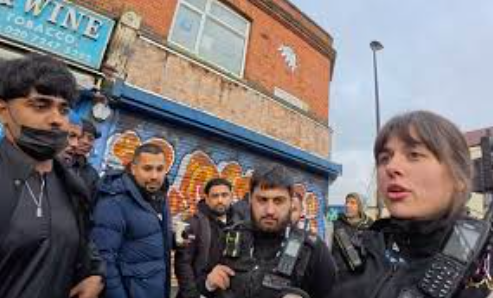
Assistant Commissioner (AC) Matt Twist addressed the issue at the London Assembly’s police and crime committee on February 25. The discussion followed a viral video showing a female officer reminding a group of men in a “Muslim area” of the United Kingdom’s commitment to freedom of speech.
The video caught the attention of Susan Hall, leader of City Hall’s Conservative group. She expressed her admiration to AC Twist, stating, “I particularly want to congratulate you on your female officer, who I think it was in Whitechapel, actually reminded people what the meaning of free speech is. I really would like to commend her and I would love to see more police officers actually doing that. I hope you thank her on behalf of very many of us.” (London Standard)
AC Twist responded appreciatively, saying, “Thank you for noting the great work of PC {Police Constable} Moule who was in Whitechapel. It’s been reposted a number of times on differing social media accounts, some more politicised than others. My view is it was a good example of officers showing policing common sense without fear or favour and doing a good job.”
Despite this acknowledgment, the Met’s historical approach to free speech has faced criticism. An incident from April 2021 stands out, involving the arrest of John Sherwood, a Christian street preacher, in Uxbridge.
Preaching from Genesis 1:27, Sherwood emphasized the traditional family structure, which led to complaints of homophobic hate speech. The subsequent arrest, under Section 5 of the Public Order Act, sparked controversy and debate over the limits of free speech.
Captured on video, Sherwood’s arrest prompted condemnation from groups like Christian Concern. They described the arrest as “brutal,” challenging the Met’s stance on free speech. Sherwood’s eventual acquittal by Uxbridge Magistrates’ Court in 2022 highlighted the legal protections for free speech under Article 10 of the 1998 Human Rights Act.
The Met defended the arrest through a statement: “At 13:35hrs on Friday, 23 April, officers on patrol were flagged down by a member of the public who made them aware of a man allegedly making homophobic comments close to Uxbridge Underground Station. A number of other people also approached the officers with concerns about the man’s language.”
The statement continued, “Officers spoke with the 71-year-old man and he was subsequently arrested on suspicion of an offence under Section 5 of the Public Order Act. He was taken to a west London police station and later released under investigation. A file has been passed to the Crown Prosecution Service [CPS] for review and consideration. The Met’s Directorate of Professional Standards [DPS] have since assessed the footage and found no indication of misconduct. The arrest will not be subject to a full DPS review.”
Despite the Met’s defense, critics argue that the eagerness to curtail so-called “homophobic comments” reflects an anti-free speech stance within the Force. Concerns persist that neo-Marxist ideology may influence priorities, potentially compromising free speech when it involves traditional Christian values.
The potential impact of PC Moule’s actions and AC Twist’s praise on the Met’s culture remains uncertain. Some fear that entrenched forces resistant to free speech continue to hold sway. As Toby Young, General Secretary of the Free Speech Union, noted in The Telegraph, “I don’t know the officer’s name – the Metropolitan Police have declined to comment – but she deserves a medal. What she demonstrated, under considerable pressure, was a good grasp of the law: that a person preaching peacefully in a public place is exercising a right protected by Article 10 of the Human Rights Act 1998, and that the feelings of bystanders, however loudly expressed, are irrelevant. Unfortunately, she is the exception rather than the rule.”
For those advocating for free speech, particularly within Christian communities, complacency is not an option. Without significant shifts in the Met’s approach, the struggle for maintaining Christian expression on London’s streets continues.
This article was originally written by www.christiantoday.com