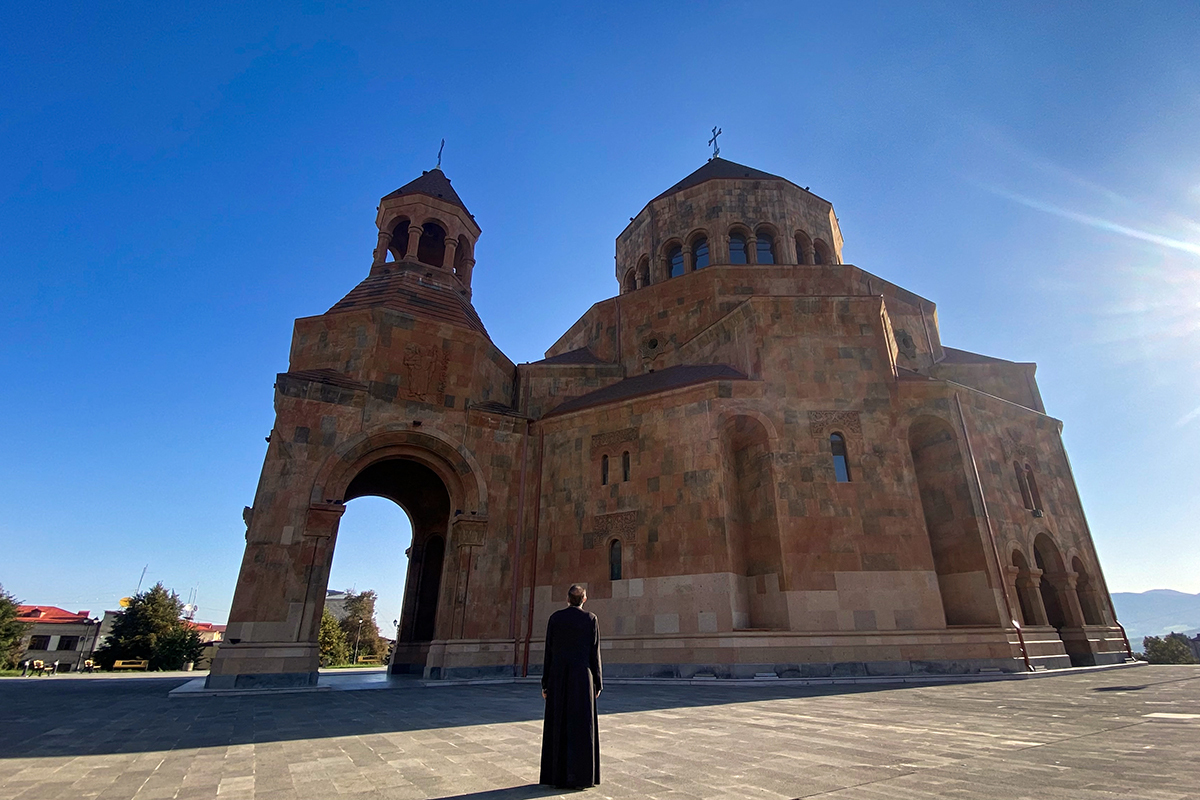
Historic Churches in Nagorno-Karabakh Razed Amidst Controversy
In a region marked by historical tensions, the demolition of two significant Christian churches in Stepanakert, a city now controlled by Azerbaijan, has sparked international debate. Satellite images have confirmed the destruction of these sites, leading Armenian church authorities to claim a targeted campaign to obliterate Armenian religious heritage.
The Holy Mother of God Cathedral, a central place of worship for Christians in Stepanakert—referred to as Khankendi by Azerbaijanis—was confirmed demolished. Radio Free Europe reported this development based on satellite imagery captured recently. Initially constructed in 2006 and consecrated in 2019, the cathedral previously served as a bomb shelter during military conflicts.
Additionally, the Church of St. Jacob, another key Christian establishment completed in 2007, has been destroyed. Funded by an Armenian-American philanthropist, it was erected in memory of his son. The Armenian church noted the obliteration of cross stones from the church grounds.
According to Asbarez, the Caucasus Muslims Board, affiliated with the Azerbaijani government, acknowledged the planned demolitions. The board stated that these structures had been “illegally” built during what they termed the Armenian occupation and argued that their removal should not be misinterpreted as destruction of cultural heritage.
Contrarily, the Mother See of Holy Etchmiadzin, representing the Armenian Apostolic Church, accused Azerbaijan of intentionally targeting Armenian Christian sites to erode Armenian influence in Nagorno-Karabakh. This accusation was reported by Middle East Eye.
In response, the Caucasus Muslims Board dismissed these claims as “hostility and disinformation.” Elnare Akimova, an Azerbaijani parliament member, labeled reports on the demolitions as “provocation by revanchist forces,” asserting that Azerbaijan maintains religious and historical monuments across its territories.
Lernik Hovhannisyan, head of the Artsakh Diocesan Council, contested Azerbaijan’s narrative, highlighting that Armenians predominantly populated Stepanakert. He questioned why Azerbaijani justifications excluded historical churches like Green Hour and Mokhrenes, which were destroyed in Shushi.
Hovhannisyan argued that these actions contradict international standards on self-determination, referencing the OSCE Minsk Group’s recognition of the Armenian population’s right to self-determination in Nagorno-Karabakh. However, the group’s activities have stalled post Russia’s invasion of Ukraine and Azerbaijan’s 2023 offensive.
The demolitions have stirred political tensions in Armenia, especially with upcoming parliamentary elections. Critics have charged Prime Minister Nikol Pashinyan with inaction over seeking international censure against Baku for the destruction of Christian sites. Pashinyan, while gathering information, has been cautious in his approach, avoiding making it an international issue.
Following Azerbaijan’s complete takeover of the territory in September 2023, approximately 120,000 ethnic Armenians fled Nagorno-Karabakh. Armenian prisoners from the conflict remain detained in Azerbaijan. Nadine Maenza, former chair of the USCIRF, described the church demolitions as “cultural genocide after the ethnic cleansing of 120,000” in a post on X.
This article was originally written by www.christianpost.com