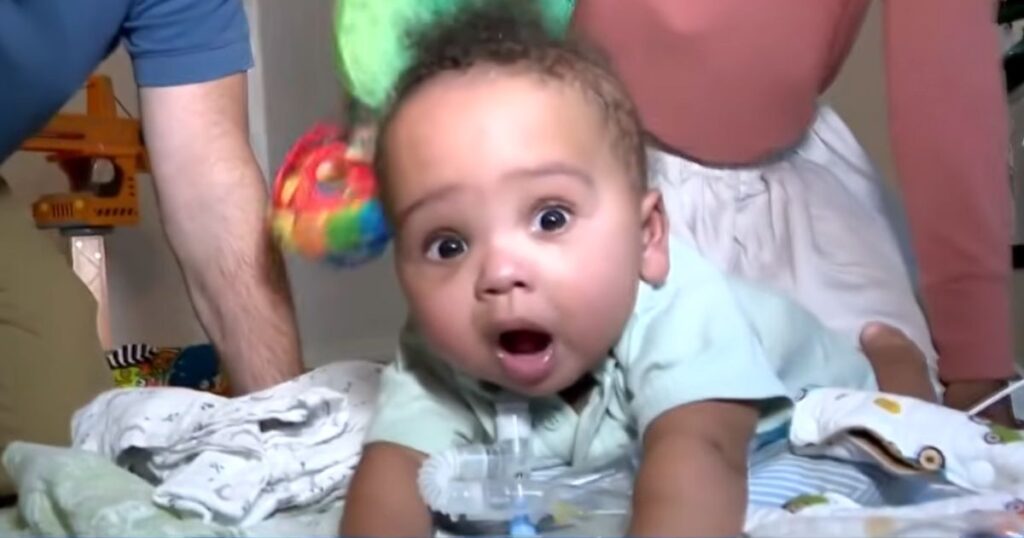
A Florida infant underwent an unprecedented medical procedure where surgeons partially delivered him at 25 weeks gestation to perform life-saving surgery before returning him to his mother’s womb to continue developing. The groundbreaking operation addressed a rare and typically fatal condition that threatened the baby’s life before birth.
Keishera and Greg Joubert were eagerly anticipating the arrival of their second son, a sibling for their 2-year-old Mattias. Their excitement transformed into fear at the 19-week ultrasound when medical professionals diagnosed their unborn baby, Cassian, with Congenital High Airway Obstruction Syndrome, commonly referred to as CHAOS.
A devastating diagnosis
This rare condition, occurring in approximately 1 in every 50,000 to 100,000 births, involves a thick membrane blocking the airway, causing fluid to accumulate in the lungs and compress the heart. The prognosis was grim, with survival rates historically very low.
“No one ever wants to hear that this baby has a very real chance of dying in the womb, not even making it to birth,” Keishera said.
Her online research only deepened her distress. “A lot of the articles would say that it’s devastatingly fatal. A lot of the babies die in the womb or shortly after birth, and I immediately just closed my laptop, and I went straight into the bedroom, into a corner, just started crying,” she said.
Greg estimated their chances at only 20 to 25% for a positive outcome before surgical intervention.
An innovative surgical approach
Dr. Emanuel Vlastos at Orlando Health Winnie Palmer Hospital brought decades of experience to the case. During his 42-year career, he had encountered a dozen CHAOS cases, with only three babies surviving. Despite these odds, he remained determined to help Cassian.
“Those are all cases from the past when we talk about the cases we know. We don’t know about the case present, and perhaps that’s where hope floats us down the stream of life,” Vlastos said.
An initial laparoscopic procedure at 22 weeks proved unsuccessful due to the membrane’s thickness. “We’re not even at square one; we’re a step behind square one,” Keishera said.
Dr. Vlastos then proposed an extraordinary solution that had never been successfully performed for this condition. He would perform a partial cesarean delivery, bringing only the baby’s head and arms outside the womb while keeping the rest of the body connected to the placenta. During this partial delivery, an ear, nose, and throat specialist would perform a tracheostomy to establish an airway.
The procedure took place at 25 weeks and succeeded. Keishera later shared a lighthearted moment with the doctor. “I am a little bit jealous. You got to see my baby before me.” When he showed her a photograph from the surgery, she saw her son’s features for the first time, including the tiny tracheal stent that was keeping him alive.
“It was a glimpse of the future. It was a glimpse of a little baby boy that I would eventually take home from the hospital,” she said.
A second birth and long recovery
Keishera’s water broke at 31 weeks, prompting a response from more than 30 medical professionals. The team replaced Cassian’s tracheostomy tube with one suitable for life outside the womb, while a ventilator and feeding tube assumed the functions previously handled by the placenta.
Following 132 days in the neonatal intensive care unit, Cassian was discharged to go home with his family.
“What greater triumph was it then that we could finally take our baby home,” Keishera said.
Looking ahead
The Joubert family plans to mark two special occasions: the anniversary of the surgery that saved their son’s life and his first birthday. Cassian still requires at least three additional surgeries before his second birthday.
“We’re not through it yet, but honestly, aren’t we all, like, in need of a good story?” Greg said.