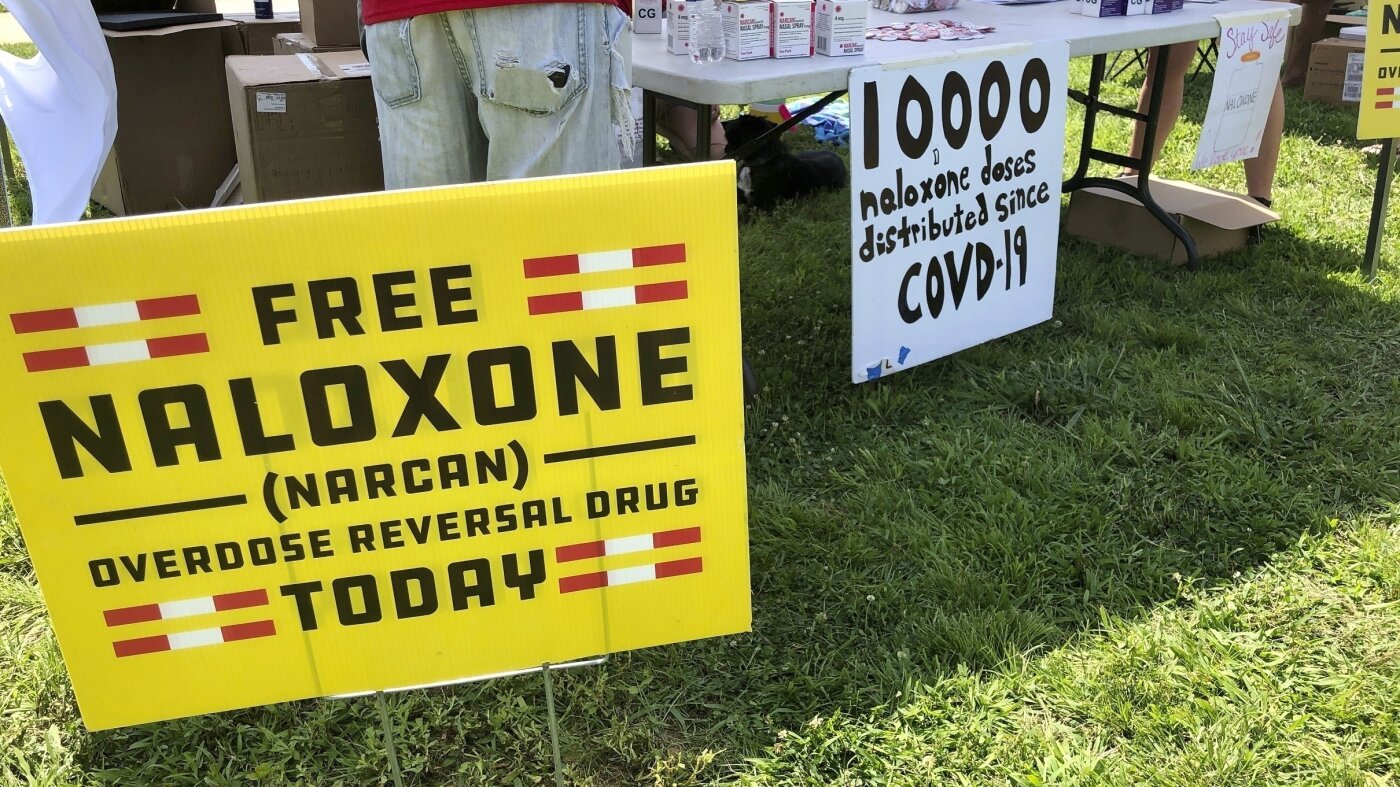
In this file photo, signs are displayed at a tent during a health event in Charleston, W.Va. Public health officials say the spread of naloxone, also known as Narcan, has dramatically reduced overdose deaths in the U.S.
John Raby/AP/AP
hide caption
toggle caption
John Raby/AP/AP
The United States has witnessed a notable reduction in drug overdose deaths, with fatalities dropping by approximately 14% in 2025 compared to the previous year, despite an uptick in certain Western states. According to the Centers for Disease Control and Prevention, 69,973 people succumbed to overdoses nationwide last year, a decrease of about 11,300 from 2024.
Dr. Nora Volkow, head of the National Institute on Drug Abuse, expressed optimism, stating, “This is very good news. We started to see the declines in 2023 but they were small and we weren’t certain they were going to be sustainable.”
Health experts attribute the decline to several factors, including increased access to opioid craving-reduction medications and naloxone, a life-saving drug that reverses overdoses. Beth Meyerson, a drug policy researcher at the University of Arizona, emphasized the significance of naloxone’s widespread availability: “Access to naloxone or Narcan has become widespread in communities. We’re beginning to see that naloxone is first aid and that is absolutely critical.”
The decline in drug-related deaths has been consistent since mid-2023, partly due to less potent fentanyl and decreased drug use among youth. Alabama, New York, and Virginia experienced the most significant reductions, with death rates falling between 25% and 30% by the end of 2025.
New York Governor Kathy Hochul commented on the progress in her state: “I am very pleased that over the past three years, we have seen a decline,” she stated in a statement. She highlighted that opioid-related fatalities from illicit fentanyl, heroin, and painkillers have halved since 2022. “We will continue our focus on removing health disparities and responding to new substances that are emerging in the illicit drug supply.”
The U.S. recorded its lowest number of drug-related deaths in 2025 since 2019, a remarkable shift from the peak of 112,418 deaths in the summer of 2023.
Troubling trends remain in some states and communities
Despite the overall decline, drug fatalities in the U.S. remain high compared to historical levels and other countries, such as Scotland, where overdose rates are significantly lower per capita, according to a January 2025 study. Older Americans and many predominantly Black and Native American communities still face high overdose mortality rates. Additionally, new synthetic drugs continue to emerge on U.S. streets, and states like Arizona, New Mexico, and North Dakota saw increased overdose deaths in 2025.
In Arizona, Meyerson suggests that potent fentanyl and methamphetamines, coupled with limited access to healthcare, could be contributing to the rise in deaths. “Arizona is the gateway for fentanyl into the United States [from Mexico],” she notes, highlighting that travel times for opioid treatments in rural areas can exceed two hours.
Volkow, from NIDA, acknowledges the challenges posed by widespread methamphetamine use in Arizona and New Mexico. She emphasizes the need for more efforts to reduce overdose deaths in Native American communities, especially in remote rural areas with inadequate healthcare services.
“Both Arizona and New Mexico have relatively large Native American populations and when you look at the demographics, what is clear is the overdose mortality among Native Americans is double that of the general rest of the United States,” Volkow said.
This article was originally written by www.npr.org