
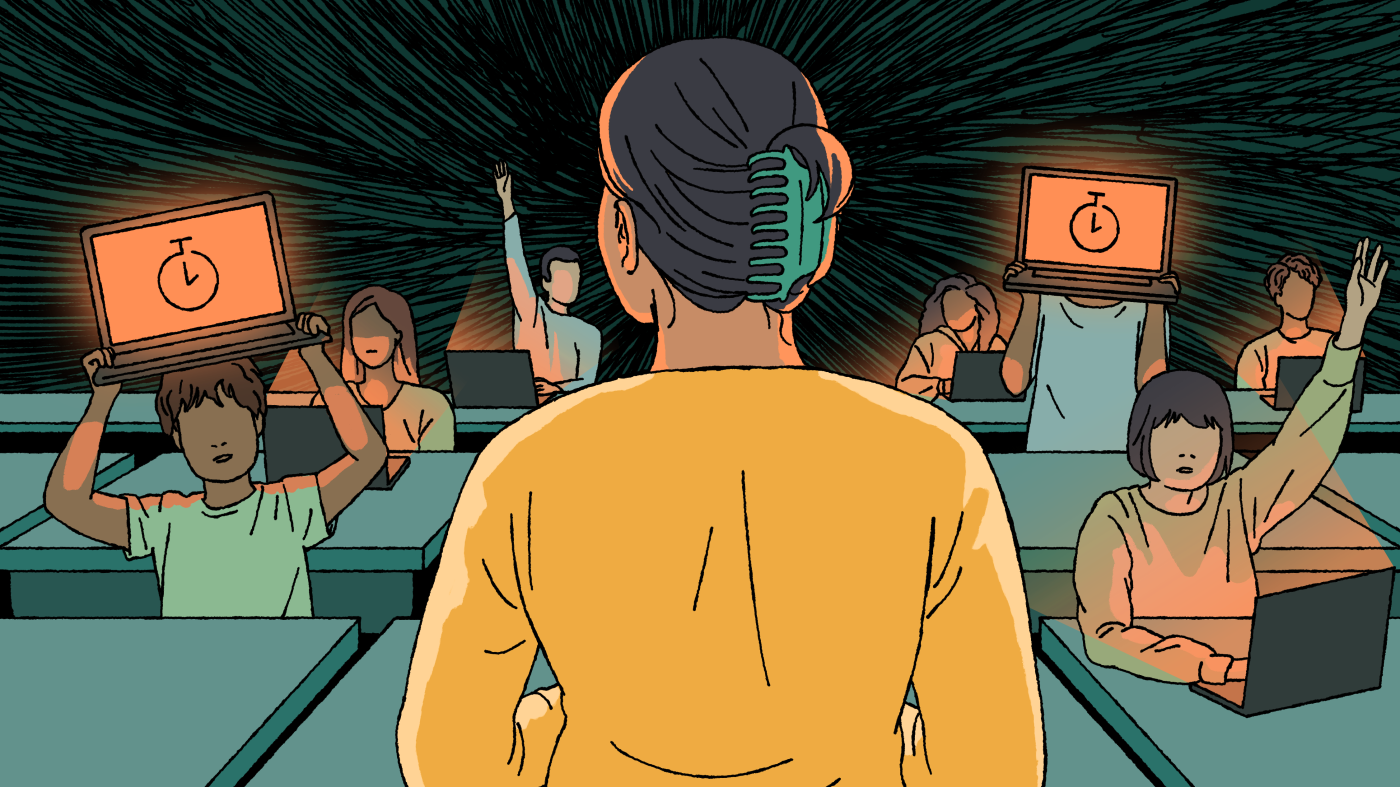
Los Angeles Schools Introduce New Screen Time Restrictions: A Transition Year for Educators
The Los Angeles Unified School District (LAUSD), the nation’s second-largest school district, is embarking on a significant shift in its educational approach by implementing strict screen time restrictions for students. For teachers like Armaghan Khan, this change presents both challenges and opportunities in adapting to new methods of instruction.
“This is going to be a big impact for me,” says Khan, a science teacher at Johnnie L. Cochran Middle School, who has relied heavily on technology in his classroom. “I would say about 75% of our work was on some kind of screen-based activity.” Khan’s use of technology has enabled students to engage in large-scale experiments, such as a car crash simulator to explore Newtonian forces, despite limited resources.
Khan acknowledges the constraints he faces, explaining, “My hands are kind of tied in terms of just what I can offer. We have a lab space, but we do not have a lab budget.”
LAUSD’s decision to reduce screen time comes amid a growing trend, with many districts and states implementing similar measures. However, the swift rollout in Los Angeles, affecting over 400,000 students, is notably ambitious. The school board’s resolution, passed in the spring, mandates no screen time for 1st grade and under, with phased limits for older students throughout the year.
Pia Sadaqatmal, the district’s chief academic officer, acknowledges the challenges of implementing such a policy. “There is no perfect solution on how to roll out to a school district the size of ours,” she admits. Sadaqatmal encourages educators to approach this year as a transition period, emphasizing the need for patience and adaptability.
The district has introduced software to monitor students’ screen time on their devices. Rather than automatically shutting off devices when limits are reached, the software will collect data for analysis at the end of the year. This data will guide future adjustments to the policy.
While virtual textbooks are exempt from the restrictions, teachers are navigating how to incorporate other digital resources within the new guidelines.
Addressing Gaps in Student Engagement
Kirti Baranwal, a teacher librarian at William Jefferson Clinton Middle School, expresses a cautious optimism about the screen time limits. “I have more questions than I do sort of immediate … concerns around it,” she says, noting her belief in the overall benefits of reducing screen time.
Baranwal recalls a lesson on screen addiction, where students reported daily screen use of 8 to 10 hours, despite a ban on cell phones—a measure increasingly adopted by schools nationwide. “And I was like, when are you sleeping?” she wonders.
Research indicates that children lacking access to extracurricular activities often resort to screens during their free time, as evidenced by a 2019 study. Baranwal and Khan agree that simply unplugging students is not a comprehensive solution. “What is it that we want kids doing?” Baranwal asks, emphasizing the need for meaningful alternatives to screen time.
As the new academic year unfolds, LAUSD is grappling with these questions, striving to balance technological engagement with broader educational experiences.
This article was originally written by www.npr.org




