Military Families Face Uncertainty Amid Ongoing Conflict in Bahrain
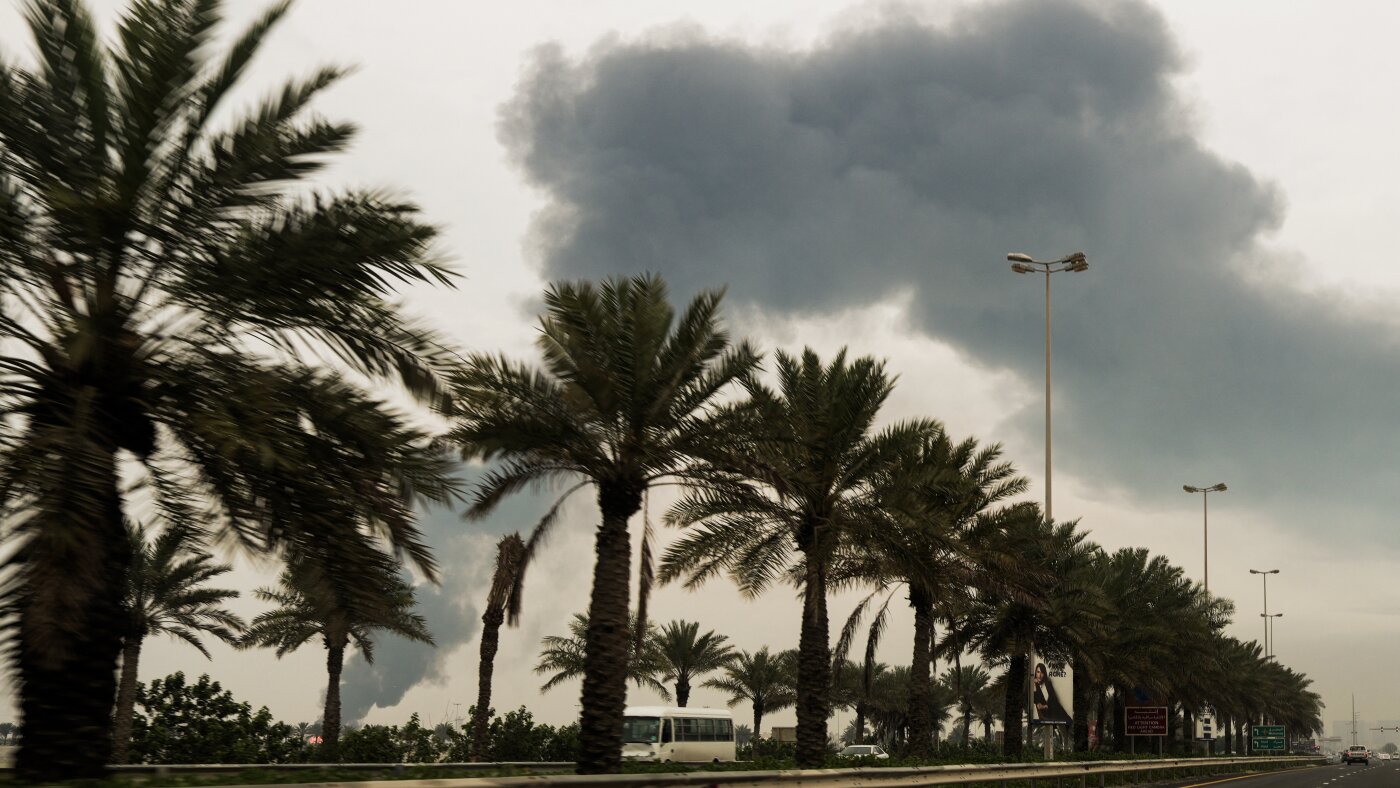
A plume of smoke rises after a reported Iranian strike on fuel tanks in Muharraq, Bahrain, on March 12.
Fadhel Madhan/AFP via Getty Images
Fadhel Madhan/AFP via Getty Images
In the wake of heightened tensions with Iran, military families find themselves in a state of limbo, with plans constantly changing. Just days before a Navy spouse was set to relocate to Bahrain with her husband, a sudden change of orders from the U.S. Navy altered their course.
“A day before we were supposed to leave to be stationed at Bahrain together, we were told we need to go somewhere else for a short period of time, and then here we are five months later,” she shared.
For security reasons, NPR has not disclosed their identities or locations. The spouse expressed concerns about potential impacts on her husband’s military career. Currently, they are living out of three duffel bags, having moved through seven different hotel accommodations.
“We were at one location for a while and then, spur of the moment, sent to another location for what ended up being 10 weeks,” she recalled. “So it’s a lot of moving with very short notice, and you can’t really unpack or own too much because you never know when you’re going to be going somewhere else.”
Currently on temporary duty status, these families are ineligible for base housing or any housing allowance, leaving them to navigate challenging living arrangements.
With U.S. bases in the region being potential targets, the proximity of Bahrain to Iran—less than 130 miles by sea—poses significant risks. Following an NPR report in April, the Navy confirmed that at least 1,500 personnel and their families had been evacuated from the Bahrain base.
The Bahrain base, home to the Navy’s 5th Fleet, is a strategic hub in the Middle East. The base was undergoing a $15.8 million upgrade of its junior sailors’ barracks when the evacuation orders were given. While some families remain in designated “safe havens,” others are still transitioning between different bases. Adm. Karl Thomas, commander of the Fleet Forces, indicated that bringing families back to Bahrain is unlikely in the near term.
“We’re really trying to take each case individually and make sure those people are taken care of and we understand what they want. But with things heating back up over there right now, it’s not an option,” Thomas mentioned.
Families, with most of their belongings overseas, grapple with decisions about purchasing vehicles and replacing essential items. “We’re looking at the monetary issues and challenges for some of those families that aren’t where they intended to be,” Thomas added.
As some families have passed through Norfolk, Virginia, others have found temporary refuge in Tampa, Florida, the location of U.S. Central Command. Organizations like Blue Star Families are assisting, providing essentials to those living in hotels, as families work to enroll children in local schools without complete records.
“When the kids first arrived, we gave them backpacks and school supplies because, you know, they left so quickly they didn’t think to grab all of what they needed to go back to school,” said Suzy Malloy, the executive director of Blue Star’s Tampa chapter.
Inge Michiels of Jetpet Global, based in Bahrain, continues to assist with the evacuation of pets. Many military families were caught off guard by the costs and logistics involved in relocating their pets, with some having to leave them behind due to flight cancellations and skyrocketing prices.
“A lot of people are in panic mode, and our team as well. We are going under that same stress where alarms go off and deprived sleep and uncertainty,” Michiels commented. As Bahrain faces intermittent attacks, Michiels advises clients to exercise patience amid the ongoing turbulence.
This article was originally written by www.npr.org