
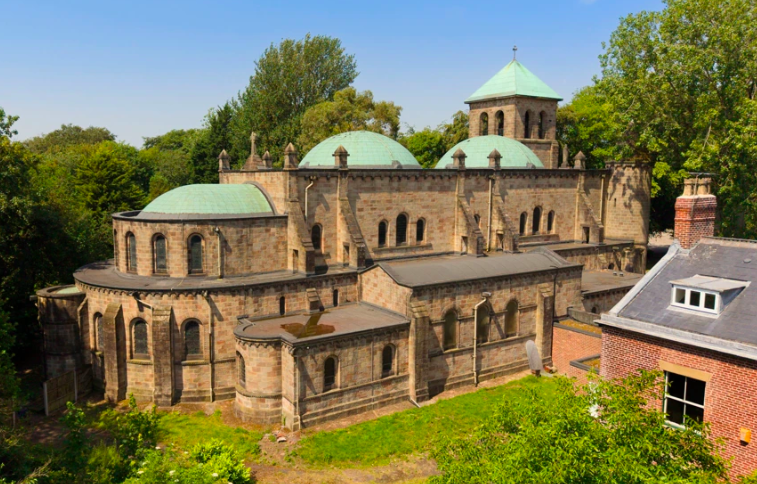
A Historic Catholic Church in Greater Manchester Receives Prestigious Upgrade
The Roman Catholic Church of St Oswald and St Edmund Arrowsmith in Ashton-in-Makerfield, Wigan, has been elevated to Grade II* listed status, recognizing its exceptional architectural and historical significance. This comes after an assessment by the Department for Digital, Culture, Media and Sport (DCMS) in consultation with Historic England.
This new status is significant as it places the church among the top six percent of listed buildings in England, highlighting its particular importance. Parish priest Canon John Gorman expressed his appreciation for this recognition, emphasizing that the church is a testament to the enduring faith of the Catholic community in the region.
“We are, of course, only custodians of what has been handed down to us, and this church is a testament to the faith of those who have gone before us,” Canon Gorman stated. He highlighted the perseverance of Catholics during the penal era, including St Edmund Arrowsmith himself, and praised the efforts of the 1920s congregation who built the church during a time of economic hardship.
Sophie Andreae, vice chair of the Catholic Bishops’ Conference’s Patrimony Committee, remarked that the designation not only acknowledges the building’s architectural value but also its religious legacy, especially in honoring St Edmund Arrowsmith, a prominent figure in Catholic history.
The church, completed between 1925 and 1930, is considered architect J Sydney Brocklesby’s magnum opus. Designed in a French Romanesque style reminiscent of southern French churches, the structure is adorned with pink and buff Darley Dale and Parbold stone, featuring intricate Norman-style details.
A notable feature of the church is its comprehensive collection of stained glass windows by Irish artist Harry Clarke. This collection, including 19 vibrant Expressionist windows installed between 1930 and 1937, is regarded as the largest and most significant of Clarke’s work in the UK.
Historic England’s Co-Chief Executives, Emma Squire and Claudia Kenyatta, praised the church as “remarkable” and deserving of its Grade II* status, acknowledging both Brocklesby’s architectural achievement and the unparalleled stained glass collection.
The church also houses a shrine containing the Holy Hand of St Edmund Arrowsmith, an English Jesuit priest and martyr. Arrowsmith, canonized as a saint by Pope Paul VI in 1970, was executed in 1628 for his Catholic faith during a period of severe religious persecution in England.
The upgrade in status coincides with broader concerns about the financial burden of preserving England’s historic places of worship. The UK government has introduced a £92 million Places of Worship Renewal Fund to support such efforts through 2030. This fund aims to replace the previous Listed Places of Worship Grant Scheme and is part of a larger initiative to invest in historic buildings.
Despite this funding, organizations like the National Churches Trust have raised alarms over the cessation of the former grant scheme and the additional financial strain placed on congregations due to VAT on repairs. The National Churches Trust has warned that these changes could further burden church communities tasked with preserving significant heritage sites.
This article was originally written by www.christiantoday.com




