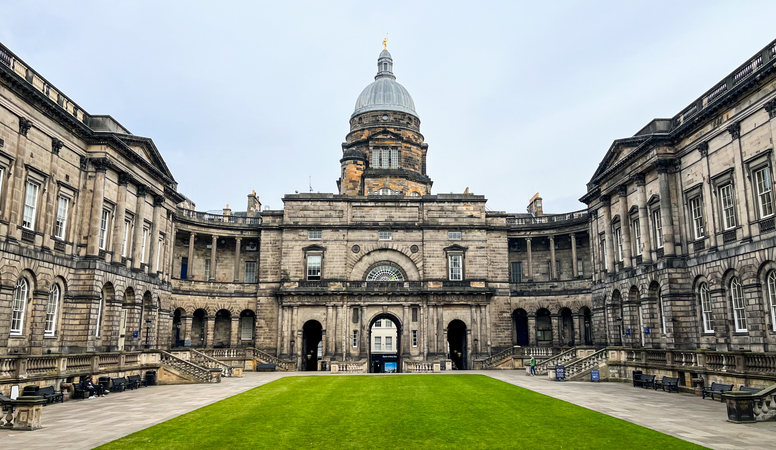
In a move that underscores broader shifts in theological education, the University of Edinburgh has announced the discontinuation of its Bachelor and Master of Divinity programmes. This decision highlights a significant transformation for the renowned institution, which has a storied past deeply rooted in religious studies.
As financial challenges mount and student interest patterns evolve, universities across the UK, including Edinburgh, are re-evaluating their approach to teaching theology and religious studies. This decision is further influenced by the Church of Scotland’s recent strategy to centralize its ministerial training at the University of Glasgow.
Since its founding in 1583, Edinburgh has served as a prominent center for theological education, particularly through New College, which gained prominence post-Scottish Reformation. The cessation of these traditional Divinity degrees marks a pivotal moment in both Scottish Christianity and the sphere of higher education.
However, this does not spell the end for theology at Edinburgh. The university’s School of Divinity is undergoing restructuring rather than elimination. Existing courses in theology, religion, philosophy, and ethics will persist, with the development of new programmes slated for 2027 and 2028. This year alone, over 200 students from various regions, including international attendees, have joined the school.
The closure of these Divinity programmes is largely a response to shifting ministerial training practices across Scotland and the Church of Scotland’s decision to streamline its training efforts.
Amidst these changes, Edinburgh is undertaking a broader academic restructuring impacting 90 programmes within its College of Arts, Humanities and Social Sciences. These adjustments aim to address a £140 million budget deficit and respond to declining demand for certain courses while aiming for a more cohesive academic offering.
The Church of Scotland’s strategic decision reflects a longer trajectory of reform rather than merely a reaction to Edinburgh’s financial woes. In May, the Church’s General Assembly selected Trinity College at the University of Glasgow as the principal academic partner for training Ministers of Word and Sacrament and Deacons. Starting in September 2027, a new Initial Ministerial Education programme will integrate in-person sessions with online learning, enabling candidates to train without relocating to Glasgow.
The Church aims to foster a unified and coherent approach to ministerial training, incorporating a shared core curriculum and emphasizing spiritual and ministerial formation alongside academic study. Historically, the University of Glasgow has been integral to ministerial training since 1560, with approximately 40 percent of its ministers in the past 50 years having studied there.
Rev Dr David Clarkson highlighted the need for “clearer leadership, deeper integration and a more coherent framework” for ministerial training, emphasizing that academic quality remains valued across different institutions.
The Church’s plans involve collaboration with other Scottish institutions like New College at Edinburgh, Christ College at Aberdeen, and Highland Theological College, which will continue offering specific ministerial education and public-access theological courses, including distance learning.
The evolution of theological education amidst changing religious landscapes sparks broader questions about its place in academia and society. Dr Michael Tang, a theology graduate with a PhD focused on spirituality in popular music, noted that declining university enrolment does not equate to waning interest in theology or Christianity. Instead, younger generations, particularly Gen Z, are exploring theology outside traditional settings.
Tang observed young individuals gathering in informal settings like coffee shops to engage in biblical discussions, highlighting a shift from conventional academic environments. “Don’t read it as a sign that theology doesn’t matter … it still matters,” he stated, urging universities to reconsider the role of theology beyond academia.
Tang’s own journey reflects the challenges for prospective theology students. Despite his academic achievements, he faced employment hurdles, now working as a barista. He advises those considering theology to carefully evaluate their motivations for study.
As traditional pathways into ministry and academic theology are reimagined, the Church of Scotland is actively linking academic study with practical ministry and contemporary mission. The new curriculum will cover subjects such as Old and New Testament studies, worship, missiology, and more, allowing candidates to explore various ministry areas including youth work and chaplaincy.
This shift in theological education, supported by technology, enables a blend of academic study with online learning and community-based formation. The Church of Scotland’s plans incorporate a hybrid model, combining face-to-face and online learning.
Edinburgh affirms the ongoing relevance of theology, asserting that it addresses critical questions about history, culture, and society while fostering critical and ethical thinking skills. The retreat from some traditional degrees occurs as questions of faith remain integral to public discourse.
The challenge remains to adapt theological education to maintain its intellectual and spiritual heritage in a changing world. Edinburgh’s decision reflects a broader conversation about the purpose and future of theological education, signaling a potential diversification of opportunities for engaging with Christian theology.
For churches facing declining traditional ministry candidates, balancing academic excellence with practical ministry skills becomes crucial. The Church of Scotland’s approach seeks to integrate these elements, offering a pathway for future theological exploration.
As Tang articulated, theology continues to hold significance. The question is now one of where and how the next generation will engage with it.
This article was originally written by www.christiantoday.com