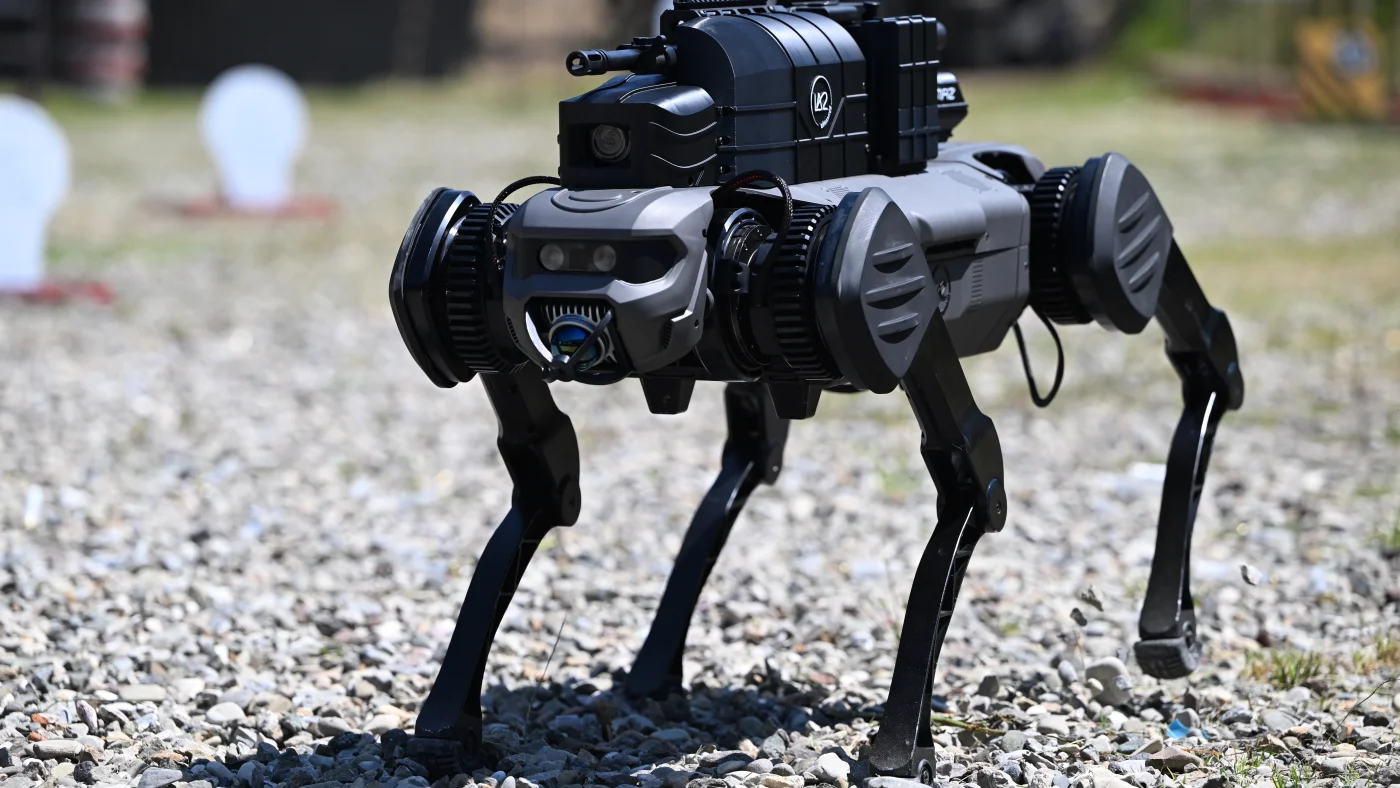
Debate Over Autonomous Weapons Intensifies at U.N. Meeting
As autonomous warfare technology advances, global leaders gather at the United Nations in Geneva to discuss potential regulations for lethal autonomous weapons, often referred to as “killer robots.” This meeting, part of the U.N.’s conference on Certain Conventional Weapons (CCW), represents what many see as a critical opportunity to establish rules for these technologies before they become widely available.
Experts have warned that the development of autonomous weapons capable of independently selecting and engaging targets is not far off. Already, in conflict zones like Ukraine and Gaza, AI-assisted weapons have been deployed to hit targets, though currently, they remain under human control.
Humanitarian groups emphasize the need to keep the decision to kill in human hands, with entities such as the United Nations, the International Committee of the Red Cross, and the Pope advocating for legally binding regulations. U.N. Secretary-General Antonio Guterres has stated that allowing fully autonomous weapons to make life-and-death decisions would “cross a moral red line.”
Potential Risks of Autonomous Weapons
The International Committee of the Red Cross expresses concern that autonomous weapons might not adhere to the Geneva Conventions, which govern the conduct of war. These rules stipulate that soldiers who are wounded or surrendering should not be targeted. Georgia Haines, a legal adviser with the Red Cross, points out that autonomous systems may struggle to interpret complex battlefield situations, increasing the risk of misidentifying targets.
“The risk is that, based on the technology we are seeing, they are not able to understand in the same way that a human is the contextual signals. And so the risks are incredibly high that there will be a misidentification of a target,” Haines warns.
Human rights organizations also highlight the rapid decline in the cost and complexity of AI-assisted weaponry, raising concerns about its potential misuse by terrorist groups or authoritarian regimes. In theory, autonomous drones could be programmed to target individuals based on clothing color, language, or other arbitrary criteria.
International Response and Challenges
Over 50 countries, including Ireland, Italy, Brazil, Mexico, France, and Germany, are advocating for a timeline to establish binding laws governing autonomous weapons. However, nations actively developing semi-autonomous systems, such as the United States, Russia, and Israel, oppose binding agreements. Instead, the U.S. has proposed a five-year period to draft non-binding guidelines.
The U.S. has historically been slow to ratify international treaties, as seen with the Ottawa Convention on landmines. Despite not ratifying, the U.S. eventually ceased their use and reduced stockpiles. Under the Trump administration, skepticism towards international law has increased, with Secretary of State Marco Rubio cautioning against “quoting laws to men with swords.”
Consensus is required for U.N. negotiations on limiting specific weapons. While this was achieved in 1995 with blinding lasers, progress on other agreements has been slow. Some countries may seek a compromise with a longer negotiation period, allowing states to adopt rules individually. However, campaigners argue this approach merely delays addressing the issue.