
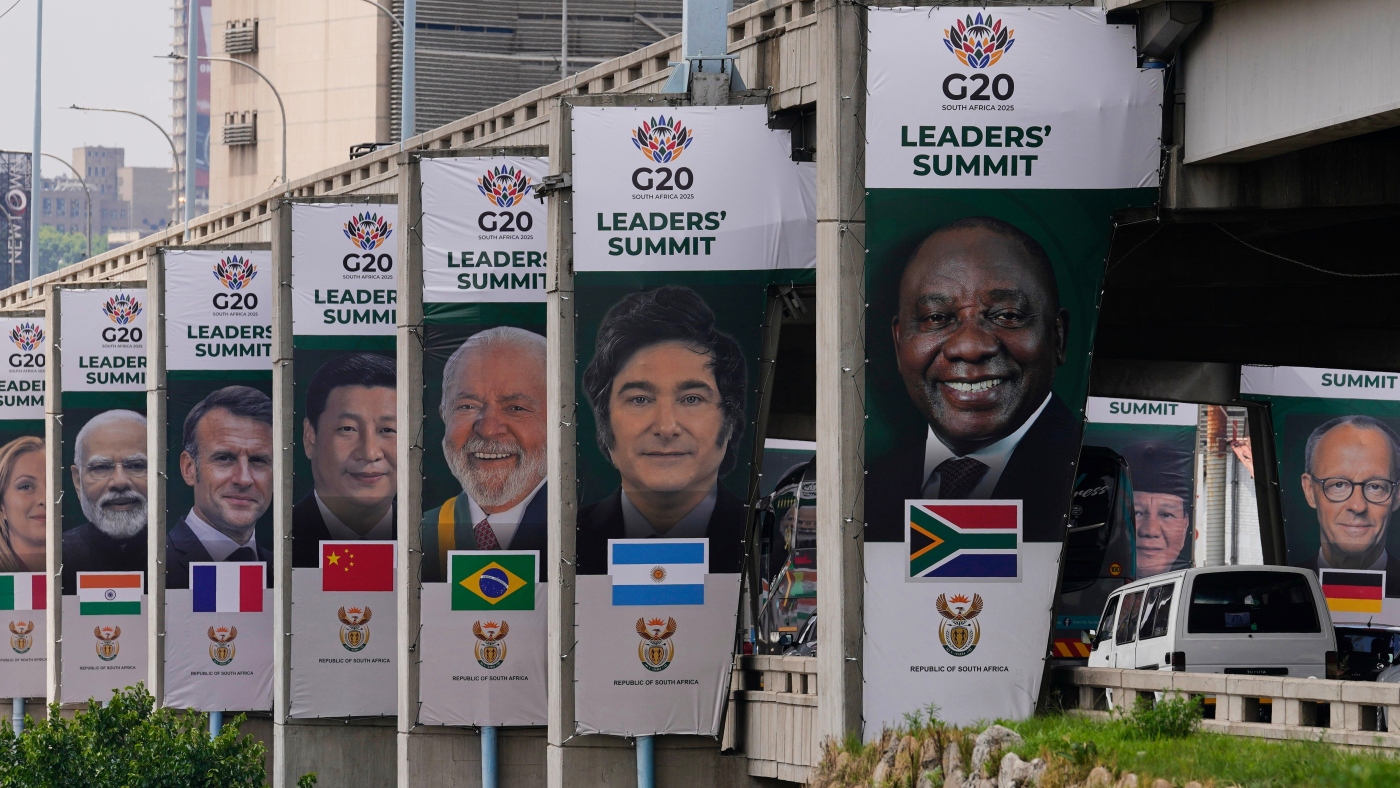
The G20 Summit Faces Notable Absences Amidst Controversy
As the G20 Leaders’ Summit convenes in Johannesburg, South Africa, the conspicuous absence of some of the globe’s largest economies underscores a growing tension on the international stage. The United States has opted to boycott the meeting, citing issues with the summit’s focus on diversity, equity, and inclusion (DEI) themes.
The U.S. administration, led by President Trump, has accused the South African government of land seizures and has raised alarms about the safety of white Afrikaners. In response to these claims, Trump remarked, “You know we have a G20 meeting in South Africa, South Africa shouldn’t even be in the Gs anymore, because what happened there is bad.”
The South African government has attempted to refute these allegations, but the efforts have not swayed the U.S. stance. President Cyril Ramaphosa commented on the U.S. absence, stating, “Their absence is their loss.”
Argentina’s President Javier Milei has also decided to abstain from attending, showing solidarity with Trump. Meanwhile, Chinese President Xi Jinping and Russian President Vladimir Putin are missing the summit for different reasons, with Xi limiting international travel and Putin facing legal challenges from the International Criminal Court.
William Gumede, an associate professor at Johannesburg’s Witwatersrand University, sees the situation as emblematic of the current global divisions. “It is symbolic of the fractured global moment that we are in… it’s almost an alternative summit without China and without America,” he said.
U.S. Spat Deepens
While international leaders like Britain’s Prime Minister Keir Starmer arrived in South Africa, tensions between the U.S. and South Africa escalated. Ramaphosa mentioned a last-minute U.S. request to send a delegation, hoping for a change in participation. “We have received notice from the United States…about a change of mind about participating in one shape, form or another in the Summit,” Ramaphosa stated.
However, White House press secretary Karoline Leavitt strongly refuted any official U.S. participation, emphasizing, “The United States is not participating in official talks at the G20 in South Africa, I saw the South African president running his mouth a little bit against the United States and the president of the United States and that language is not appreciated.”
With the U.S. assuming the G20 presidency after South Africa, a junior official from the U.S. embassy will symbolically represent the country. Still, Ramaphosa’s spokesman made it clear that “the president won’t hand over to a chargé.”
Tensions at Home
Domestically, the summit has sparked dissatisfaction among South Africans, particularly regarding the sudden improvement in Johannesburg’s infrastructure. Journalist Redi Tlhabi remarked, “Oh they are fixing, the traffic lights are up…the grass has been cut, all for? G20… You’re showing off for visitors but you have no regard for the people that live in that city,” on her podcast.
The event coincided with a day of action against gender-based violence, where thousands of women dressed in black and protested in silence to draw attention to high femicide rates in the country. This was organized by Women for Change, aiming to highlight these issues during the summit.
Additionally, a billboard battle has emerged in South Africa, with right-wing Afrikaner groups echoing Trump’s views on racial persecution, while progressive Afrikaners counter with displays featuring the national rugby team, the Springboks, reflecting unity.




