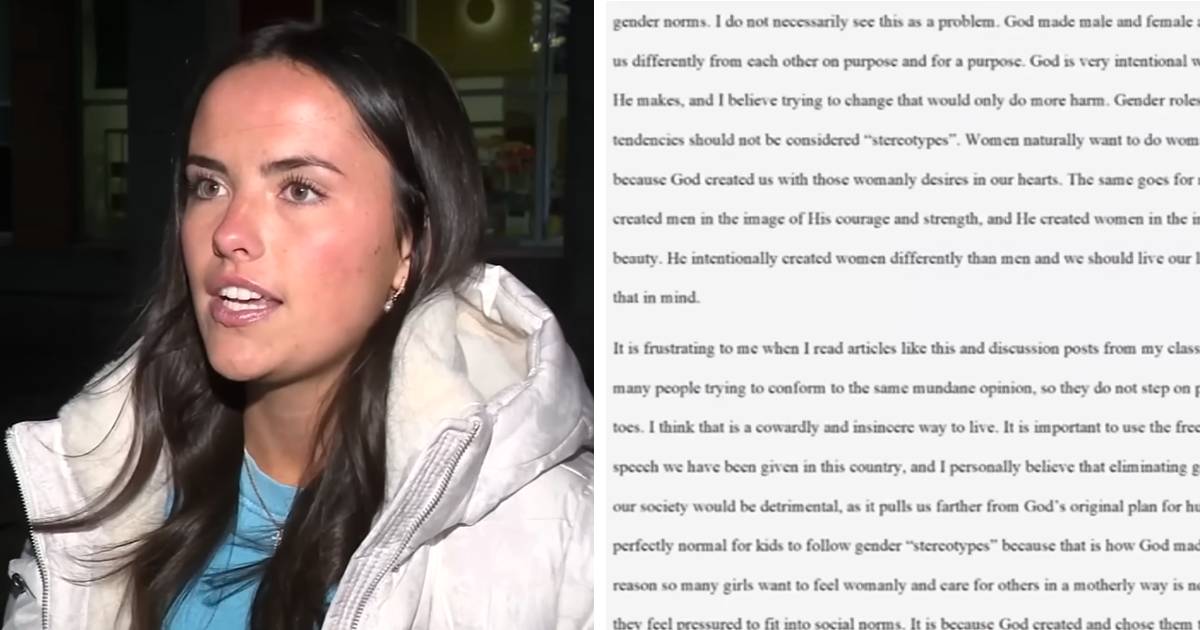
When Samantha Fulnecky submitted what she thought was a routine opinion essay for her psychology class at the University of Oklahoma, she never anticipated the firestorm that would follow. The junior student, who aspires to become a pediatrician serving Native American communities, received a failing grade on an assignment that asked for her personal perspective—a grade she believes was unjustly given because she incorporated biblical references into her response.
The assignment in question asked students to reflect on an article about gender and share their own thoughts. Fulnecky, who had been earning perfect marks on her previous assignments in the course, received a zero on this particular essay. According to the student, the teaching assistant justified the failing grade by stating she hadn’t provided scientific evidence to support her viewpoints.
The controversy over academic requirements
Fulnecky contested the grade, arguing that the assignment explicitly called for opinions rather than empirical research. “I pointed out that it didn’t say anywhere I needed evidence, and his response was, no that was the grade you deserved,” she explained. The student noted that she was unaware of her teaching assistant’s personal identity or beliefs when completing the work. “I didn’t know that the TA was transgender or what his beliefs are or anything like that,” Samantha said. “I just did the assignments and turned them in and went about my day, so there hadn’t been any tension in the past until we were asked to do an assignment over this topic.”
In her essay, the psychology student expressed her belief that gender differences are divinely ordained and that attempting to diminish these distinctions contradicts religious teachings. She wrote about how God created men and women with distinct purposes, referencing the Hebrew term “ezer kenegdo” from Genesis, which translates to “helper equal to,” to support her argument that women’s roles are valued equally to men’s in biblical context.
What the student wrote in her essay
“This article was very thought provoking and caused me to thoroughly evaluate the idea of gender and the role it plays in our society. The article discussed peers using teasing as a way to enforce gender norms. I do not necessarily see this as a problem. God made male and female and made us differently from each other on purpose and for a purpose. God is very intentional with what He makes, and I believe trying to change that would only do more harm.
Gender roles and tendencies should not be considered ‘stereotypes’. Women naturally want to do womanly things because God created us with those womanly desires in our hearts. The same goes for men. God created men in the image of His courage and strength, and He created women in the image of His beauty. He intentionally created women differently than men and we should live our lives with that in mind.
It is frustrating to me when I read articles like this and discussion posts from my classmates of so many people trying to conform to the same mundane opinion, so they do not step on people’s toes. I think that is a cowardly and insincere way to live. It is important to use the freedom of speech we have been given in this country, and I personally believe that eliminating gender in our society would be detrimental, as it pulls us farther from God’s original plan for humans.
It is perfectly normal for kids to follow gender ‘stereotypes’ because that is how God made us. The reason so many girls want to feel womanly and care for others in a motherly way is not because they feel pressured to fit into social norms. It is because God created and chose them to reflect His beauty and His compassion in that way.
In Genesis, God says that it is not good for man to be alone, so He created a helper for man (which is a woman). Many people assume the word ‘helper’ in this context to be condescending and offensive to women. However, the original word in Hebrew is ‘ezer kenegdo’ and that directly translates to ‘helper equal to’. Additionally, God describes Himself in the Bible using ‘ezer kenegdo’, or ‘helper’, and He describes His Holy Spirit as our Helper as well. This shows the importance God places on the role of the helper (women’s roles). God does not view women as less significant than men. He created us with such intentionally and care and He made women in his image of being a helper, and in the image of His beauty.
If leaning into that role means I am ‘following gender stereotypes’ then I am happy to be following a stereotype that aligns with the gifts and abilities God gave me as a woman. I do not think men and women are pressured to be more masculine or feminine. I strongly disagree with the idea from the article that encouraging acceptance of diverse gender expressions could improve students’ confidence. Society pushing the lie that there are multiple genders and everyone should be whatever they want to be is demonic and severely harms American youth. I do not want kids to be teased or bullied in school. However, pushing the lie that everyone has their own truth and everyone can do whatever they want and be whoever they want is not biblical whatsoever.
The Bible says that our lives are not our own but that our lives and bodies belong to the Lord for His glory. I live my life based on this truth and firmly believe that there would be less gender issues and insecurities in children if they were raised knowing that they do not belong to themselves, but they belong to the Lord. Overall, reading articles such as this one encourage me to one day raise my children knowing that they have a Heavenly Father who loves them and cherishes them deeply and that having their identity firmly rooted in who He is will give them the satisfaction and acceptance that the world can never provide for them.
My prayer for the world and specifically for American society and youth is that they would not believe the lies being spread from Satan that make them believe they are better off as another gender than what God made them. I pray that they feel God’s love and acceptance as who He originally created them to be.”
University response and administrative action
After receiving the failing grade, Fulnecky escalated her concerns to university administrators and even reached out to the governor’s office. The University of Oklahoma agreed that the zero would not impact her final course grade, though officials declined to change the grade recorded on the assignment itself. The teaching assistant involved was placed on paid administrative leave and will no longer evaluate Fulnecky’s coursework.
The situation gained national attention after a campus organization shared the essay on social media platforms, where it accumulated more than 15 million views. Public reaction has been sharply divided, with supporters praising the student’s willingness to express her faith while critics have challenged her perspective, some sending hostile messages.
Political involvement and advocacy
State Senator Shane Jett has taken an active interest in the case, requesting a meeting with the university president to address what he characterizes as an infringement on religious expression. “It’s about a state funded, taxpayer funded institution allowing their faculty members to abridge or impede a student’s right to express their faith,” Jett said. The Oklahoma Freedom Caucus has also called for the university to issue a public apology to the student.
Fulnecky, who is Comanche and hopes to serve Native American communities as a pediatrician after completing medical school, was invited to share her experience at the Oklahoma History Center alongside state officials. Despite facing criticism and what she describes as misrepresentations of biblical teachings used against her, the student remains resolute. “A lot of people have taken things from the Bible and twisted it against me,” Samantha said. “My main goal is to encourage other Christians to stand up for their beliefs,” she stated.