
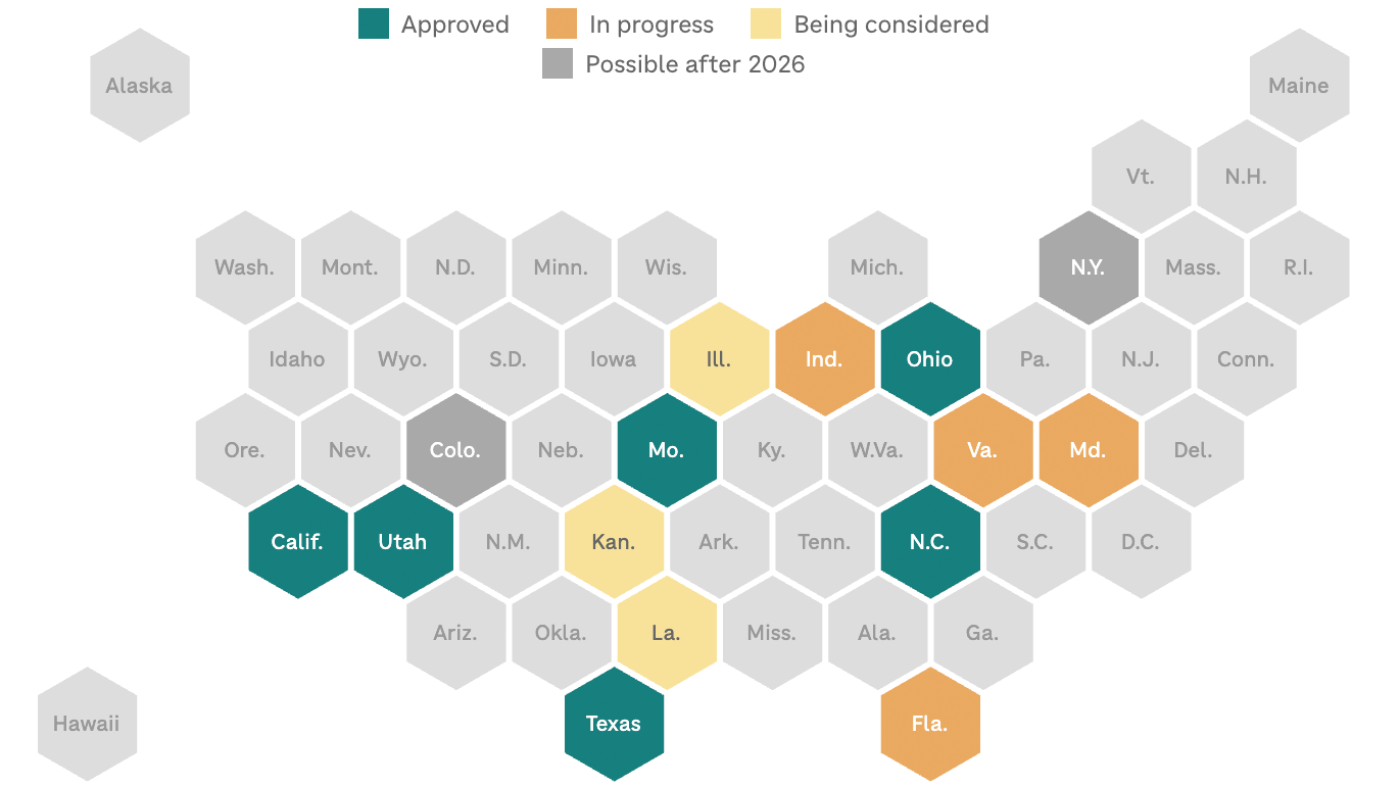
The political landscape in the United States is witnessing a significant shift as the Supreme Court’s recent ruling favors Texas Republicans in a contentious redistricting battle. This decision could potentially alter the balance of power in the upcoming 2026 elections, giving the GOP an advantage in their quest to maintain control of the House of Representatives.
The Supreme Court’s decision last Thursday allows the new congressional map proposed by Texas Republicans to proceed, despite a lower court previously identifying it as a racial gerrymander. This map is expected to secure an additional five seats for the Republican Party.
This development is part of a broader national redistricting effort initiated by President Trump to strengthen Republican influence in the House. The current division in the House stands at 220 seats for Republicans and 213 for Democrats, with the president’s party historically losing seats in midterms.
The redistricting race is still unfolding, with the potential to swing 12 to 14 seats toward Republicans, while Democrats could gain around nine seats. However, these numbers depend heavily on future court rulings and legislative decisions.
Democratic State Representative Matt Pierce speaks against redistricting in the Indiana House last week. Credit: Ben Thorp/WFYI
In Indiana, lawmakers are currently engaged in redistricting discussions, while in Missouri, petitioners are racing against time to collect signatures to delay redistricting until a public vote can be held. The ultimate impact of these efforts on the 2026 elections will only be clear once the votes are tallied.
Trump’s Influence on Redistricting
Traditionally, redistricting occurs early in the decade after the census. However, Trump’s call for redistricting has reignited a nationwide effort reminiscent of the 1960s. The recent Texas ruling follows a summer of political maneuvering, with Democrats staging a walkout to protest the map that they believe undermines Black and Latino voting power. Democrats walked out for over two weeks to delay the maps they deemed unfair.
In contrast, California Democrats have responded by approving a map that could potentially flip five seats currently held by Republicans.
Republicans have also targeted Democratic-held seats in Missouri and North Carolina. In Indiana, the state House has passed a map favoring the GOP, though it faces a divided Senate. Some Indiana Republicans, hesitant to follow Trump’s lead, face pressures including primary challenges and threats.
Republicans’ Redistricting Advantage
Republicans have a strategic advantage in redistricting, primarily because they control more state legislatures, which are responsible for drawing district lines. Some Democrat-controlled states have legal restrictions on partisan gerrymandering, necessitating non-partisan commissions to oversee redistricting.

Republican Gov. Mike Braun (in glasses, center left) and Lt. Gov. Micah Beckwith attend a pro-redistricting rally in Indiana organized by Turning Point Action. Credit: Zach Bundy/WFYI
Virginia’s Democratic-led legislature has approved a special election that could amend the state constitution for redistricting, potentially favoring Democrats. Meanwhile, Maryland’s Democratic governor has formed a commission to explore redistricting options, albeit with limited Republican seats to target.
In Florida, Republican Gov. Ron DeSantis is pushing for redistricting to potentially gain five seats. However, the state faces legal constraints against partisan gerrymandering under the federal Voting Rights Act. The Supreme Court’s current consideration of the VRA could impact these efforts.
As these developments unfold, the outcome of the redistricting efforts remains uncertain, with potential implications for the political balance in the House of Representatives.




