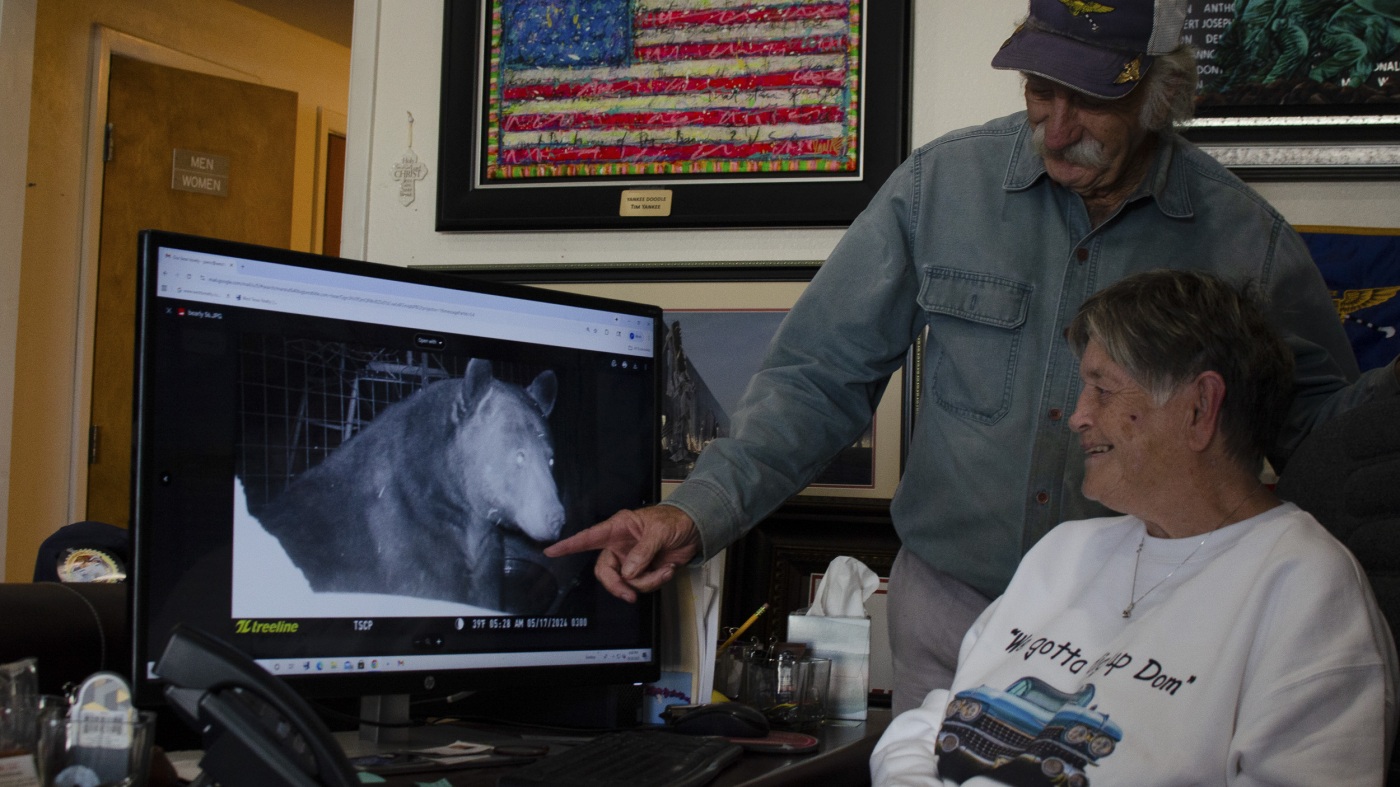
Ken Clouse and his wife Pam look at a still image taken from a game camera on their porch. The couple says in the last two years, they’ve regularly seen black bears in their neighborhood south of Alpine, Texas.
Carlos Morales/NPR
hide caption
toggle caption
Carlos Morales/NPR
ALPINE, Texas — In the secluded corners of Texas, researchers are increasingly observing black bears, with their presence becoming more common in the mountains and deserts of Far West Texas. Here, in the remote wilderness, Matt Hewitt, a researcher from the Borderlands Research Institute, is on a mission to understand the expanding bear population.
Hewitt unlocks a giant steel trap, hoping to capture one of these elusive creatures. “It’s completely empty,” he notes, reaching for a bucket filled with bait — a mix of old donuts and frozen cantaloupe. His team uses collars to track the roaming bears, but the exact number remains unclear. “There’s more than people realize,” Hewitt suggests.
Black bears, once the predominant predators in the region, faced decline due to overhunting and habitat loss. However, recent years have seen a resurgence in their numbers. State data indicates an increase in sightings, from nearly 80 in 2020 to over 130 this year. Such growth is not isolated to Texas; other states report similar trends.

Inside an eight-foot steel trap, researcher Matt Hewitt has sprinkled stale doughnuts and chunks of cantaloupe. Hewitt hopes the bait’s enough to lure and trap a black bear.
Carlos Morales/NPR
hide caption
toggle caption
Carlos Morales/NPR
The resurgence of bears, while celebrated, also brings challenges. Bears have begun venturing into neighborhoods, raising concerns about potential threats to livestock and pets. “I don’t mind the bears coming back, we don’t want them wiped out, that’s for sure,” said Pam Clouse, a resident of Alpine. Her encounters with bears have become more frequent, despite efforts to deter them by removing food sources and electrifying fences.
These adaptive creatures continue to approach residential areas, undeterred by measures taken to keep them at bay. “These bears are pretty large,” Pam Clouse remarked, estimating weights of up to 500 pounds based on trail camera images.

Matt Hewitt, a researcher with Borderlands Research Institute, heads for his truck after securing a snare, which he hopes will snag tufts of bear hair.
Carlos Morales/NPR
hide caption
toggle caption
Carlos Morales/NPR
In response to the increasing presence of bears in urban areas, communities are exploring ways to coexist with these wild animals. The Clouses, like many others, have taken precautions to prevent bear encounters, yet they believe more can be done to address the situation. “I’m not promoting a hunting season for the black bears,” stated Ken Clouse, “but there’s got to be some type of control.”

A mural in downtown Alpine, Texas highlights the wildlife that call the Trans-Pecos region of West Texas home – including the black bear.
Carlos Morales/NPR
hide caption
toggle caption
Carlos Morales/NPR
Adapting to Coexistence with Bears
States like Montana and Colorado have implemented various strategies to live alongside bears, including the use of bear-resistant dumpsters and alarm systems. The essential approach, however, is to eliminate any potential food sources that might attract bears.
As black bears prepare for hibernation in late summer and fall, they search extensively for food to meet their caloric needs of 20,000 calories a day. “They have a great sense of smell, much better than our own,” said Raymond Skiles, former wildlife biologist at Big Bend National Park. He emphasized the importance of removing food sources to prevent bear encounters.
Skiles witnessed the return of black bears to Big Bend National Park in the late 1980s. Through the introduction of bear-proof dumpsters and public education, the park successfully minimized bear-human conflicts. Skiles hopes similar measures can be adopted in West Texas communities.

Krysta Demere sits in the offices for Texas Parks and Wildlife Department in Alpine. Part of her job as a wildlife biologist is getting people ready to live with black bears and educate them in hopes of reducing bear-human conflict.
Carlos Morales/NPR
hide caption
toggle caption
Carlos Morales/NPR
In the vast deserts of West Texas, the land may have reached its “carrying capacity,” causing bears to expand their territory northward in search of food. “And when you’re over carrying capacity, there’s not [enough] resources on the natural landscape for those animals,” explained Krysta Demere, a wildlife biologist with the Texas Parks and Wildlife Department. Her role involves preparing residents for coexisting with bears, a challenge not faced by any living generation in the area.
As the bear population continues to grow, future generations in Alpine and beyond may come to know West Texas as bear country once more.
This article was originally written by www.npr.org