
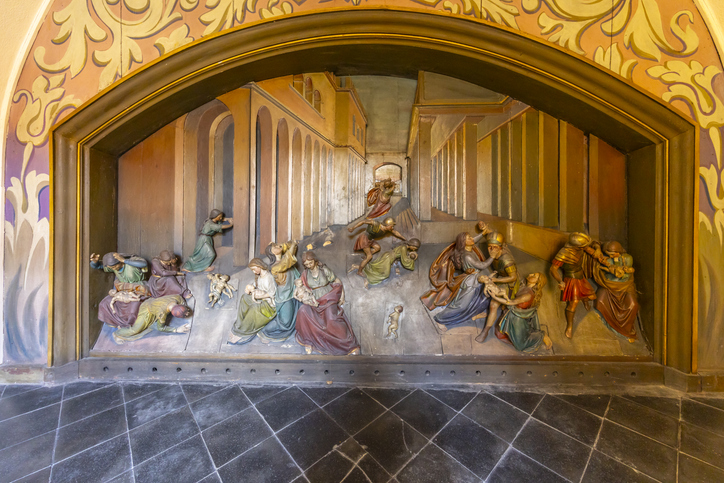
King Herod of Judea, often portrayed as the antagonist in Nativity plays, was more than just a character in biblical stories. His reign marked a significant period in Judean history, characterized by political maneuvers, architectural achievements, and notorious acts of brutality.
End of the Davidic Dynasty
The biblical narrative of the kings of Israel and Judah concludes with King Zedekiah, a descendant of King David, during the prophetic era of Jeremiah. His reign ended with the Babylonian conquest and the subsequent exile, marking the close of the Davidic line as outlined in 2 Kings 24:17–25:7.
Hasmonean Dynasty
Following the return from exile, the Jewish kingdom did not reestablish its sovereignty and fell under Greek influence. In 139 BC, the Hasmonean family, known as the Maccabees, successfully expelled the Seleucid Greeks, establishing their rule over Judea. Originating from the tribe of Levi, they were not of Davidic descent but were embraced for reinstating Jewish independence. The Hasmoneans conquered Idumea, where the inhabitants converted to Judaism. Their history is chronicled in the books of Maccabees. The death of Queen Alexandra Salome in 67 BC led to a civil war over succession.
Roman Rule
Amidst the conflict, Roman intervention under General Pompey resulted in the annexation of Judea, ending its autonomy. By 47 BC, Antiper, an Idumean, was installed as procurator, responsible for Roman tax collection. His son, Herod, born around 72 BC, gained favor with Mark Antony, leading to his appointment as Governor of Galilee, where he earned a reputation for harshness. After Antiper’s assassination in 43 BC, Herod was named tetrarch. With Roman support, Herod reclaimed Jerusalem from the Parthians, becoming a client king from 37 BC, a tenure documented by the historian Josephus.
King Herod
Herod’s rule was marked by unpopularity among Jews who viewed him as an illegitimate ruler collaborating with Rome. To gain favor, Herod wed Princess Mariam of the Hasmonean line, appointing her brother Aristobulus as High Priest, though the latter was seen by many as the rightful heir. Herod’s grand plans for Judea included constructing amphitheaters, aqueducts, and fortresses like Masada, funded by heavy taxation. In 20 BC, he expanded and adorned the Temple in Jerusalem, aiming to rival Solomon’s grandeur. He also established Caesarea Maritima, a crucial port for Mediterranean trade, complete with a freshwater aqueduct. Despite these achievements, Herod’s later years were marred by paranoia, leading to the execution of perceived threats, including family members. Augustus Caesar reportedly said, “I would rather be Herod’s pig than his son.”
King Herod and Jesus
The Gospels of Matthew and Luke introduce Herod in the context of Jesus’s birth. Luke notes John the Baptist’s birth during Herod’s reign (Luke 1:5), while Matthew records Jesus’s birth in Bethlehem under Herod’s rule (Matthew 2:1). A Roman census, administered by Herod, brought Joseph and Mary to Bethlehem (Luke 2:1-3). The visit of the wise men troubled Herod, fearing a new king’s rise (Matthew 2:3). Herod’s response was the infamous massacre of infants in Bethlehem (Matthew 2:16), aligning with his known history of eliminating rivals. This threat prompted Joseph to flee with Mary and Jesus to Egypt, beyond Herod’s reach, until his death (Matthew 2:19).
Herod’s Death
Herod’s death occurred in Jericho around 4 BC or 1 BC, depending on scholarly interpretation. He was interred at Herodium. Posthumously, Caesar Augustus divided his kingdom among Herod’s sons: Archelaus governed Judea, Samaria, and Idumea; Herod Antipas ruled Galilee and Perea; and Philip oversaw Iturea and Trachonitis.
King Archelaus
Upon Herod’s death, Joseph and Mary contemplated returning from Egypt. However, news of Archelaus’s reign deterred them, as he swiftly quashed dissent, reportedly killing 3,000 and canceling Passover, as noted by Josephus. Matthew 2:22 reflects Joseph’s fear of Archelaus’s cruelty, prompting the family to avoid Judea.
Herod Antipas
Joseph settled with his family in Nazareth, Galilee, under Herod Antipas’s rule, which was less feared than that of Archelaus. Although Antipas later executed John the Baptist and interrogated Jesus, he was not initially seen as a threat.
Legacy
Herod’s legacy endures as Herod the Great, distinguishing him from subsequent Herodians. His descendants ruled for generations, but in AD 70, the Romans destroyed Jerusalem, sparing only the Western Wall of Herod’s Temple Mount, now sacred to Jews. Herod’s fortress at Masada, a site of Jewish resistance in AD 73, attracts tourists today. In 2007, archaeologists uncovered Herod’s tomb at Herodium. Despite these historical footprints, Herod is largely remembered as the Nativity play villain. More about the Nativity can be found here.
This article was originally written by www.christiantoday.com




