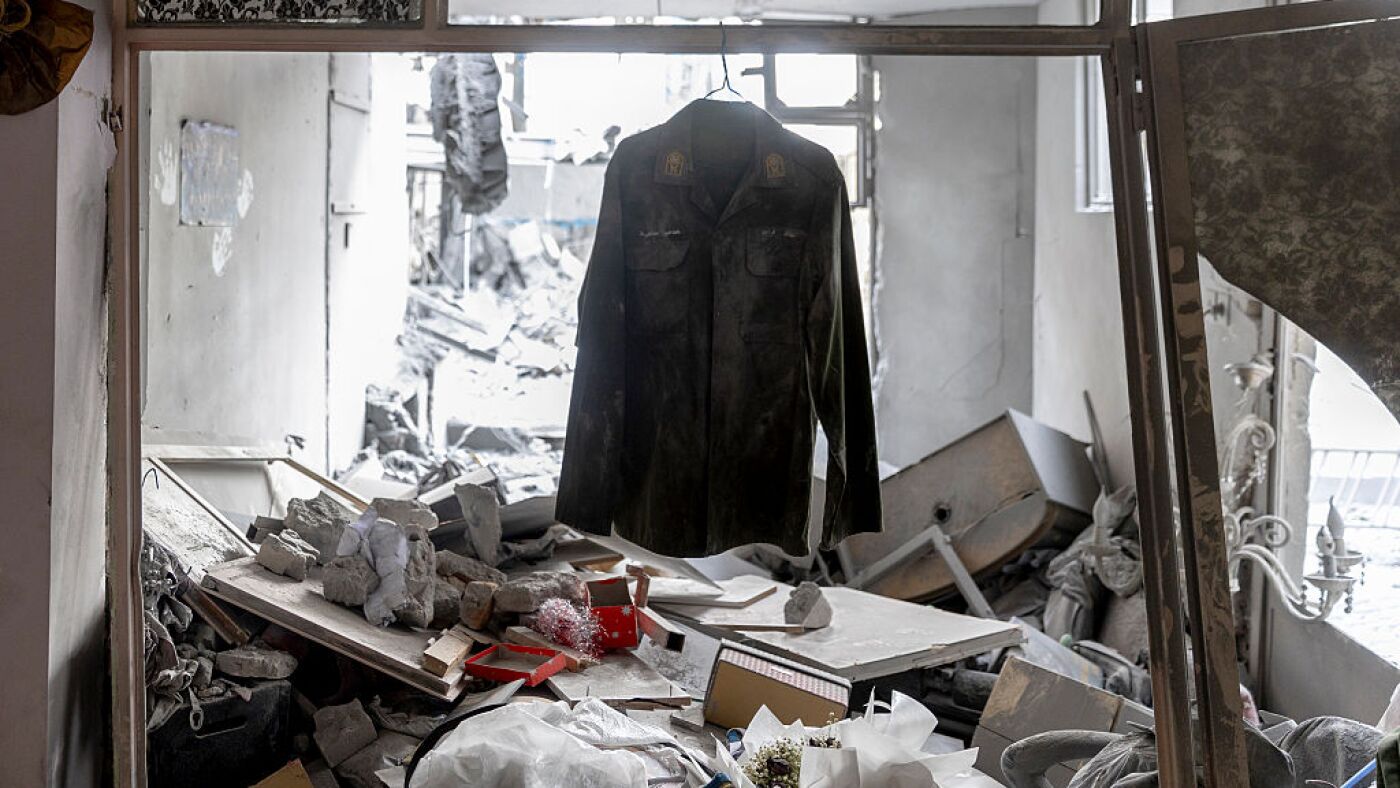
A shirt is seen hanging Sunday amid the rubble in the Beryanak District in Tehran, Iran, after it was damaged by missile attacks two days before.
Majid Saeedi/Getty Images
hide caption
toggle caption
Majid Saeedi/Getty Images
As the conflict involving Iran enters its third week, oil prices have surged to nearly $105 per barrel, prompting President Trump to once again call upon NATO allies and China to assist the United States in securing the crucial Strait of Hormuz.
In a statement made on Saturday, Trump urged China, France, Japan, South Korea, the United Kingdom, and other nations to dispatch warships to the strategic passage, which Iran has obstructed since the onset of hostilities. This vital route typically facilitates the transit of approximately 20% of the world’s oil supply.
Despite these calls, no country has publicly pledged support for Trump’s request. In a Sunday interview with The Financial Times, the president warned that failure to assist could have dire consequences for NATO’s future.
Here are the latest developments in the Middle East situation.
To explore specific topics, click on the links below:
Nations’ response | Strikes across Middle East
U.S. allies, China respond with caution
President Trump indicated that he had approached seven nations for assistance in escorting vessels through the Strait of Hormuz, claiming that some had agreed, though he did not specify which ones.
He emphasized that it would be in these countries’ interests to assist, particularly China, which relies heavily on the strait for its oil imports. Trump also noted that the U.S. would “remember” any lack of support from NATO partners.
Foreign nations have been cautious in their responses to Trump’s appeal. Throughout his presidency, Trump has troubled NATO allies by questioning the alliance’s value, criticizing their defense spending, and threatening U.S. withdrawal.
EU foreign policy chief Kaja Kallas stated on Monday that she had discussed unblocking the strait with U.N. Secretary-General António Guterres.
“It is in our interest to keep the Strait of Hormuz open and that’s why we are also discussing what we can do in this regard from the European side,” she said.
Downing Street has remained noncommittal, noting only that British Prime Minister Keir Starmer had a phone conversation with Trump about the importance of reopening the strait to alleviate global shipping disruptions, as reported by the BBC.
British Energy Secretary Ed Miliband reassured that all possible options to reopen the strait are being explored collaboratively with allies.
Prime Minister Starmer is expected to hold a press conference later on Monday.
China has expressed the importance of maintaining open access to the Strait for international trade, with its foreign ministry calling for an end to hostilities. President Trump’s upcoming visit to China could be canceled based on Beijing’s decision regarding warship deployment.
South Korea is evaluating Trump’s request, while Japan faces legal constraints on overseas military operations. Tokyo has raised concerns about the legality of participation in operations at the Strait of Hormuz.
“We have not made any decisions whatsoever about dispatching escort ships. We are continuing to examine what Japan can do independently and what can be done within the legal framework,” Prime Minister Sanae Takaichi told parliament.
The issue is likely to be a top agenda item during Takaichi’s visit to the White House on Thursday.
Australia has stated that it has not been asked to contribute and will not be sending ships.
Iran and Israel continue attacks; Gulf states face strikes
The Israel Defense Forces announced on Monday that they had commenced limited ground operations targeting Hezbollah strongholds in southern Lebanon to enhance their forward defense strategy.
Reports also indicate significant bombing activity in Tehran.
The Israeli military reported detecting Iranian missile strikes aimed at Israel, urging residents in affected areas to seek safety.
Meanwhile, Iran has continued its assaults on Gulf neighbors, despite the Iranian foreign minister’s denial of targeting civilian infrastructure.
Dubai International Airport reported a drone attack on a fuel tank on Monday, leading to a fire. While there were no injuries, the incident caused a brief suspension of operations, and Emirates airlines halted flights.
Saudi Arabia also reported being targeted by numerous drones, all of which were intercepted.
The humanitarian toll of the conflict continues to rise. Thus far, 13 U.S. service members and at least 12 Israeli civilians have lost their lives. In Iran, over 1,200 civilians have died, and up to 3.2 million people have been temporarily displaced. In Lebanon, more than 800 people have been killed, with over 800,000 displaced.
Emily Feng in Istanbul, and Kate Bartlett
This article was originally written by www.npr.org