Astronauts on Historic Mission as NASA’s Artemis II Approaches the Moon
NASA’s Artemis II mission is set to achieve a major milestone as its crew nears the moon. The mission marks a significant step in space exploration, sending humans to the lunar vicinity for the first time in more than half a century.
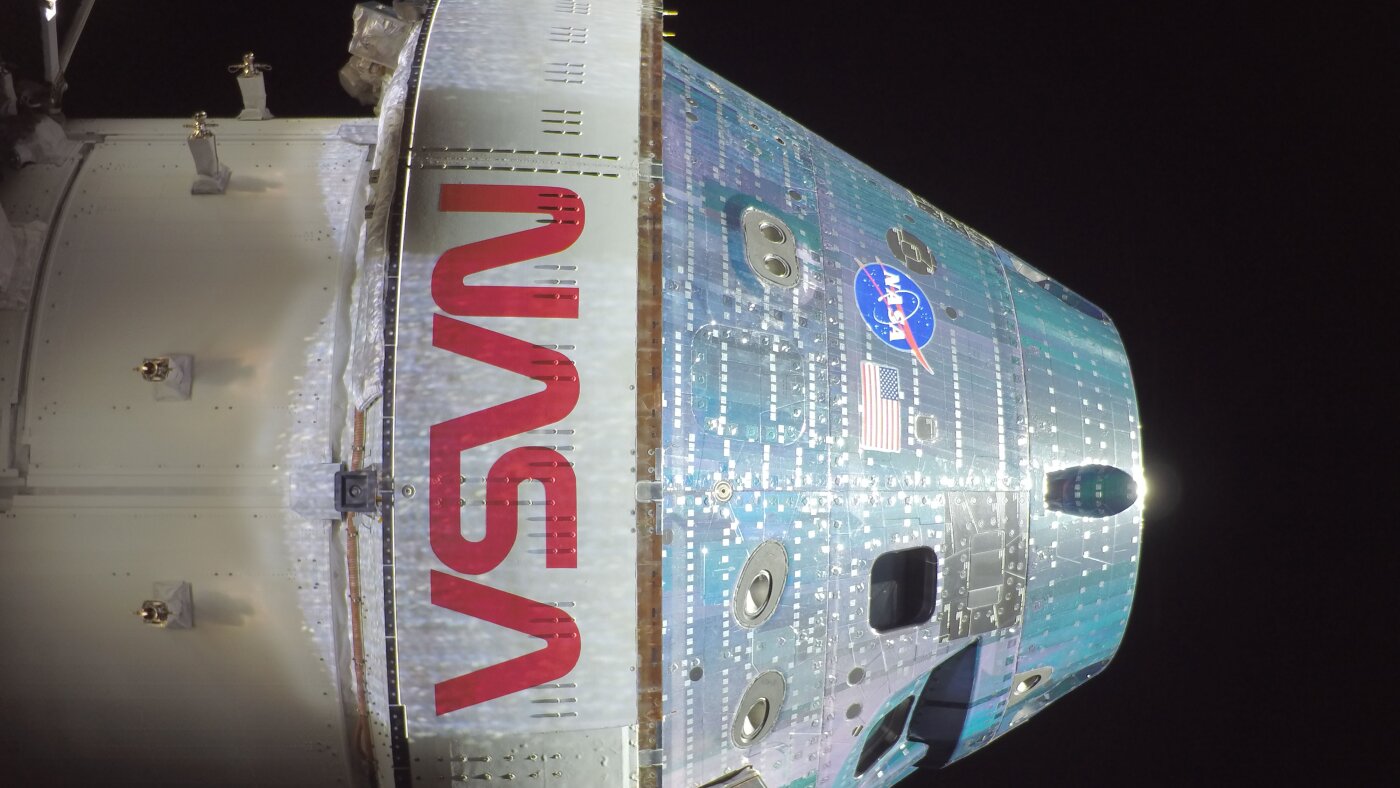
A photo of NASA’s Orion space capsule taken by a remote camera mounted on one of its solar arrays as it sped towards the moon. The four astronauts will loop around the moon on Monday and also venture farther into space than any humans before. NASA via Getty Images
The crew launched from Kennedy Space Center and is scheduled to approach the moon on Monday afternoon, marking the first human lunar mission since the Apollo era. As the Orion space capsule loops around the moon, the astronauts will venture farther into space than ever before.
Currently, the crew is within the lunar sphere of influence, where the moon’s gravity predominates over Earth’s. At 1:46 p.m. ET, they are expected to break the record for the farthest distance traveled from Earth by humans, surpassing Apollo 13’s record of 248,655 miles. Observations of the moon’s surface will commence shortly after.
Communication with Earth will be temporarily lost for about 40 minutes as the spacecraft travels behind the moon. Later in the day, at 7:02 p.m., the mission will reach its maximum distance from Earth of 252,760 miles. The flyby is projected to conclude by 9:20 p.m., with a return journey culminating in a Pacific Ocean splashdown off San Diego on Friday evening.
During their mission, the crew will pass over the Apollo 12 and 14 landing sites, providing a unique opportunity for lunar science observations. The closest approach to the moon will be 4,070 miles, allowing the astronauts to capture images and data from a new perspective.
Lunar Science Observations
NASA scientists have identified 35 geological features for observation, with astronauts working in pairs to document and relay findings to Mission Control in Houston. “They’re going to be absolutely buzzing,” said Kelsey Young, Artemis II lunar science lead. The team will synthesize the data for further analysis.
One key objective is to observe color variations on the lunar surface, which can reveal mineral composition. Human observation is crucial as these nuances are challenging to capture with satellites like the Lunar Reconnaissance Orbiter.
“This is something that human eyes are just incredibly good at teasing out nuances about,” Young explained. The mission’s insights will build on existing knowledge and aid future lunar landing missions.

NASA astronaut and Artemis II mission specialist Christina Koch peers out of one of the Orion spacecraft’s main cabin windows, looking back at Earth. NASA via Getty Images
The Mission So Far
Artemis II is over halfway through its mission to slingshot around the moon and return. As a test flight of the Orion capsule, the mission includes manual control tests and life support system evaluations.
“Our mission continues to go incredibly well,” stated Lori Glaze, head of NASA’s Artemis program. The crew has practiced capsule maneuverability for future lunar rendezvous and tested space suits for emergency scenarios.
Artemis II is also pioneering the use of a deep-space toilet, resolving initial issues to ensure its functionality. “We’re continuing to proceed with the mission and the use of the toilet nominally,” confirmed flight director Rick Henfling.
This article was originally written by www.npr.org