Economic Impact of Immigration Enforcement on Chicago’s Businesses
The economic landscape of Chicago witnessed a significant upheaval following the immigration crackdowns initiated in early 2025. A new report reveals that these enforcement actions drained over $1.26 billion from the local economy, affecting businesses citywide.
A poster calling on U.S. Immigration and Customs Enforcement (ICE) to get out of the community hangs on a door in the Little Village neighborhood on January 22, 2025 in Chicago, Illinois.
Scott Olson/Getty Images
The report by the University of Illinois Chicago utilized anonymous cellphone GPS data to analyze movements between immigrant and non-immigrant neighborhoods in Cook County. It found a rapid decline in interactions between these communities shortly after President Donald Trump’s inauguration on January 20, 2025, due to rumors and actual ICE raids targeting Chicago.
Professor Matt Wilson, a co-author of the study, highlighted the broader economic effects: non-immigrant neighborhoods suffered a $1.26 billion loss in retail and restaurant revenues, with the state of Illinois losing $107 million in tax income. Wilson explained to NPR, “We see a 9% drop in retail and a 10% drop in restaurant visits, and it persisted for about a year… People’s behavior systematically changed after January 20, 2025.”
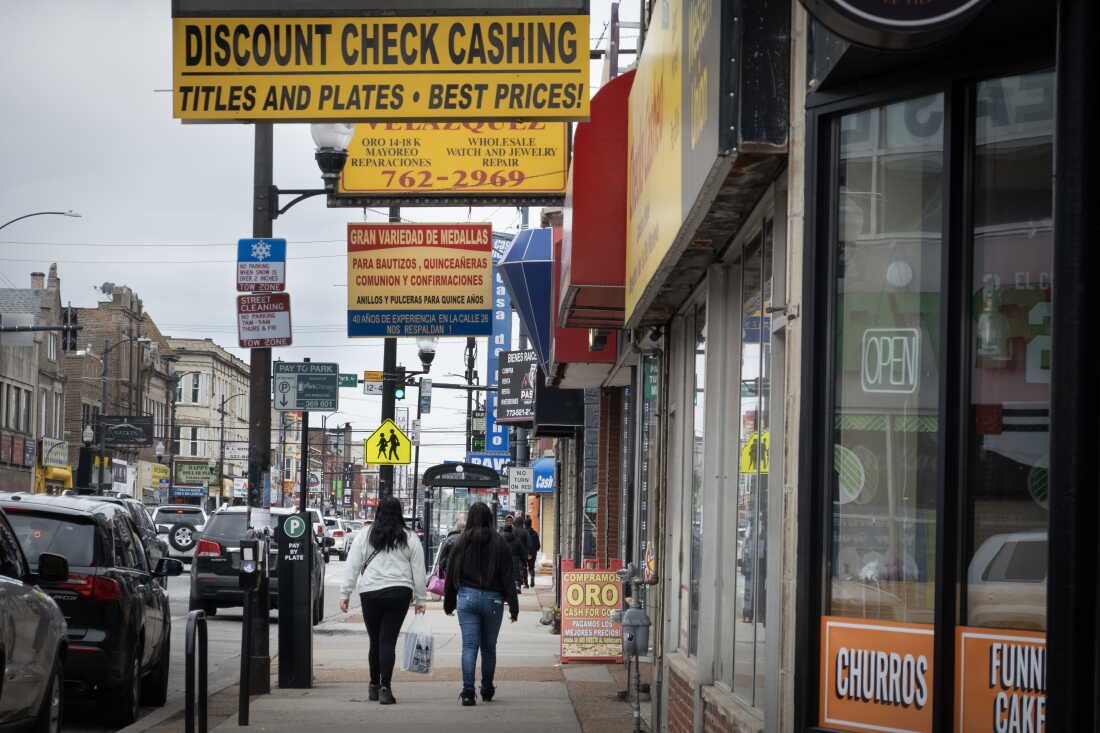
People walk along 26th Street, the heart of the commercial district in the Little Village neighborhood in Chicago, a neighborhood predominantly composed of Mexican immigrants.
Scott Olson/Getty Images
For small businesses, a steady 10% decline in customer visits over a year can be devastating. This research refutes the notion that immigrant communities are isolated, with Wilson stating, “I think a lot of people treat Latino and some immigrant communities as if they’re insular and isolated, but it’s really that these communities are much more integrated into the broader economy.”
The fear of raids was intense during the 2025 inauguration period. A Chicago waitress, Caridad, expressed her fears to NPR, saying, “I have to go grocery shopping, but I haven’t. What if ICE is there? People are more than afraid, they’re panicking.”
These crackdowns have resulted in hundreds of thousands of arrests nationwide. Currently, around 65,000 people are detained, marking a record high.
The White House, defending its enforcement policy, stated, “Removing these criminals from the streets makes communities safer for business owners and customers. Nearly 70% of ICE arrests are of illegal aliens charged or convicted of a crime in the U.S.” However, ICE statistics indicate that about 70% of detainees have no criminal convictions.
The report contributes to growing research showing that immigration enforcement can significantly impact local economies. A Brookings Institution study suggests a 1.7 percentage point drop in consumer spending in high-enforcement states.
Minneapolis has also been affected, with estimates showing nearly $700 million in damages from ICE sweeps, and small businesses losing over $81 million in January alone.
This article was originally written by www.npr.org