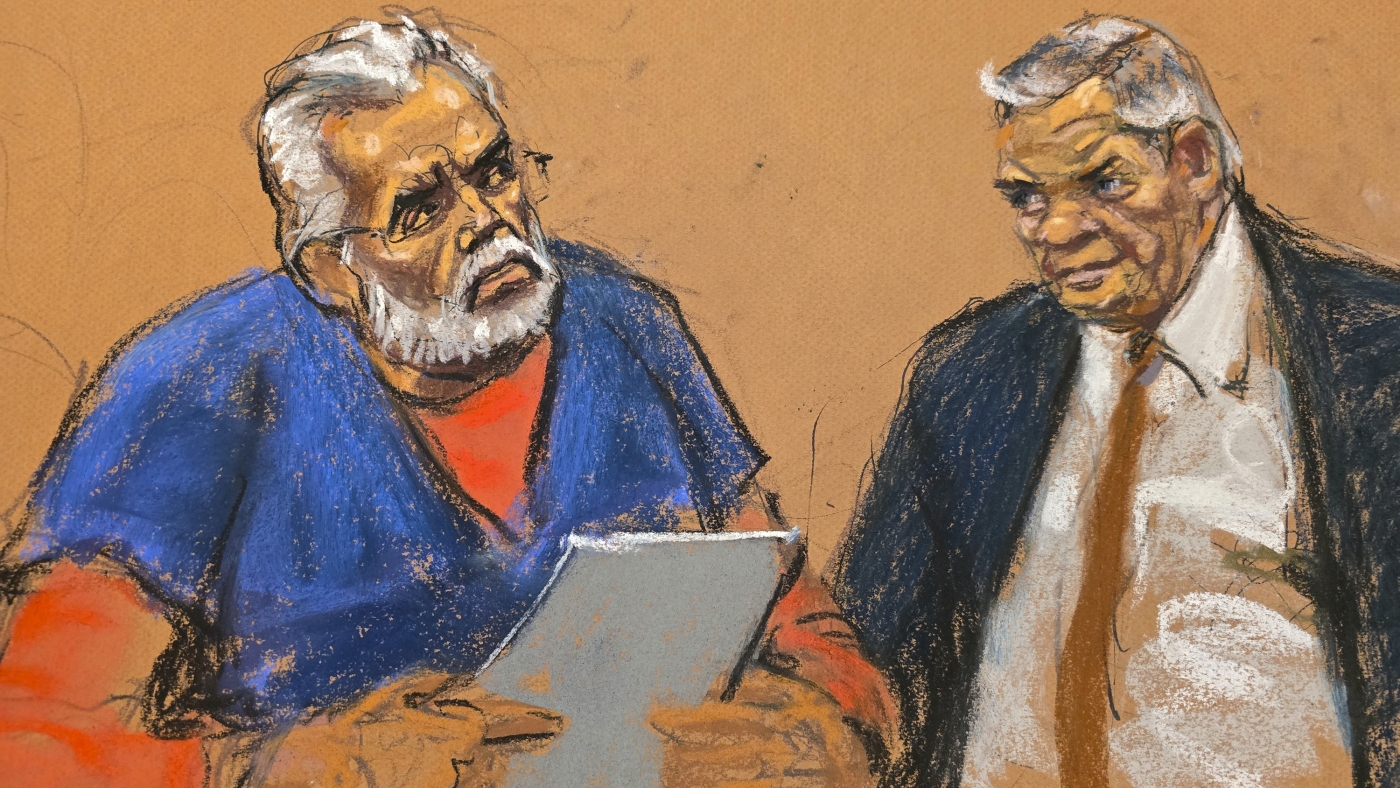
“El Mayo” Zambada speaks to Judge Brian Cogan (not pictured) in Brooklyn federal court, as his defense attorney Frank Perez looks on, Monday, Aug. 25, 2025, in New York. Jane Rosenberg/AP
In a landmark legal development, Ismael “El Mayo” Zambada, a former leader of the Sinaloa cartel, has been sentenced to life imprisonment after admitting guilt to drug trafficking charges in the United States. Zambada, who presided over the cartel’s operations alongside Joaquín “El Chapo” Guzmán, publicly expressed remorse for his actions, acknowledging the devastating impact of his operations on both Mexican and American societies.
“I recognize the great harm illegal drugs have done to the people of the United States, of Mexico, and elsewhere,” Zambada, 75, communicated via a Spanish-language interpreter. “I take responsibility for my role in all of it and I apologize to everyone who has suffered or been affected by my actions.”
For over two decades, Zambada evaded capture by U.S. authorities, overseeing a drug empire that became the world’s largest under his and Guzmán’s leadership. This empire was built on extensive networks, including alliances with Colombian cocaine producers and operations that moved narcotics into the U.S. through elaborate smuggling routes.
The Cartel’s Rise and Operations
Prosecutors detailed how Zambada’s organization generated massive profits, reportedly in the hundreds of millions annually. These funds facilitated corruption within Mexican law enforcement, with bribes ensuring the cartel’s unimpeded activities. Zambada’s plea of “culpable” was made in a Brooklyn courtroom, far from his operational base in Sinaloa, Mexico.
U.S. Attorney General Pam Bondi underscored the significance of Zambada’s conviction, describing it as a triumph for justice. “This guy, ‘El Mayo,’ was living like a king,” Bondi remarked. “Now he’s living like a criminal for the rest of his life.”
The case is a focal point of the Trump administration’s intensified anti-cartel measures, which have included designating cartels as terrorist groups and leveraging military resources to combat them.
Consequences and Legacy
Zambada’s capture in Texas, following an alleged kidnapping from Mexico, led to violent conflicts within the Sinaloa cartel. His arrest exacerbated tensions between factions loyal to him and those supporting Guzmán’s sons, known as the Chapitos.
Despite his reputation as a pragmatic negotiator, Zambada was implicated in numerous violent acts, including ordering the murder of a relative. The toll of cartel violence continues to be felt acutely in regions like Culiacan, where civilian life is frequently disrupted by bloodshed.
Legal Proceedings and Future Implications
In a breakthrough for the prosecution, Zambada’s agreement to a life sentence was reached without the possibility of the death penalty, aligning with Mexico’s stance against capital punishment. His lawyer, Frank Perez, confirmed that there was no obligation for Zambada to cooperate with further investigations.
As his sentencing approaches on January 13, Zambada faces significant financial penalties in addition to his prison term. His admissions in court provided a stark overview of his criminal career, tracing back to his youth when he began cultivating marijuana and progressed to orchestrating cocaine distribution.
The indictment also accused him of trafficking other dangerous substances, such as fentanyl and methamphetamine. Zambada’s plea covers multiple charges, including running a criminal enterprise and racketeering conspiracy over several decades. His conviction mirrors that of Guzmán, who was sentenced to life imprisonment in 2019 in the same court.
This article was originally written by www.npr.org