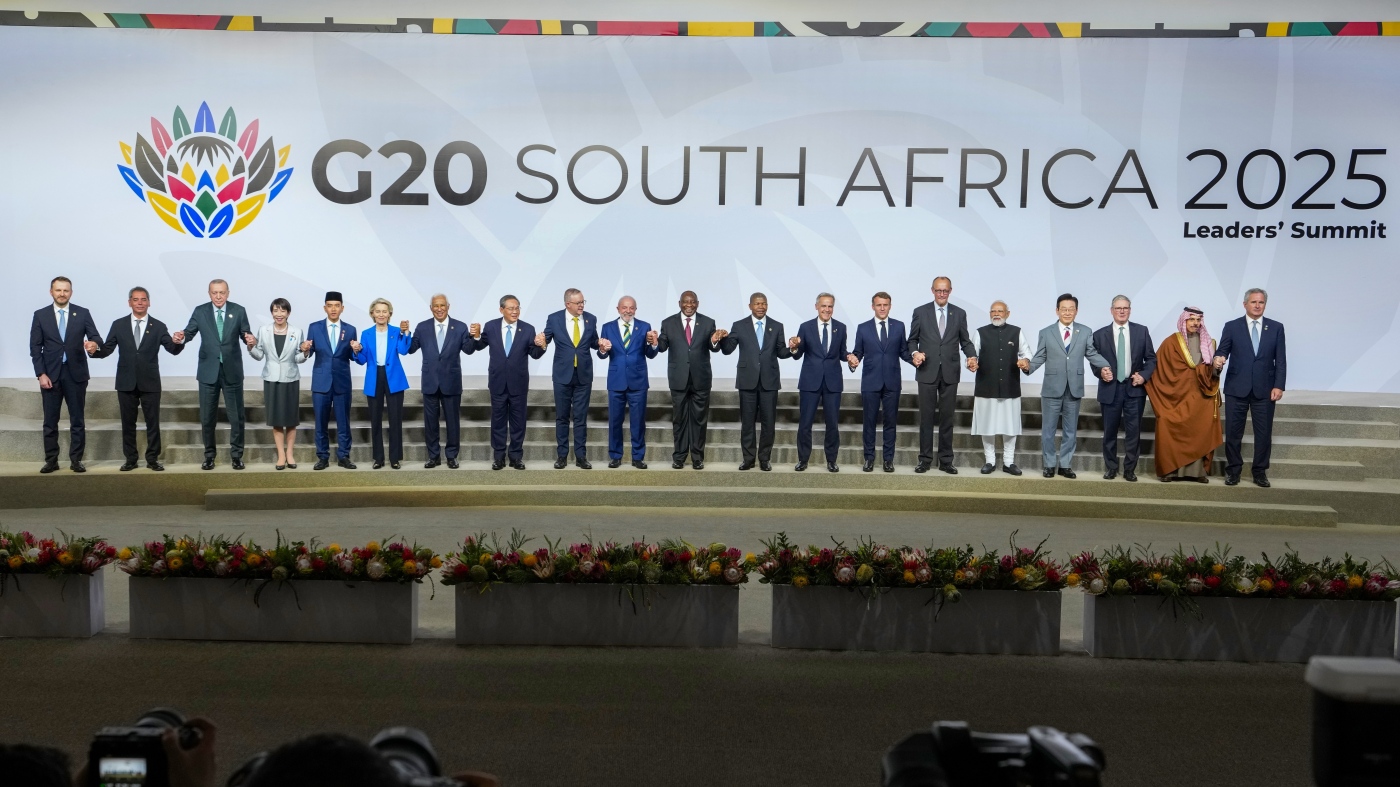
Heads of states pose for a family photo following the first plenary session of the G20 leaders’ summit in Johannesburg, South Africa, on Saturday. Misper Apawu/Pool AP
Misper Apawu/Pool AP
JOHANNESBURG, South Africa — The G20 Leaders’ Summit held this weekend in South Africa marked a series of firsts. Not only was it the inaugural summit on African soil, but it also saw the United States boycott the gathering of the world’s foremost economies.
In an unusual series of events, an agreement was reached at the beginning of the meeting rather than its conclusion, and the traditional ceremonial handover between the outgoing and incoming G20 chairs did not occur.
President Donald Trump’s administration chose to boycott the summit, citing false accusations against the South African government of land confiscation and violence against white Afrikaners. Additionally, the U.S. expressed disapproval of the summit’s focus on diversity, equity, and inclusion (DEI).
Despite the tensions, South African Minister of International Relations Ronald Lamola expressed satisfaction with the outcome as the summit concluded on Sunday near the Johannesburg township of Soweto. “In a nutshell … this has been a great success for our country,” Lamola stated.
The summit officially closed as President Cyril Ramaphosa struck a ceremonial gavel, signifying the end of the event. “This gavel of this G20 summit formally closes this summit and now moves on to the next president of the G20, which is the United States, where we shall see each other again next year,” he announced. However, the expected gavel handover to the U.S. did not occur, as President Trump was absent. A request to pass the gavel to a junior embassy official was declined by South Africa.
Joint Declaration
The U.S. had also requested that South Africa refrain from issuing a joint declaration at the summit’s conclusion, suggesting instead a “chair’s statement.” However, Ramaphosa, who had declared prior to the event that “we will not be bullied,” revealed on Saturday that a consensus had already been reached, and a joint statement was issued without U.S. participation.

People walk by a large screen TV where South African President Cyril Ramaphosa holds a wooden gavel as he officially closes the G20 leaders’ summit, in Johannesburg, South Africa, on Sunday. Jerome Delay/AP
Jerome Delay/AP
While G20 declarations are not legally binding, White House spokesperson Anna Kelly criticized the outcome, accusing Ramaphosa of “refusing to facilitate a smooth transition of the G20 presidency” and stating that President Trump is looking forward to “restoring legitimacy” to the group next year, with plans to host the event in Florida.
The declaration included DEI language that the Trump administration opposes, focusing on climate change threats, gender equality, and the financial challenges faced by poorer nations. Argentina, whose libertarian president, Javier Milei, is a staunch Trump ally and did not attend the summit in solidarity but sent other representation, raised some objections to the language, yet the declaration was still issued.
World leaders present expressed gratitude to South Africa for its G20 leadership, with French President Emmanuel Macron offering Ramaphosa a warm embrace. However, Macron also noted the evident divisions within the summit. Ramaphosa emphasized South Africa’s efforts to prioritize the Global South’s concerns and issues important to developing economies, though conflicts in other regions dominated the discussions.
European leaders released a statement expressing concerns about the U.S.’s new peace plan for Ukraine, suggesting it favored Moscow and required “additional work,” while Brazilian President Luiz Inácio Lula da Silva voiced worries about the U.S. military buildup near Venezuela.