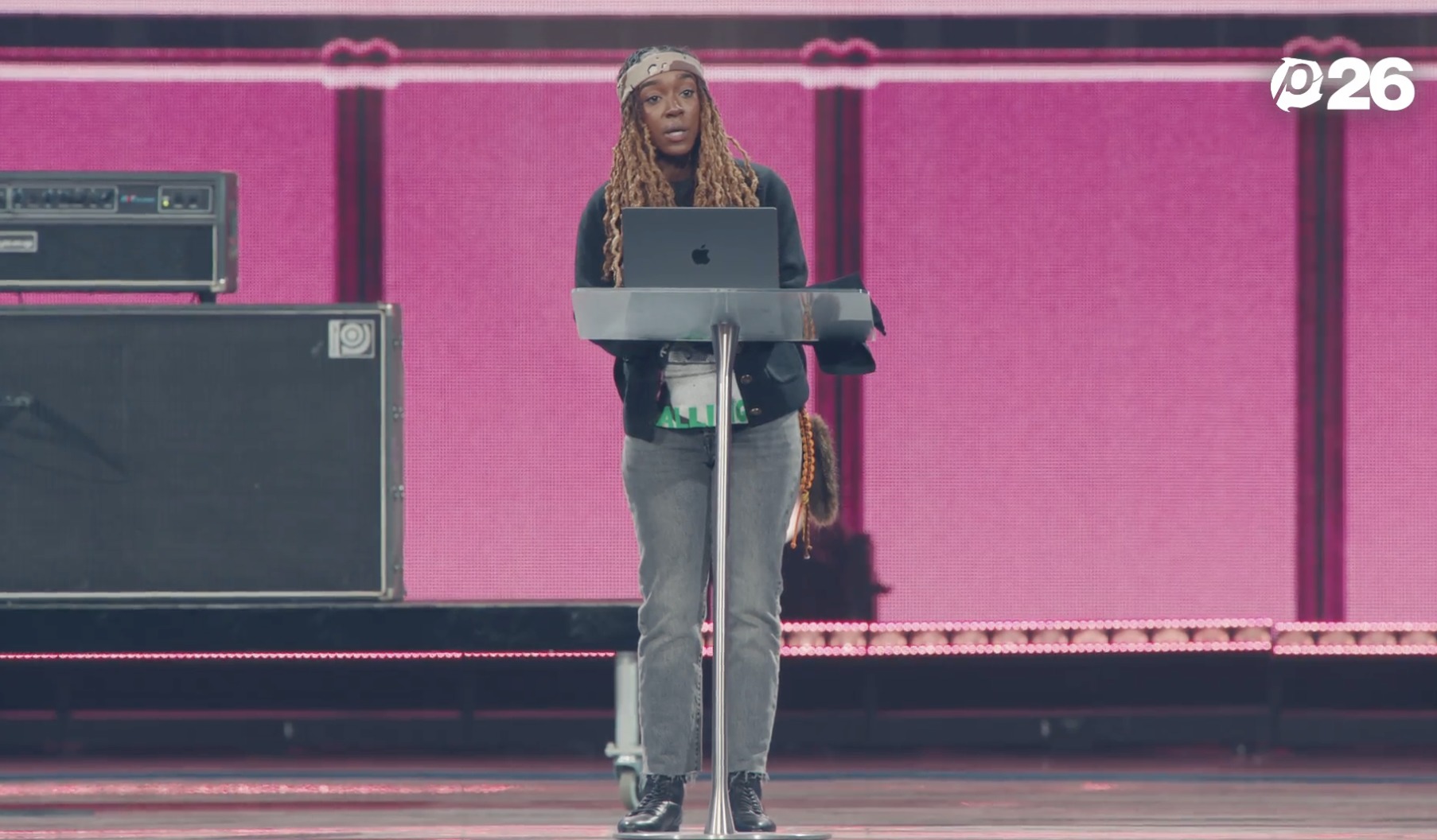
Jackie Hill Perry’s Message at Passion 2026: Rethinking Salvation and Heroism
Speaking to a vast crowd of college students and young adults at Passion 2026, Jackie Hill Perry delivered a compelling sermon highlighting the counterintuitive nature of salvation in Christianity. The key theme explored was the idea that true salvation emerges not from self-preservation but through surrender, exemplified by Jesus Christ’s sacrifice.
Perry, renowned as an author, Bible teacher, and poet, began her address at Globe Life Field in Arlington, Texas, by referring to a poignant scene from the 1997 movie “Titanic.” She described Jack Dawson’s self-sacrifice for Rose DeWitt Bukater, pointing out the ongoing debate about whether both could have survived on the makeshift raft.
“People love saviors,” Perry commented, emphasizing, “We love heroes. We love those who will sacrifice themselves for the greater good. What we don’t like are those who save themselves.”
Perry argued that this scene is powerful because it taps into a universal desire to be heroic. However, she proposed that humanity more closely aligns with Rose, the character in need of rescue, rather than the self-sacrificing Jack.
“That’s why that scene sticks with us,” Perry pointed out. “We all want to be like Jack. But we are actually like Rose.”
Drawing from Luke 23:32-43, Perry illustrated the crucifixion of Jesus between two criminals, highlighting how onlookers repeatedly challenged Him to “save yourself.”
Perry explained that the allure to use power for self-preservation echoed throughout Jesus’ life, from temptations in the wilderness to Peter’s objections to His suffering. However, she asserted that the crucifixion was predestined, akin to a script where Jesus’ death was always essential.
“The man in the middle cross isn’t the one who needs to be saved from death,” Perry remarked. “It is always us.”
Exploring the Gospel of Luke, Perry recounted Jesus’ journey, from betrayal by Judas to His anguished prayers in Gethsemane, all underscoring His destined death as part of God’s plan for redemption. She referenced Jesus’ lineage traced back to Adam, emphasizing His unique position to address sin.
“Here is the Son of God,” Perry stated, “being put to death like a sinner,” although He was sinless, facing the punishment meant for the guilty.
Perry turned to Genesis 3, discussing the fall of humanity and the entrance of spiritual death, linking it to the inherited sin from Adam. Yet, even then, God had a plan for redemption through Jesus.
“The wages of sin is death,” Perry declared, “Every single person who has ever been born is born deserving death.”
Citing the biblical promise of a savior to defeat sin and death, Perry emphasized Jesus’ role as the fulfillment of this prophecy.
“Jesus was not on the cross because He was a criminal,” she clarified. “He was on the cross because we are.”
Perry highlighted the futility of self-salvation through various means like gifts, relationships, or substances. The cross, she argued, demonstrates the inadequacy of such attempts, as true salvation comes through Christ’s weakness.
“Kings don’t hang on crosses,” Perry concluded, “unless the King is Yahweh.”
In an emotional segment of her sermon, Perry described one thief’s transformation on the cross, as he acknowledged his guilt and Jesus’ innocence. This change, she suggested, might have been prompted by Jesus’ prayer for forgiveness for His persecutors.
Salvation, Perry emphasized, is not simply relief from earthly trials but reconciliation with God. She drew upon Romans 3 to describe substitutionary atonement, where Jesus’ death fulfills God’s justice while granting mercy.
The thief’s final plea — “Jesus, remember me when you come into your Kingdom” — showcased profound faith, recognizing Jesus’ royal authority beyond death. Perry underscored that salvation is through faith in “the man on the middle cross.”
She shared a poignant anecdote popularized by preacher Alistair Begg, imagining the thief in Heaven with no credentials, except his faith.
“The man on the middle cross said I could come,” Perry concluded, with the audience transitioning into a worship session led by artist Brooke Ligertwood.
The Passion movement, initiated in 1995 by Louie and Shelley Giglio, seeks to inspire young adults to live for the “name and renown of Jesus.” This year’s conference also featured speakers like Earl McClellan, Jonathan Pokluda, and Sadie Robertson Huff.
This article was originally written by www.christianpost.com