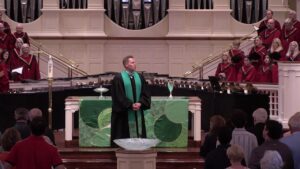
As artificial intelligence continues its rapid integration into daily life, concerns over its impact on spiritual practices are being raised by prominent figures like John Lennox, an apologist and Oxford mathematician. At the Sing! Conference’s 10th year, Lennox shared his apprehensions about AI’s influence on diminishing reading habits, particularly among the youth, and the potential spiritual ramifications.
During a dialogue with Wes Huff, Lennox explored the dual nature of AI, acknowledging its benefits in fields like medicine and Bible translation while highlighting its potential to detract from traditional reading practices. He warned, “One of the negative effects of these large language models is the rapid decline in reading, particularly among young people.”
Lennox expressed concern over the decline in engagement with Scripture, emphasizing that reading forms a critical part of spiritual nourishment and defense. “If reading declines, reading Scripture will decline, and so Christians will not thrive,” he stated, emphasizing the need for continued engagement with biblical texts.
The Sing! Conference, led by hymn writers Keith and Kristyn Getty, celebrated the 500th anniversary of William Tyndale’s English New Testament, focusing on the theme “Symphony of Scripture.” Lennox highlighted historical figures who risked their lives for Scripture accessibility, warning against allowing AI to become a new barrier between people and the Bible.
Huff pointed out that while access to Bible translations has never been greater, there is a risk of AI serving as an intermediary, replacing deep meditation on Scripture with quick summaries. “We’re confusing the mechanisms of giving us information with actually meditating and reading and delving into Scripture,” he said.
Despite these challenges, Lennox and Huff advised against simplistic views of technology as entirely beneficial or harmful. Lennox likened technology to a “sharp knife,” which “can be used to save a life or to commit murder,” stressing the importance of recognizing both potential outcomes.
AI’s role in advancing Bible translation into complex languages was noted as a positive application. However, Lennox cautioned that technology, while a useful tool, could become “a very dangerous master.” He advocated for the involvement of Christians grounded in biblical ethics in AI research.
Addressing the nature of AI, Lennox reminded Christians that machines do not possess consciousness or the divine image inherent in humans. “AI is not made in the image of God,” he stated, emphasizing the flawed nature of human creators.
Huff underscored the existential questions faced by today’s young generation, who seek “meaning and purpose and identity and hope and justice,” suggesting these are deeply rooted in the Christian worldview.
Lennox observed a shift in questions from scientific objections to existential inquiries, urging Christians to engage by listening and asking questions. “Be honest if you don’t know the answers. Just say I don’t know, but I’ll look it up,” Lennox advised.
He also highlighted the Apostle Paul’s message about turning from idols, warning of modern distractions like AI that can control lives. “The wonderful promise is that Jesus is coming again,” Lennox assured, offering hope amid technological concerns.
The conference also marked a reflective moment as Keith and Kristyn Getty discussed the growth and future of Sing!, initially planned as a five-year project but now set to continue until at least 2030. Keith Getty noted the increasing demand for resources within the global Church, promising further support and development for aspiring hymn writers.
“The international need … is huge,” Getty remarked, acknowledging the role of platforms such as YouTube in shaping worship practices globally. His enthusiasm for the future of Sing! was palpable, underscoring a commitment to nurturing the next generation of hymn writers.
This article was originally written by www.christiantoday.com