
Retired Bishop Reinterprets Key Biblical Passage on Ministry
DALLAS — A frequently cited Bible verse traditionally understood as supporting atonement may actually pertain to the Apostle Paul’s own ministry, according to a well-respected theologian.
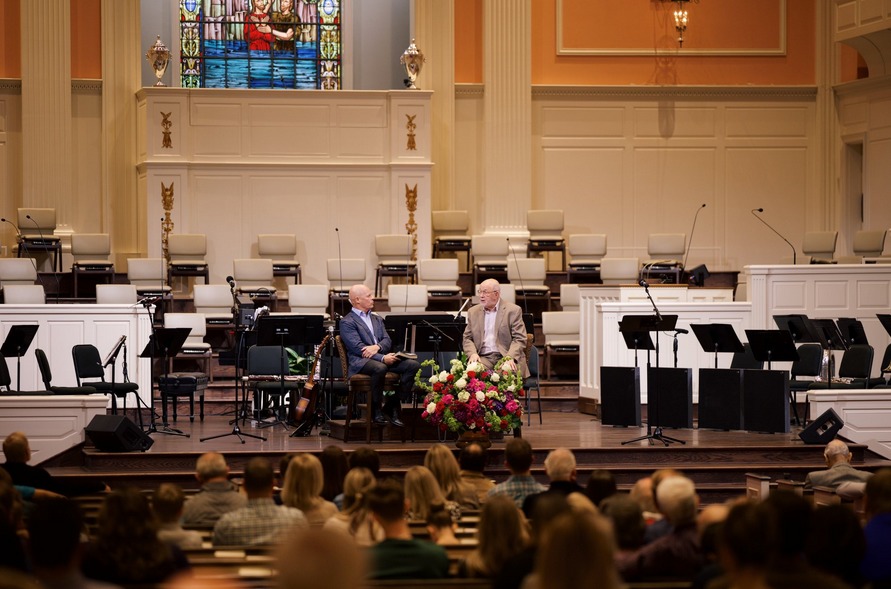
During a Q&A session that concluded the “Exploring Philippians with N.T. Wright” conference at Park Cities Baptist Church, New Testament scholar N.T. Wright offered a fresh perspective on a passage central to Reformed theology. Drawing from his 2013 work, Paul and the Faithfulness of God, the 76-year-old scholar argued that 2 Corinthians 5:21 should be viewed not as a doctrine of penal substitutionary atonement but as a defense of Paul’s apostolic ministry.
Traditionally, Reformed theologians have interpreted the verse — “God made him who had no sin to be sin for us, so that in him we might become the righteousness of God in him” — as a key support for the concept of imputed righteousness. This idea suggests that Christ’s sinlessness is credited to believers, thus justifying them before God.
Wright, however, rejected this interpretation, calling it a “straggler” reading that overlooks the passage’s narrative context. According to Wright, “The whole passage is about Paul’s apostolic ministry and the defense of the apostolic ministry over and against the Corinthian attack that he’s not really a proper apostle.” He emphasized Paul’s repeated assertion in the chapter that “God was in Christ reconciling the world to himself and entrusting us with the message of reconciliation.”
“That isn’t about atonement,” Wright said. “That’s about the ministry.”
Wright’s argument centered on Paul’s choice of the verb “become” — a term he argues would differ had Paul intended to convey imputed righteousness. Instead, Wright views “righteousness” as a reflection of God’s “covenant faithfulness,” a theme prevalent in Paul’s writings where divine promises to Israel find their fulfillment in Christ and are demonstrated in Paul’s apostolic role.
In his view, Paul becomes a testament to this faithfulness, validated by the cross to proclaim its message.
To substantiate his claim, Wright cited Paul’s reference to Isaiah 49 from the Old Testament, where the Messiah serves as “a covenant for the people, a light for the Gentiles.”
“Paul is saying because of the death of Jesus, that has constituted me, as an embodiment of God’s covenant faithfulness,” Wright explained, referring to the word “become” and the Isaiah 49 connection as crucial to his interpretation. This leads into 2 Corinthians 6‘s depiction of a resilient ministry, emphasizing Paul’s challenges against Corinthian elitism.
Historically, figures like Luther have treated 2 Corinthians 5:21 as evidence for the imputed righteousness of Christ, famously dubbed the “wonderful exchange.” Meanwhile, evangelical voices like John Piper have described it as a “double imputation” where believers receive God’s righteousness by faith as their sins are transferred to Christ.
In his 2016 book The Day the Revolution Began, Wright wrote that atonement is often incorrectly assumed to have a singular, clear meaning: “It is easy to imagine that it carries a single and obvious meaning. It does not.”
A 2009 review by the Southern Baptist Theological Seminary noted Wright’s differentiation between righteousness as a legal verdict and the transfer of legal status. He defines justification as God’s declaration of a sinner being “not guilty” because of Christ’s sacrifice, rather than the granting of Christ’s perfect righteousness to the believer.
This interpretation, criticized by some, was deemed “wrong and confusing” by Reformed publication Ligonier. Furthermore, the late Pastor John MacArthur referred to Wright in 2017 as a “happy heretic,” criticizing The Day the Revolution Began for being “piled up high-sounding words, raised up against the knowledge of God, to be smashed by the truth: fortifications to be crushed under the force of the truth.”
This article was originally written by www.christianpost.com




