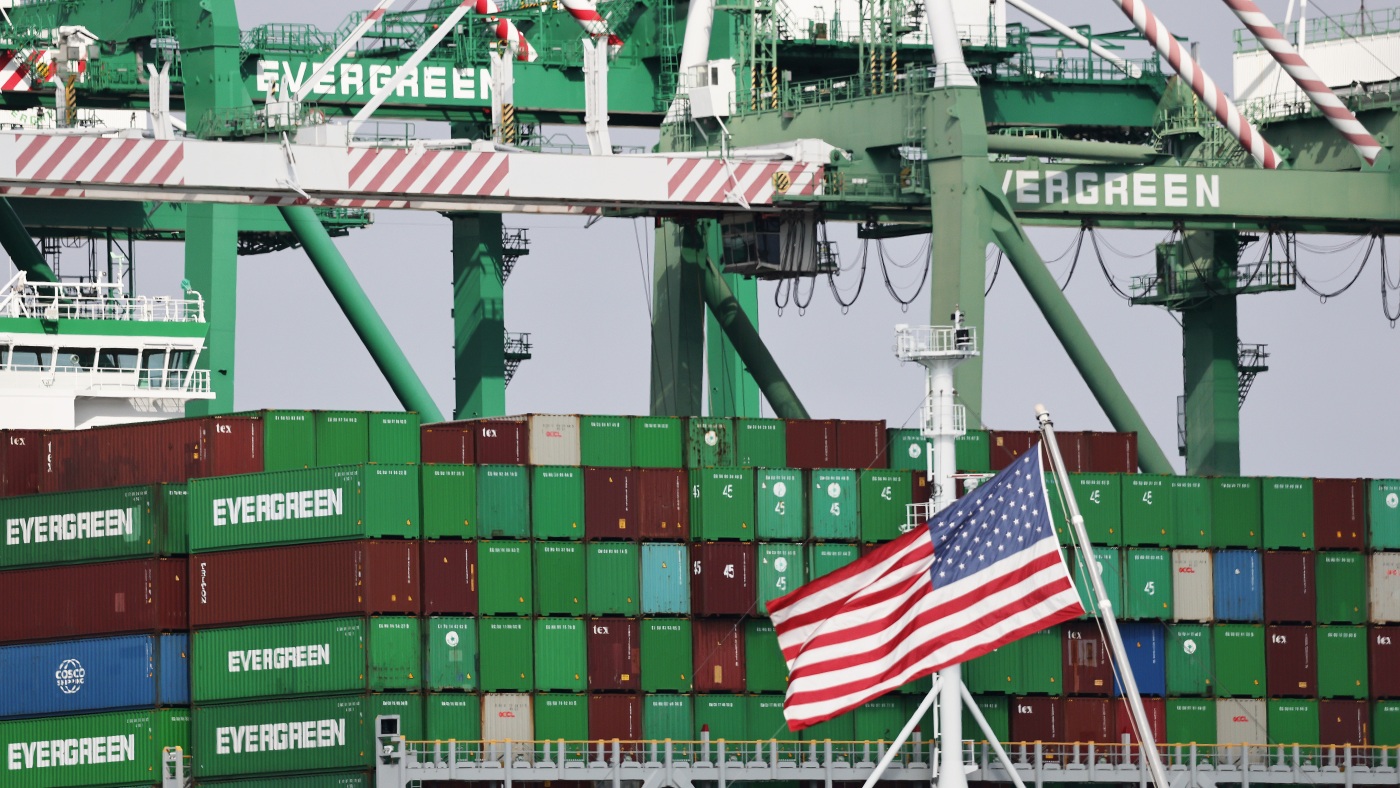
An American flag flies near shipping containers at the Port of Los Angeles on Sept. 26.
Mario Tama/Getty Images
hide caption
toggle caption
Mario Tama/Getty Images
In an unusual show of bipartisanship, the Republican-dominated Senate voted on Tuesday to curtail President Trump’s emergency powers used to impose tariffs on Brazil. This measure, aimed at limiting the administration’s trade barrier policies, saw a 52 to 48 vote in favor of rescinding the 50% tariffs introduced in July. Among those who joined Democrats were five Republicans: Susan Collins (Maine), Lisa Murkowski (Alaska), Thom Tillis (North Carolina), Mitch McConnell (Kentucky), and Rand Paul (Kentucky).
The resolution’s passage poses a significant challenge to the President’s tariff agenda, although it may remain largely symbolic. The likelihood of the measure being taken up in the House by Speaker Mike Johnson, R-La., is slim, and even if it were, a presidential veto is anticipated.
This vote comes at a crucial time, testing Republican support for Trump’s tariff strategies amidst growing concerns about their negative effects on key sectors like manufacturing and agriculture. It also precedes a Supreme Court case that questions Trump’s use of emergency powers for tariff imposition.

Democrats, alongside a few Republicans, are planning two more votes this week to challenge the President’s tariff policies on other countries, including Canada. Senator Tim Kaine, D-Va., who spearheaded the measure, emphasized the economic toll of tariffs and questioned the extent of presidential power over Congress.
“They’re about the economic destruction of tariffs, but they are also really about how much will we let a president get away with?” Kaine asked. “Do my colleagues have a gag reflex or not, in terms of powers that constitutionally are handed to Congress?”
Despite stiff opposition, five Republicans defied lobbying efforts by Vice President JD Vance, who advocated for maintaining the tariffs as a strategic tool for the President in global negotiations. “To block the president’s emergency powers to set tariffs, is to strip that incredible leverage from the president of the United States,” Vance remarked.

Vice President JD Vance talks with reporters after attending the weekly Senate Republican policy lunch on Tuesday. Vance told reporters that tariffs are a critical source of leverage for President Trump on the international stage.
Chip Somodevilla/Getty Images
hide caption
toggle caption
Chip Somodevilla/Getty Images
Simultaneously, President Trump is engaging in a multi-nation tour in Asia, focusing extensively on trade discussions.
Senator Josh Hawley, R-Mo., noted that Vance had briefed Republicans about the President’s trade efforts. “It’s successful, and it’s bringing in a lot of revenue,” Hawley stated, expressing his support for the tariff policy.

Nevertheless, doubts remain within the Republican ranks. Tillis, after the meeting, voiced his intention to vote against the tariffs, citing the unpredictability they cause in the business landscape.
The tariffs on Brazil were initiated by Trump in an attempt to pressure the Brazilian government to cease its actions against former President Jair Bolsonaro. Bolsonaro, having been sentenced to 27 years in prison for trying to maintain power following his 2022 electoral defeat, has been a controversial figure in Brazil.
This isn’t the first instance of Senate Republicans challenging Trump over tariffs. Earlier in April, a similar measure aimed at removing tariffs on Canada saw support from both parties, ultimately passing with a simple majority. Among the supporters were Senators Kaine, Paul, McConnell, Collins, and Murkowski.