
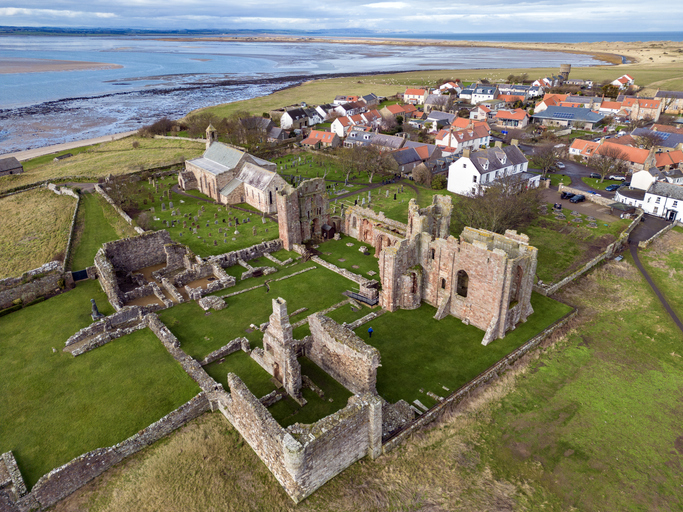
(Photo: Getty/iStock)
In the shadow of history’s great upheavals, the Viking raids on Lindisfarne stand as a turning point that reshaped the spiritual and cultural landscape of Anglo-Saxon England. The infamous attack in 793, often equated to a medieval ‘9/11 moment’, left an indelible mark on the collective memory of the time, echoing through both religious and secular narratives.
The Viking Impact on England
In the late 8th century, the monastery at Lindisfarne was a beacon of Christian learning and culture. Renowned for the saintly monk Cuthbert and the creation of the Lindisfarne Gospels, this spiritual center was violently sacked by Viking raiders in 793. This event sparked widespread fear and is often remembered as a catastrophic moment comparable to modern disasters.
Alcuin, a scholar at Charlemagne’s court, chronicled this calamity, noting the unanticipated terror from the sea that left the church of St. Cuthbert desecrated. He interpreted these raids as divine retribution for societal sins, a common perspective in Christian history during times of crisis. Alcuin’s letters urged introspection among the clergy and suggested that the raids were a result of moral failings.
Escalating Viking Raids
The raids on Lindisfarne were only the beginning. By 800, Viking incursions were a common threat across the British Isles and parts of Europe, extending as far as the Mediterranean and even Baghdad. The “great heathen army” that landed in East Anglia in 865/6 marked a significant escalation, leading to the establishment of Viking kingdoms in England.
These invasions were driven by multiple factors, including population pressures in Scandinavia and shifts in trade dynamics. Additionally, the aggressive expansion of the Frankish Empire may have spurred defensive reactions from pagan Scandinavian communities.
Complicated Historical Narratives
Despite the destruction, monastic life at Lindisfarne persisted, with the community eventually relocating several times due to ongoing threats. The narrative of Viking raids is complex; not all raids were carried out by Vikings, and some were the result of local conflicts or rivalries.
Viking raids often had calculated objectives, such as targeting festivals to maximize slave capture. Historical records indicate that these raids were sometimes seen as opportunities for profit, with diplomatic channels used for ransoming captured monks.
Legacy and Assimilation
Over time, the Scandinavian settlers began to integrate into the Christian framework of England. By the late 9th century, the influence of Christianity had extended to the Viking rulers themselves, evidenced by the minting of coins honoring St. Edmund by the descendants of those who had martyred him.
Archaeological evidence suggests a rapid assimilation of Vikings into Christian society, with very few pagan burials found in England. This conversion was likely facilitated by the vibrant Christian communities they encountered.
The story of the Viking raids is not solely one of destruction but also of cultural exchange and adaptation. The eventual emergence of a Christian Anglo-Norse community in England illustrates the resilience and transformative power of faith during turbulent times.
This article was originally written by www.christiantoday.com




