On 1 March, Wales celebrates St David’s Day, a day steeped in history and tradition. The engagement of the Welsh with the Bible has evolved dramatically over the centuries, embracing the technological shifts of the digital era. Here’s a closer look at this transformation.
Historic Roots
During the era of Dewi Sant (St David) in the sixth century, the Bible in western Europe was only accessible in Latin, housed in ornate manuscripts within monasteries. While ordinary folks could only interact with Scripture through sermons and visual art, Wales was a deeply Christian region, sending missionaries far and wide, all without possessing a Bible in their native tongue.
The Arrival of the Welsh Bible
In 1563, under the rule of Queen Elizabeth I, an Act of Parliament mandated the translation of the Bible into Welsh, making it accessible in every parish church. The New Testament appeared in Welsh in 1567, followed by the complete Bible in 1588, with copies securely chained in churches.
Modern Developments
Fast forward to 1988, four centuries later, the introduction of Y Beibl Cymraeg Newydd (the New Welsh Bible) marked a significant milestone. Revised in 2004 as Y Beibl Cymraeg Newydd Diwygiedig, it remains the primary Welsh-language Bible today.
beibl.net Initiative
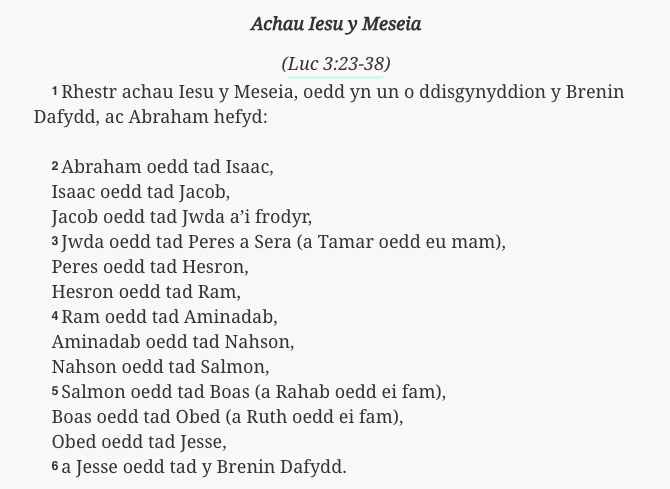
The distinction between literary and spoken Welsh led Gobaith i Gymru (Hope for Wales) to translate the Bible into everyday Welsh. Utilizing the latest software, this version was hosted online at https://beibl.net/, facilitating dynamic updates based on user feedback. By 2002, the New Testament was completed, and by 2013, the Old Testament was added. This translation, known as “beibl.net,” was initially published online before appearing in print in 2015.
ap Beibl
In 2015, the Bible Society launched ap Beibl, a mobile app for the Welsh Bible, during the Eisteddfod festival. This app, developed with Gobaith i Gymru, offered one of the first Bible apps in Welsh. Today, it can be downloaded from app stores by searching for “ap Beibl” or “Welsh Bible”.
Digitisation Efforts
On the 450th anniversary of the Welsh New Testament, a digitisation project began to make historical translations accessible online. This initiative addressed the challenge faced by Welsh-speaking Bible students who relied on English versions due to a lack of Welsh resources. Collaborating with the Bible Society, Gobaith i Gymru worked to digitise these resources, now available on ap Beibl and https://cymraeg.global.bible/.
YouVersion Expansion
Launched in 2008, YouVersion has become the world’s most downloaded Bible app. By 2011, it included William Morgan’s Welsh Bible, followed by the Beibl Cymraeg Newydd Diwygiedig in 2012, and beibl.net in 2015. The interface now supports Welsh, contributing to its ranking as the language with the second-highest number of items on the app.
Audio and Synchronisation
Audio formats have gained popularity, with the New Testament of Y Beibl Cymraeg Newydd Diwygiedig recorded in 2010 and made available online in 2017. Additionally, William Morgan’s Bible and beibl.net were recorded, the latter featuring diverse Welsh-speaking accents. These audio versions can be synchronised with text on both YouVersion and ap Beibl.
Digital Lectionary
Since the 1567 publication of the Welsh New Testament, the Church in Wales has embraced bilingual practices. Their project to digitise the lectionary culminated in the launch of Llithiadur Digidol in 2024, accessible at https://lectionary.churchinwales.org.uk/, offering daily readings in both Welsh and English.
Welsh Bible in the Digital Era
The journey of the Welsh Bible into the digital age represents a commitment to preserving both the language and its religious texts. For a new generation of Welsh speakers, the Bible is now available in formats that resonate with contemporary digital habits, ensuring its continued relevance across the globe.
This article was originally written by www.christiantoday.com