
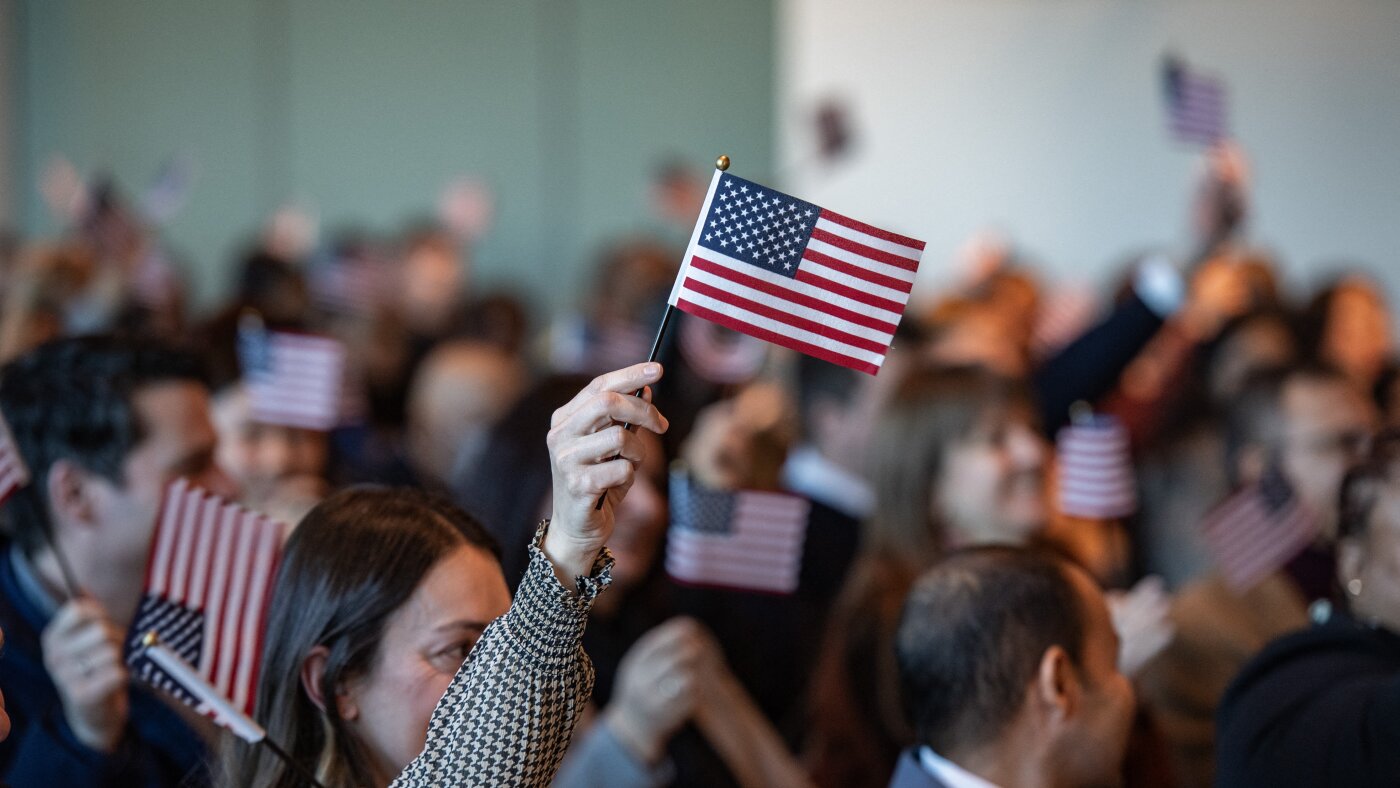
People wave U.S. flags to celebrate becoming U.S. citizens after taking the oath of allegiance during a naturalization ceremony in Boston in January 2025.
Joseph Prezioso/AFP via Getty Images
Joseph Prezioso/AFP via Getty Images
Stay up to date with our Politics newsletter, sent weekly.
The efforts by the Trump administration to restrict legal migration have extended to a group that was largely exempt: spouses of U.S. citizens. This has been part of a broader set of policies aimed at reducing immigration numbers.
Since President Trump resumed office, the administration has enacted various policy changes, including halting immigrant visas for 75 countries and intensifying scrutiny during green-card interviews. These measures have impacted many immigrants, even those married to U.S. citizens.
According to immigration lawyers and family interviews conducted by NPR, some non-citizen spouses have been separated from their American partners and are hesitant to engage with the U.S. immigration system.
“Life has become a lot more difficult for Americans who are married to somebody who is not born in this country,” said Ashley DeAzevedo, executive director of American Families United. The organization represents U.S. citizen spouses and immediate family members involved in immigration processes.
The organization has seen a rise in membership due to these rapid policy shifts. Currently, about 1.4 million people in the U.S. are seeking support from the group, along with 300,000 outside the country, including those who have left the U.S. or wish to enter.
“We saw so many of our members make the decision to self-deport, to leave the country for fear of this indefinite detention,” DeAzevedo noted. “We saw some members who had their spouses detained — and that was something we had not experienced previously because there was always this prioritization of who was going to be detained.”
Sharvari Dalal-Dheini, the senior director of government relations at the American Immigration Lawyers Association, mentioned that while spouses of U.S. citizens have always been scrutinized, they were usually not the focus of broad immigration enforcement.
“This group of individuals have always had a special place under the law,” Dalal-Dheini said. “Spouses of U.S. citizens aren’t subject to the immigrant quotas. They don’t have to have a cap. Spouses of U.S. citizens don’t [have to have maintained] their legal status here in order to adjust. And so the law has considered them to be a privileged class.
“But this administration is treating them like all other immigrants.”
The administration argues that past presidents should have applied more scrutiny to these marriage-related applications. USCIS maintains that their actions are in accordance with the law.
In a statement to NPR, USCIS spokesman Zach Kahler emphasized the importance of verifying personal histories and identities of those seeking immigration benefits. “A pending or approved Form I-130, Petition for Alien Relative, does not confer any immigration status,” Kahler stated. “Those who entered without inspection or who remain in the United States beyond their permitted stay are illegal aliens who may be subject to immigration enforcement action.”
Family and fiancé petitions make up nearly half of green-card approvals
Sponsorship for immediate family, including spouses and fiancés, remains a significant channel through which U.S. citizens interact with the immigration system.
The most recent Homeland Security Department data from 2024 reveals that around 343,000 individuals gained green cards through their spouses, representing about a quarter of all green-card approvals. This number has remained between 200,000 and 340,000 over the past decade.
When including other immediate family members capable of sponsorship, such as children and parents, the number of approved green cards doubles, illustrating the pathway’s importance for U.S. citizens and their immigrant relatives.
The processing time for each petition averages 13 months for family members and seven months for fiancés. These durations are consistent with wait times from early 2025, prior to the implementation of Trump’s policies.
During the first quarter of the 2026 fiscal year, 167,401 petitions for immediate family relatives were approved, alongside 8,612 fiancé petitions.
Chaos for U.S. citizens, including military members
Despite the data, noncitizen spouses’ challenges might not be fully captured, particularly those from over 70 countries affected by travel and immigrant visa holds.
Es’, a green-card holder married to a U.S. citizen, was born in one of the 39 countries subject to a travel ban implemented last year. Despite residing in the U.S. for three decades, her citizenship application remains pending.
There are no exceptions to the travel ban, even for spouses of military personnel.
The couple’s situation has been thrown into turmoil in recent months. “We are due to [move] to Germany,” said Es, who requested anonymity due to her husband’s military service and her pending immigration case. “We were actually due to leave in July but had to push it to October to see if we can get [my citizenship] done.”
The couple now faces decisions regarding their house, potential separate travel arrangements, and implications for their two young U.S. citizen children and belongings.
“That’ll mess up his readiness [for military service],” Es expressed. “He’ll be thousands of miles away and he has to think about his job and will be worried about us and that is just not fair.” A federal judge ruled the pause was unlawful, yet her case remains stagnant.
“This is not impacting people who have done anything wrong. This is impacting everyone,” she remarked.
Delays at consulates are adding to the strain, leaving some spouses or fiancés without legal status.
“People who are marrying U.S. citizens often are no longer in status, whether they came in legally and then their status expired or their status was terminated, like if they had [temporary protected status],” Dalal-Dheini highlighted.
“And then there’s extra scrutiny being applied to them now,” she said, referring to the USCIS’s approach to all applications.
Chilling effect on engaging with the process
Advocates indicate that recent policy changes have heightened scrutiny on immigration applications, discouraging families from engaging with the government.
USCIS officers are now required to conduct more interviews, while a recent memo advised officers to consider whether applicants returned to their home country for a green card. Staying in the U.S. could result in extended and more intrusive vetting. The Trump administration has also requested financial institutions to examine the bank accounts of those without permanent status.
Eric Welsh, an immigration attorney in California, stated that applicants must now be prepared to answer questions about their green card application process, including evidence of “good moral character,” which was not previously required.
“What’s important to keep in mind is that spouses are vulnerable,” Welsh explained, noting that while pathways to citizenship or a green card exist, they are not guaranteed. “There’s no absolute right to remain and there’s no absolute right to be afforded adjustment to status. And so I think that’s something that most people don’t commonly understand, especially not the U.S. citizens.”
Both Welsh and DeAzevedo have observed families hesitating to advance their immigration cases.
“[This] has had an absolute chilling effect on many people in this country and their desire to put their spouse in that position,” DeAzevedo stated.
This article was originally written by www.npr.org




