
Good morning. You’re reading the Up First newsletter. Subscribe here to get it delivered to your inbox, and listen to the Up First podcast for all the news you need to start your day.
President Trump Projects Economic Growth Amid Criticism
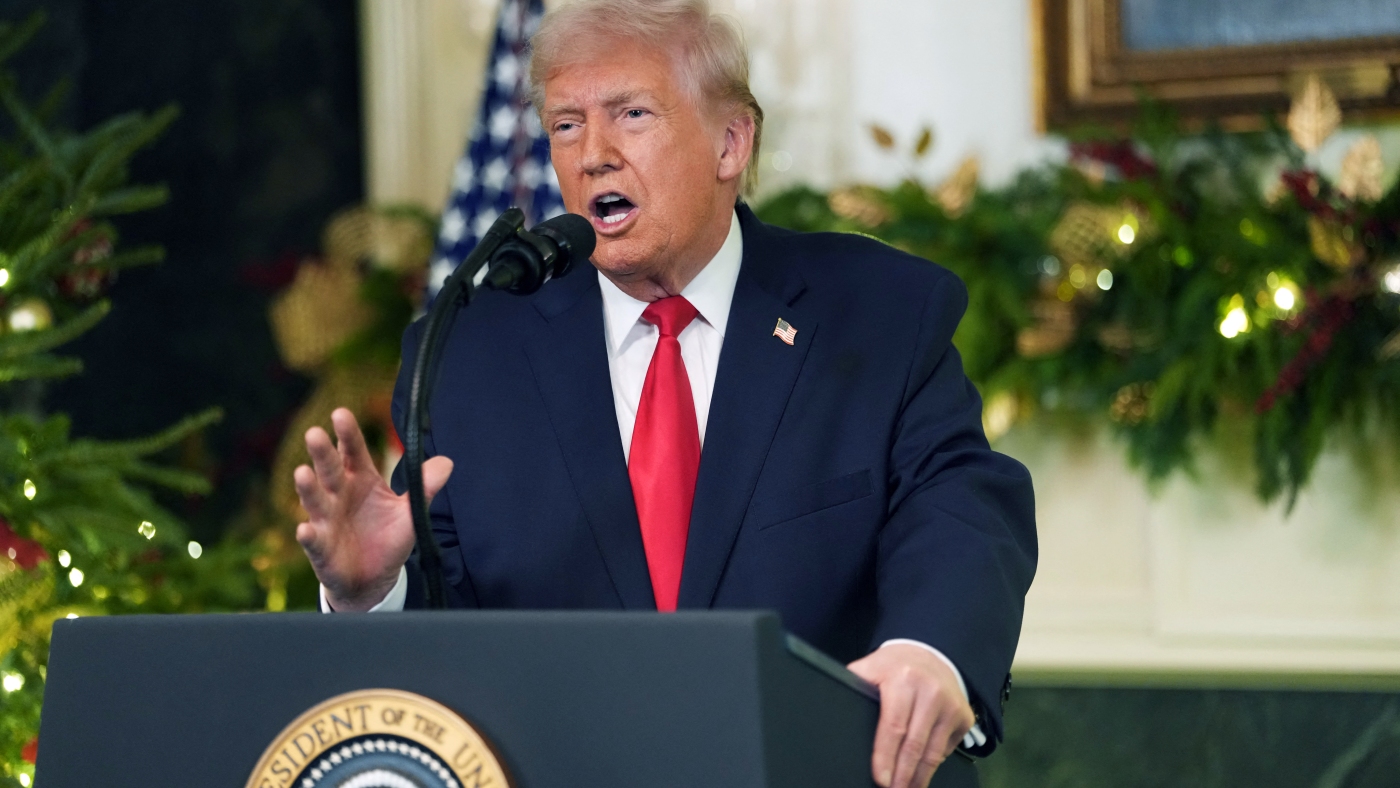
In a nationally televised address, President Trump expressed optimism about a future economic surge, crediting a decline in high prices. He shifted responsibility for current economic challenges to previous administrations and immigration. The address coincides with a period of low economic approval ratings for Trump, as highlighted by the latest NPR/PBS News/Marist poll.
President Trump addresses the nation from the Diplomatic Reception Room of the White House in Washington, D.C., on Dec. 17, 2025.
Doug Mills/Pool/AFP via Getty Images
hide caption
toggle caption
Doug Mills/Pool/AFP via Getty Images
- 🎧 The president essentially asked people to wait because his policies, which he passed this year, will have benefits in the new year, NPR’s Deepa Shivaram tells Up First. Trump said families will see a larger tax refund next year. He also announced an initiative that would pay service members $1,776 and an upcoming plan to help lower the cost of housing. Shivaram said that overall, it sounded like a pretty typical Trump address, which included a long list of everything he sees as his accomplishments, all tacked together.
Health Care Subsidies at a Crossroads
The U.S. House of Representatives recently voted on a Republican-led health care plan that notably excluded the extension of enhanced health care subsidies. Over 20 million citizens, who depend on these subsidies due to expire soon, are at risk. A faction of Republicans sided with Democrats to push for a vote on a three-year extension.
- 🎧 The House speaker now has a decision to make on whether to move the vote sooner, NPR’s Barbara Sprunt says. If the vote doesn’t happen by the end of this week, it won’t take place until next year, as lawmakers are leaving for the holidays. Sprunt says some Republicans could be shifting their stance on these subsidies because next year is a midterm year. Lawmakers recognize what is important to their constituents — in this case, the impact of expiring subsidies on insurance premiums.
International Tensions Rise Over Venezuelan Oil
President Trump has issued a directive to ban all sanctioned oil tankers operating between Venezuela and other nations. This maneuver, part of a broader campaign against Venezuelan President Nicolás Maduro, raises concerns about potential military conflict.
- 🎧 A full blockage is considered an act of war, but the Trump administration appears to be targeting only tankers already on the sanctions list, according to NPR’s Greg Myre. For years, the U.S. has been sanctioning “ghost ships,” which are tankers that attempt to disguise their identities and locations in an effort to evade U.S. and Western sanctions. This latest move could prove to be a major blow to Venezuela, as the country is heavily dependent on oil exports. A fully loaded large tanker carries over $100 million worth of oil. If the U.S. seizes a number of ships, it could possibly scare away non-sanctioned tankers who may decide it’s not worth the risk.
Concerns Over AI Detection Tools in Education
AI detection tools have become a common tool for educators in U.S. schools, yet their accuracy is under scrutiny. A survey by the Center for Democracy and Technology reveals over 40% of teachers from grades 6-12 used these tools, despite their questionable reliability.
- ➡️ John Grady, a language and literature teacher, uses AI detection tools as a starting point to initiate conversations with students about AI use.
- ➡️ Grady says he scans all essays with GPTZero, and if the tool flags a 50% likelihood of AI use, he digs deeper by using revision history tools to measure writing time and edit counts. If a student submits work with few edits and minimal time writing, he will conduct a check-in.
- ➡️ High school student Zi Shi, whose first language is Mandarin, fears that AI software will flag his work due to his writing style and his limited English vocabulary.
Rise of Buy Now, Pay Later Options
This holiday season, more shoppers are opting for “buy now, pay later” methods, with Cyber Monday alone seeing $1 billion financed through this option, according to Adobe Analytics. By season’s end, purchases using this service are expected to reach $20.2 billion.
- 💲 If you already have credit card debt or cannot afford to cover the payments, be wary of using BNPL.
- 💲 Try to only take these loans from one lender, so all your payment plans are in one place, allowing you to better keep track of payments.
- 💲 Avoid impulse buying just because BNPL is an option. One way to avoid buyer’s remorse is to imagine talking with your future self, who is looking at all those bills.
If you are curious to learn more about how BNPL loans work, check out these six pros and cons. Subscribe to the Life Kit newsletter for expert advice on love, money, relationships and more.
Three Things to Know Before You Go
- The National Oceanic and Atmospheric Administration’s Arctic Report Card for this year finds that the Earth’s northernmost part is warming faster than the global average. This is leading to melting glaciers, shifting fish populations and rivers running orange.
- In Chiloé Island, Chile, NPR’s Michele Kelemen noticed many stores selling images of witches. She asked her friend Chilean anthropologist Alejandra Leighton to explain the reason. Check out the lore behind these witches in this week’s edition of the Far-Flung Postcards series.
- Stealing a smooch under the mistletoe is a time-honored holiday tradition, but the word’s origins aren’t quite so romantic. For NPR’s “Word of the Week,” we explore the plant’s name history, dive into the kissing tradition and take a scientific detour.
This newsletter was edited by Suzanne Nuyen.




