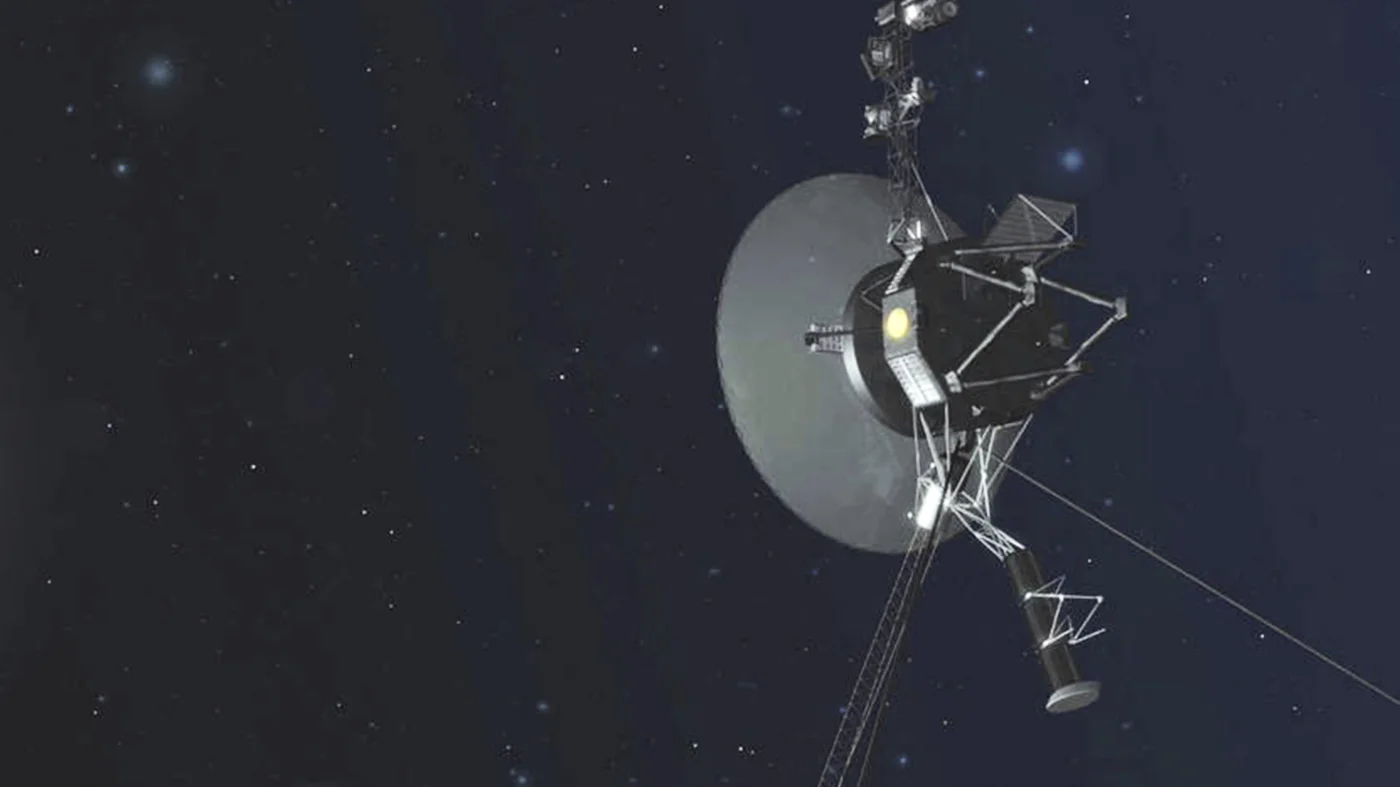
Voyager 1: A Historic Journey Reaches New Milestones
For almost half a century, Voyager 1 has been on a remarkable journey through the cosmos. On Wednesday, it will achieve a new feat by becoming the first human-made object to reach a distance of one light-day from Earth. This milestone marks a significant chapter in space exploration history.
NASA plans to commemorate this occasion with a public event titled “Shine Bright for Voyager’s Light-Day”. The space agency invites everyone to participate by signaling Voyager’s call sign, V-G-R, into the night sky using Morse code. Participants are encouraged to use flashlights, phone lights, or any other blinking light source.
To join in, follow these Morse code instructions:
- V – Three quick flashes, one long flash
- G – Two long flashes, one quick flash
- R – One quick flash, one long flash, one quick flash
What is a Light-Day?
A light-day is the distance light covers in 24 hours, equivalent to over 16 billion miles. Voyager 1, launched on September 5, 1977, has now traveled this immense distance.
During its mission, the spacecraft has completed flybys of Jupiter and Saturn. In 1979, it uncovered a faint ring system around Jupiter and, a year later, captured detailed images of Saturn’s rings and moons.
On February 17, 1998, Voyager 1 surpassed the Pioneer 10 probe, becoming the most distant human-made object. Together with its sibling, Voyager 2, it is one of the only spacecraft to have journeyed beyond the heliosphere, the sun’s protective shield.
Having reached the interstellar boundary in 2012, Voyager 1 continues to explore regions beyond our solar system, measuring magnetic fields, particles, and plasma waves of distant stars.
In a strategic move to conserve power, NASA recently turned off Voyager 1’s Low-energy Charged Particles experiment. Despite this, the spacecraft still operates two scientific instruments: one for measuring magnetic fields and another for detecting plasma waves.
Moreover, Voyager 1 carries with it the Golden Record, a “time capsule” intended to communicate Earth’s story to extraterrestrial civilizations. This gold-plated record features 115 images, sounds of nature like surf and wind, and greetings in 35 languages, along with instructions on playing it and information about the probe’s origin.
Voyager 1 is set to achieve “light-day status” at 5:16 a.m. ET on Wednesday, culminating 49 years, two months, and 11 days of its epic voyage.
This article was originally written by www.npr.org