
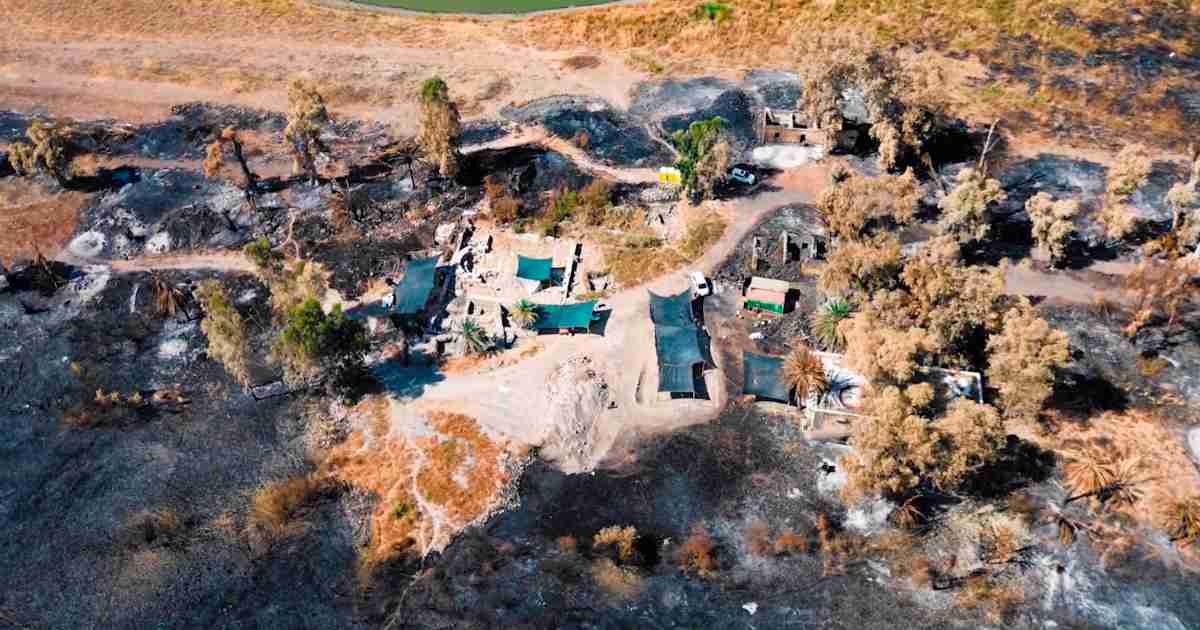
An unexpected wildfire near the Sea of Galilee this past summer revealed archaeological evidence that may confirm the location of Bethsaida, one of the most significant towns mentioned in the New Testament. The ancient settlement is identified in Scripture as the birthplace of three of Jesus’ apostles and the site of multiple miracles.
The destructive blaze, which burned for 17 hours in July, had an unintended consequence: it cleared away dense vegetation that had concealed the full extent of the ancient ruins at el-Araj for more than a century. This revelation has provided archaeologists with their clearest view yet of what may be biblical Bethsaida.
Fire exposes hidden structures
The timing of the fire couldn’t have been more ironic. Archaeological teams were preparing to begin a new excavation season when flames engulfed the site. Dr. Steven Notley of Pillar College recalled the moment: “We looked across the lake and saw there was a fire here.” The blaze destroyed equipment and tools, but it also removed layers of overgrowth and debris that had obscured the ancient town’s true dimensions.
When researchers returned to survey the damage, they discovered something remarkable. Dr. Motti Aviam of Kinneret College explained: “After the fire was down and we walked in the burned area, we found the remains of Bethsaida Julius.”
The newly exposed ruins include residential structures, pottery fragments, and portions of public buildings dating to the Roman era. These findings demonstrate that the settlement was considerably more expansive than previous archaeological assessments had suggested.
Byzantine church narrowly escapes flames
In what some researchers view as providential, the fire stopped just short of reaching a Byzantine-era church at the site. Dr. Notley described the narrow escape, stating: “It was the hand of God that stopped it from burning the basilica.” This structure houses a Greek inscription that honors Peter as the ‘Keeper of the Keys.’
According to Dr. Aviam, this inscription is unique in the region: “There is no other inscription in the eastern Mediterranean that is mentioned as the ‘Keeper of the Keys.'”
Archaeological evidence supports biblical accounts
Additional artifacts uncovered at the site include stone vessels and an inkwell, suggesting the inhabitants maintained organized and literate communities. Dr. Carrie Wood of Regent University emphasized the significance of these discoveries: “The Bible is true… Archaeology shows us and strengthens the word of God.”
For centuries, thick vegetation and periodic flooding from the adjacent lake had obscured the site’s full archaeological profile. The removal of this natural barrier has provided researchers with unprecedented access to structures and artifacts that connect the physical landscape to biblical narrative.
The site has now emerged as one of the most important New Testament locations in the region, offering tangible evidence of places and events described in Scripture. The discovery has generated significant interest worldwide, with many viewing it as confirmation of the historical accuracy of biblical texts.
One observer commented on the find’s spiritual implications: “May God open the eyes of the spiritually blind to know the truth and turn to Jesus the only way to salvation and eternal life before it’s too late.”
Another reflected on the broader meaning of such discoveries: “Whatever is hidden will surely come to light and it doesn’t matter how loudly or how intensely people deny the existence of the early church and Christ, the truth will either set them free or condemn them.”
WATCH: Wildfire Reveals Lost Biblical Town of Jesus’ Disciples




