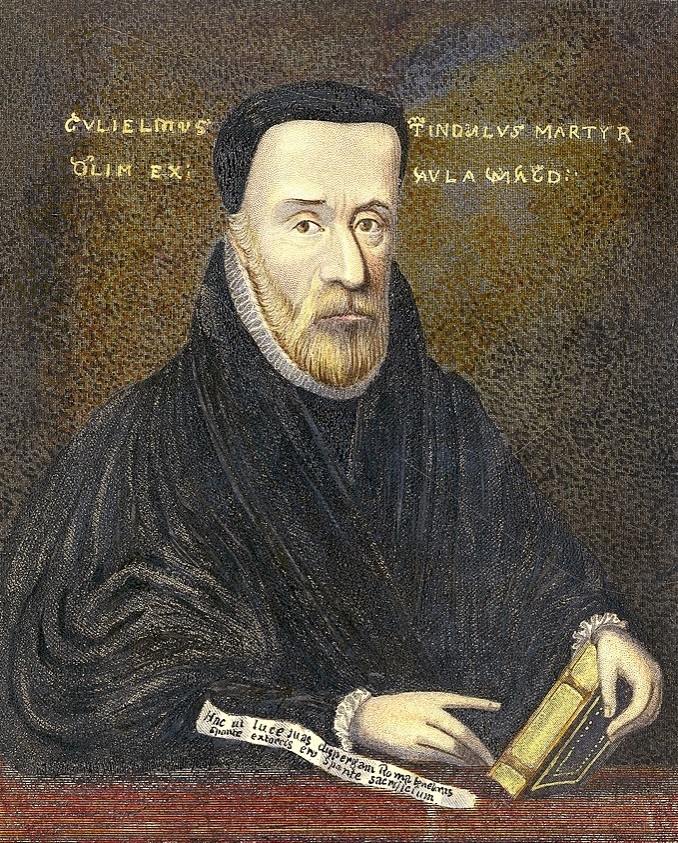
William Tyndale: The Unsung Hero Behind the English Bible
Globally acknowledged on October 6, William Tyndale is revered by Anglicans and Lutherans for his groundbreaking contributions to making the Bible accessible. This year marks a milestone, 500 years since his initial publication, shining a light on his daring and transformative life.
Early Life and Education
In the early 1490s, William Tyndale was born in the vicinity of Stinchcombe near Dursley, within the affluent Tyndale family, also known by the surname Hychyns. He was educated in Lollard circles, early Evangelicals who advocated for English usage, and later pursued studies at Oxford, excelling in Latin by 1512. Tyndale was ordained in London in 1515, possibly spending time in Boston, Lincolnshire, and Cambridge.
The Bible in Tyndale’s Time
During Tyndale’s era, the Latin Vulgate, translated by St. Jerome, was the official Church Bible. However, the language barrier was significant as most people were not versed in Latin. The Wycliffe Bible, labeled heretical, was the only English version but was deemed outdated and cumbersome in its language. This backdrop set the stage for Tyndale’s ambition to translate the Bible into contemporary English.
Impact of European Developments
The 16th-century Reformation in Europe significantly influenced Tyndale. Erasmus, a Dutch priest, published the “Novum Instrumentum omne” in 1516, offering the first Greek New Testament and revised Latin translation. Tyndale was inspired by Martin Luther’s 1522 German New Testament, which prompted him to translate the Bible into English from Greek, employing resources by Erasmus and Luther as reference points.
Embarking on Translation
Between 1522 and 1524, Tyndale translated much of the New Testament while serving as a chaplain for Sir John Walsh at Little Sodbury Manor. Although technically not illegal, English translation required a bishop’s approval per the 1407 Constitutions of Oxford. Tyndale’s request for permission from the Bishop of London was denied, propelling him into self-exile in Europe for his safety.
Tyndale’s European Sojourn
Relocating to the Holy Roman Empire in 1524, Tyndale is believed to have worked in Wittenberg, Luther’s base, and later moved to Cologne for printing. Despite Catholic Cologne’s dangers, Tyndale’s New Testament manuscript was initially printed there. A leak in the print shop led to potential confiscation, prompting Tyndale to flee with his assistant, William Roye.
The Cologne Fragment
Rescuing a partial print, Tyndale secured the first 22 chapters of the Gospel According to St Matthew, known as the “Cologne fragment,” which was smuggled into England and Scotland in 1525. This marked the first instance of printed English scripture reaching the public. The only surviving copy is housed in the British Library’s Grenville Collection.
Success in Antwerp
In Antwerp, Tyndale succeeded in publishing the complete New Testament in English in 1526. His writings further propagated his theological views, which were influenced by Luther and Lollard teachings, emphasizing faith, vernacular language use, symbolic communion elements, and the Bible’s supremacy over church traditions.
Betrayal and Martyrdom
Despite publishing parts of the Old Testament, Tyndale was betrayed in 1535 and faced heresy charges. While Bible translation was not illegal in Brabant, the English authorities targeted him for his works. Imprisoned in Vilvoorde, he was executed, allegedly praying for the King of England’s enlightenment at the stake.
Enduring Influence
Tyndale’s translation set the stage for future English Bible editions, influencing versions like the New Revised Standard Version. His linguistic contributions, including terms like atonement and scapegoat, left a lasting mark on the English language. Further insights on his life and work can be explored on the Tyndale Society website.
Commemorative Prayer
The Anglican collect for October 6 honors Tyndale’s dedication: “Lord, give to your people grace to hear and keep your word that, after the example of your servant William Tyndale, we may not only profess your gospel but also be ready to suffer and die for it, to the honor of your name; through Jesus Christ your Son our Lord, who is alive and reigns with you, in the unity of the Holy Spirit, one God, now and for ever.”
This article was originally written by www.christianpost.com