
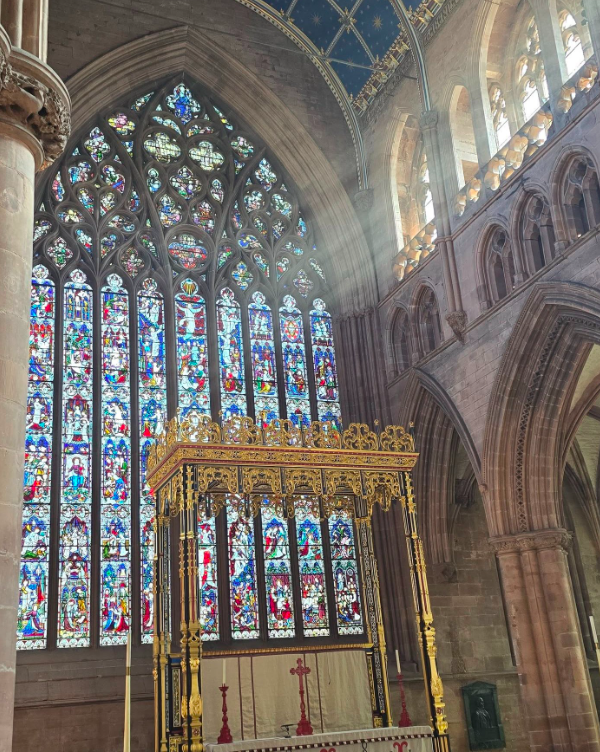
Historic Glasswork at Carlisle Cathedral Named Nation’s Favorite
(Photo: Association of English Cathedrals)
The intricate stained glass of Carlisle Cathedral has earned the title of “The Nation’s Favourite Stained Glass Window,” according to the Association of English Cathedrals.
The celebrated feature is the Curvilinear East Window, distinguished by its vivid portrayal of Jesus’ life and the last judgement, crafted between the late 13th and 14th centuries.
Initiated in 1292, the window was part of a larger restoration project following a destructive fire. The progress was hindered by frequent Scottish invasions and the catastrophic Black Death.
In 1314, Edward Bruce, brother to Robert the Bruce, capitalized on Scotland’s victory at Bannockburn by occupying Carlisle, causing severe economic turmoil. The following year, Robert the Bruce besieged the city, leading to local resource plundering, though the siege was eventually lifted.
By 1349, the Black Death had ravaged Carlisle, with a third of its inhabitants succumbing to the plague.
Significant advancements on the window occurred post-disasters. In 1359, John de Salkeld, a local yeoman, contributed 40 shillings to “make a window anew in the chancel.” The upper segment, illustrating the last judgement, is credited to Ivo de Raughton during this period.
The lower sections disappeared before the mid-18th century. In the 19th century, Hardman & Co. of Birmingham was tasked with reconstructing the lower segments, honoring the late Hugh Percy, Bishop of Carlisle. This work includes depictions from Jesus’ life.
Britain’s earliest stained glass windows date to the mid-12th century, commissioned after Thomas Becket’s murder.
The French Abbé Suger, who passed in 1151, asserted that stained glass allowed divine light to penetrate churches, symbolizing God’s earthly presence. He designed the church of Saint-Denis as a “temple of light,” marking the shift from Romanesque to Gothic styles.
This article was originally written by www.christiantoday.com




