
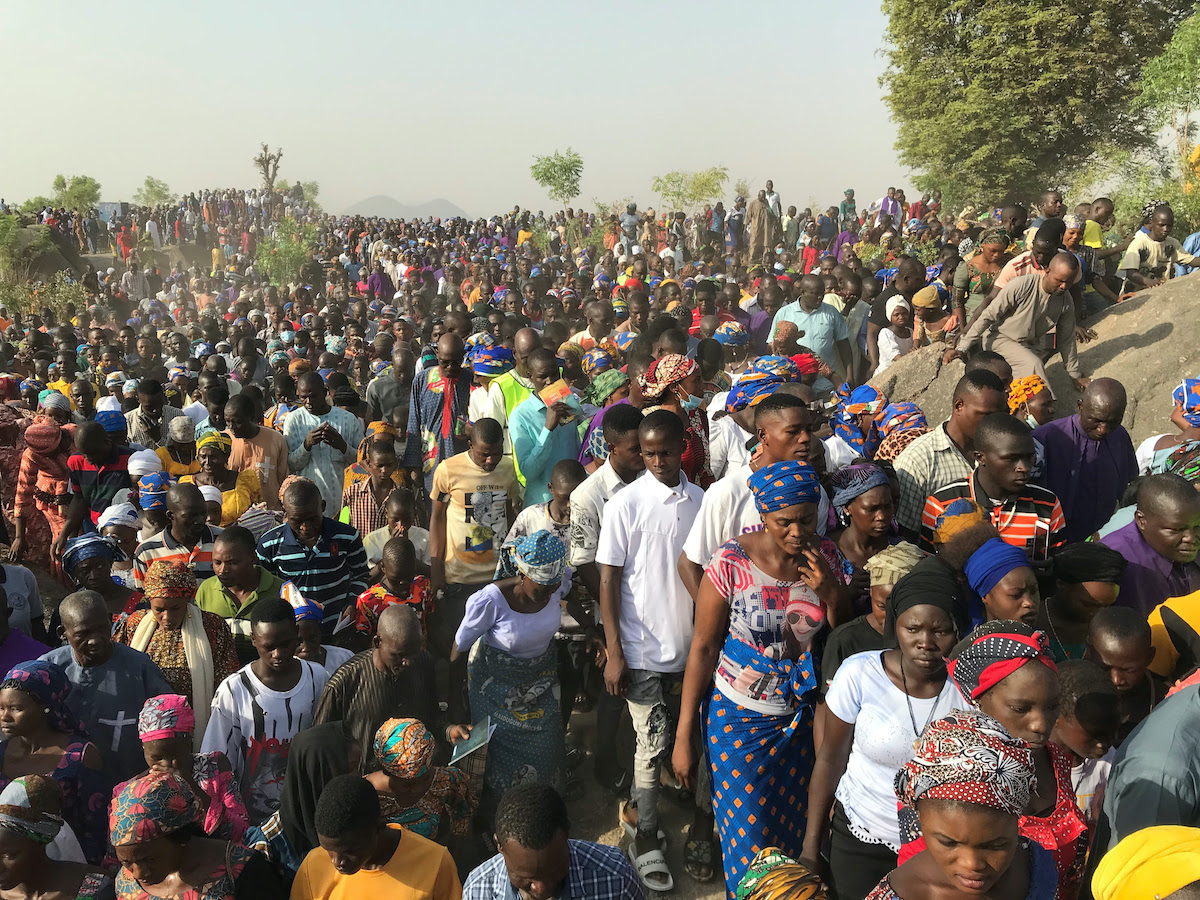
(Photo: Aid to the Church in Need)
Defying years of turmoil and violence, Catholic churches in north-east Nigeria are experiencing an unexpected revival, with attendance numbers soaring beyond pre-crisis levels. Bishops in the region report a noteworthy return of worshippers, described as arriving in “thousands, not hundreds,” despite more than a decade of conflict.
Bishop Oliver Doeme and Bishop John Bakeni from the Maiduguri Diocese in Borno State, speaking to Catholic charity Aid to the Church in Need (ACN), highlighted the resurgence of congregations. This growth comes after years of displacement and violence instigated by Boko Haram, a group whose insurgency since 2009 has led to approximately 20,000 deaths and displaced over two million people.
At the peak of the conflict, Bishop Doeme noted that over 90,000 Catholics were forced to leave the diocese, with more than a thousand losing their lives and over 210 churches being destroyed. Today, however, the situation appears to have transformed significantly.
“The faith of our people is unshakeable,” Bishop Doeme stated to ACN. “The number of Catholics we have in our diocese now is more than the number of Catholics we had before the Boko Haram crisis.” The diocese has seen a marked increase in religious ceremonies such as weddings, First Holy Communions, and baptisms, with child baptisms alone reaching 1,000.
The Whuabazhi Pilgrimage Centre, established with ACN’s support, has become a focal point of this spiritual revival, drawing record numbers of attendees. The bishops describe it as a place of healing and hope, particularly for the youth.
During the insurgency’s darkest years from 2009 to 2014, Christian communities faced severe attacks, emptying entire villages. Out of 279 abducted individuals, including children, 100 remain missing. Some young men were forcibly recruited by extremists and remain unaccounted for, as per Bishop Doeme’s report to ACN.
Despite the threats, clergy continued their mission, traveling to rural areas to administer sacraments at great personal risk. Bishop Doeme observed that persecution has paradoxically invigorated the Church. “The moment the church faces persecution, the people become more alive, their faith becomes more active,” he explained to ACN. “Despite gunshots … bomb attacks … series of attacks … you will find them going to Masses for their sacraments.”
While the security situation in Maiduguri has seen improvement, Bishop Bakeni cautions that instability persists across Nigeria. “There is a cloud of fear, anxiety and insecurity hovering over our country,” he remarked. “Every day Nigerians are being killed, or abducted or kidnapped. This has become a reality.”
Elsewhere, Catholic leaders continue to urge stronger governmental measures to combat violence. In Taraba State, recent assaults attributed to militant Fulani herdsmen have resulted in 10 deaths and widespread destruction. In Wukari Diocese, clergy report over 100 fatalities in recent months, with more than 200 churches and communities destroyed and thousands displaced.
Pope Leo XIV has expressed sorrow over the ongoing violence and called for prayers for peace. Amidst these challenges, the revival of church life in Maiduguri stands out as remarkable. “Ordinarily, when people are confronted with violence, the church should be less populated,” Bishop Bakeni noted. “But what we are seeing is the opposite.”
He added, “As bad as the persecution is, this is the testimonies we have. It’s the testimonies of faith and the faith which is tested.”
This article was originally written by www.christiantoday.com




