
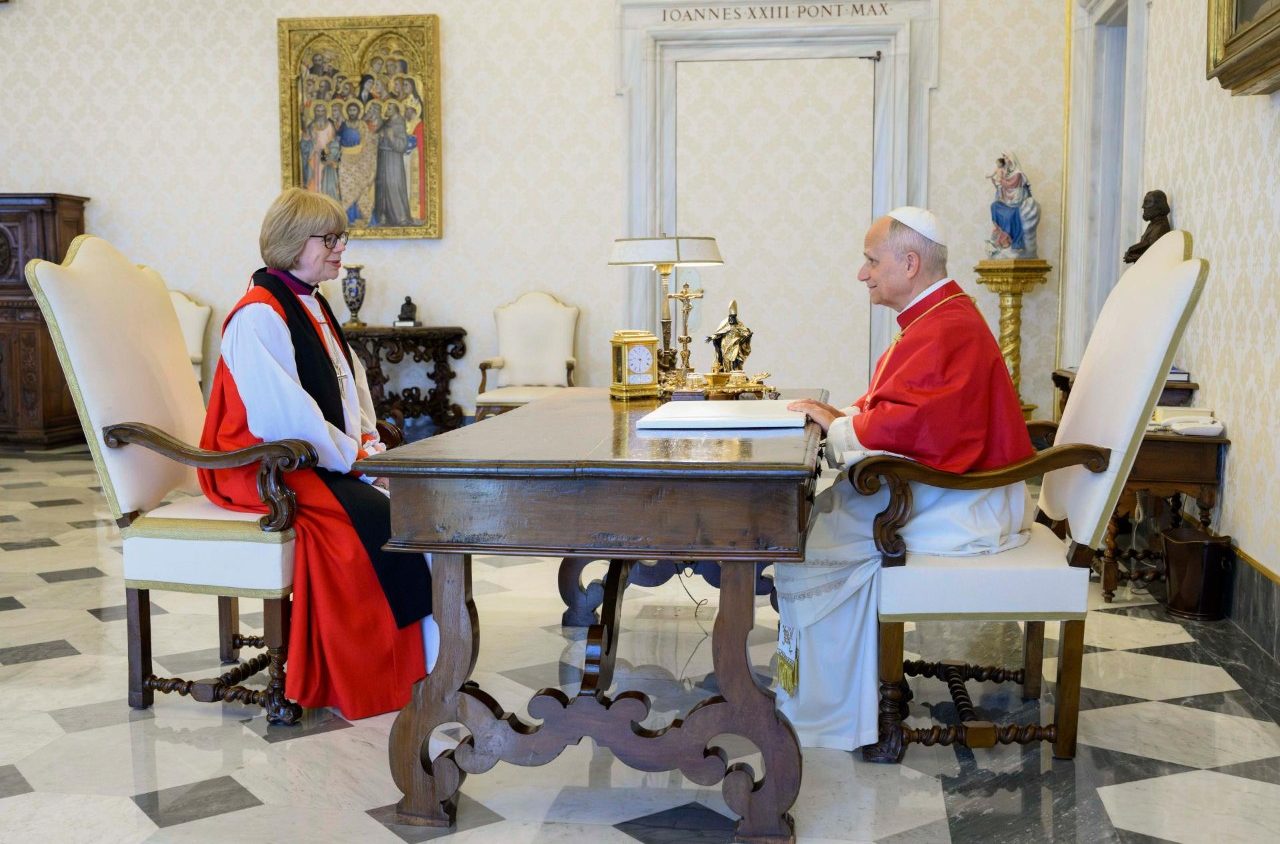
(Photo: Vatican Media)
In a historic journey to Rome, the Archbishop of Canterbury, Sarah Mullally, highlighted the enduring relationship between the Anglican and Catholic communities. Her visit, which included a stop at St Paul’s Within the Walls—the first non-Catholic church erected in the city since the Reformation—underscored the significance of ecumenical dialogue.
Mullally’s second day in Rome saw her delivering a homily at the evening service held at this notable Anglican church. Earlier, she paid her respects at key Catholic sites, including the Papal Basilica and the Cathedral of St John Lateran, as well as the Papal Basilica of St Mary Major, where she paused for prayer at the late Pope Francis’s tomb.
Her sermon emphasized St Paul’s Within the Walls as a beacon of unity between the two branches of Christianity. The church, celebrating 150 years since its consecration, boasts bronze doors installed in 1966, commemorating an earlier milestone in ecumenical relations—the 1960 meeting between Pope John XXIII and Archbishop Geoffrey Fisher.
Mullally remarked that “the very doors of this church speak of Christian unity,” recognizing the pivotal 1966 meeting between Pope Paul VI and Archbishop Michael Ramsey, which she said invigorated modern ecumenical dialogue.
She further elaborated that the doors symbolize a profound theological message, stating, “Unity is not merely an idea, but a calling: a calling to reconciliation, to deeper communion, and to a shared life in Christ that reaches beyond our divisions.”
During her pilgrimage, Mullally also had an audience with Pope Leo XIV, where they prayed together. She assured him, “I will remain united with you in prayer: prayer for peace in our world; prayer for justice; and prayer that every person may come to discover the fullness of life that God offers. We are united in prayer because we pray to the Father, through Jesus Christ our Lord.”
Both religious leaders had previously used their Easter messages to advocate for peace. Mullally reiterated this plea in her sermon, urging a return to the core value of Christian love in a world marred by conflict.
“And yet, we look at our world today and often we see something very different: instead of making justice and peace a priority, we see terrible violence inflicted on innocent people in conflicts across the globe,” she noted. “In such a world, the Church cannot lose confidence in the Gospel. For the Gospel is precisely this: that life, not death, has the final word; that Christ has broken the power of violence, not by greater force, but by self-giving love.”
This article was originally written by www.christiantoday.com




