
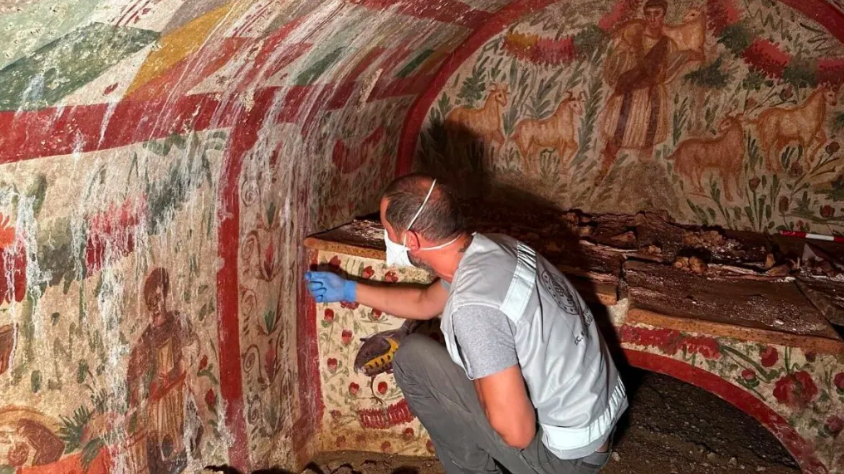
Ancient Mural of Jesus Discovered in Turkey: A Glimpse into Early Christian Art
(Photo: Turkish Culture and Tourism Ministry)
In the heart of Turkey, a remarkable archaeological find is shedding light on early Christian artistry. Experts have unearthed a 3rd century mural portraying Jesus as the good shepherd, located in an underground tomb within the Hisardere necropolis near Iznik. This discovery offers a rare glimpse into the religious and cultural expressions of ancient times.
Iznik, known in antiquity as Nicaea, holds a significant place in Christian history. It was here in 325 AD that the First Council of Nicaea was convened by Constantine, the pioneering Christian Roman Emperor. This pivotal council aimed to address key doctrinal issues, culminating in the creation of the Nicene Creed, a foundational statement of faith embraced by Catholic, Protestant, and Orthodox denominations alike.
The recently uncovered mural presents Jesus as a youthful figure clad in a simple tunic, bearing a sheep on his shoulders. In his hand, he holds a date palm, a symbol often associated with eternal life and resurrection. Alongside this image are frescoes depicting an aristocratic couple on a funerary platform and a banquet scene with attendants. Notably absent are crosses, reflecting the cautious symbolism early Christians employed due to the threat of persecution.
Although the mural was discovered in August of the previous year, news of the find emerged in November, shortly after the visit of Pope Leo XIV to Iznik. The Pope’s visit marked the 1,700th anniversary of the Council of Nicaea, during which he received a tile reproduction of the fresco from Turkish President Recep Tayyip Erdoğan.
Archaeologists are optimistic that this find will deepen understanding of early Christian life and culture. Plans are in motion to restore the ancient artwork, ensuring its preservation for future generations.
This article was originally written by www.christiantoday.com




