
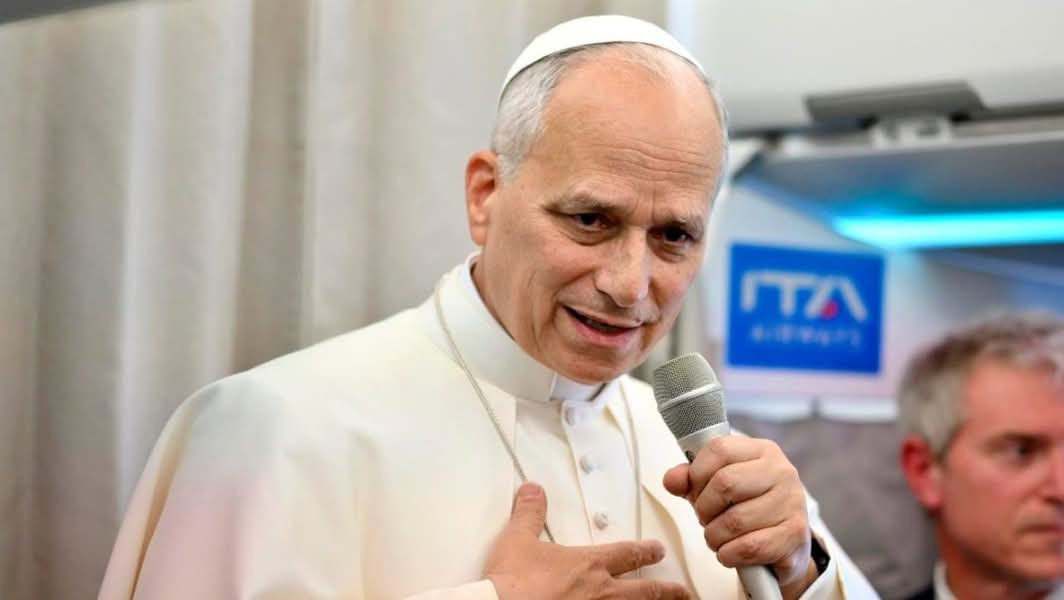
There is a sentence that should stop every Christian in America cold: The President of the United States attacked the Pope this week for preaching peace.
Not for corruption. Not for overstepping into legislation or elections. Donald Trump came after Pope Leo XIV because the leader of the Catholic Church stood at the Vatican during Holy Week — the most sacred week on the Christian calendar — quoted the words of Jesus, and called for an end to the slaughter of human beings. For that, the President of the United States called him weak, dismissed him as a tool of the radical left, and told him to stay in his lane.
If you are a follower of Christ, that should give you pause. Because the lane Pope Leo XIV is operating in is the one Jesus himself mapped out.
What the Pope Actually Said
It is worth being precise about this, because the gap between what Leo XIV said and how Trump characterized it tells you almost everything.
Easter weekend, while Trump was publicly threatening Iran with military destruction — raising the specter of what he called the potential “eradication” of a “whole civilization” — Pope Leo was delivering his Palm Sunday message. He called Jesus the “King of Peace.” He warned that God “does not listen to the prayers of those who wage war.” He lifted up the suffering of people in Ukraine and Gaza, described the world as locked in a “third world war in pieces,” and said Trump’s threats against Iran were “truly unacceptable.”
These are not the words of a political operative. They are the words of a pastor doing his job — the same words that have flowed from pulpits, monasteries, and street corners for two thousand years. The Sermon on the Mount. The Beatitudes. Blessed are the peacemakers. Love your enemies. Whatever you do to the least of these, you do to me.
Trump’s response was not to engage with any of it theologically. It was to reach for his phone and call the Pope names.
“I Don’t Want a Pope Who Criticizes Me”
Trump’s own words are the most revealing part of this story, so they deserve to be read plainly.
“I don’t want a Pope who criticizes the President of the United States,” he wrote, “because I’m doing exactly what I was elected, IN A LANDSLIDE, to do.” He labeled Leo “weak” and accused him of being captured by the “Radical Left.” He also made the eyebrow-raising claim that the Vatican elevated an American to the papacy specifically as a diplomatic strategy to manage Donald Trump — a claim with no credible basis, offered without evidence, and almost certainly false.
Vice President JD Vance joined in, telling the Pope to “stick to matters of morality” — which would be a remarkable thing to say to any religious leader, but becomes almost surreal when directed at the head of the Church about war, human dignity, and the sanctity of life. If those are not matters of morality, it is genuinely unclear what would qualify.
What emerges from all of this is a portrait of political leaders who want a Christianity that endorses their power rather than one that challenges it. That is, of course, a very old impulse. It just does not usually come this close to the surface.
Who Is This Pope, and What Does He Stand For?
Robert Francis Prevost — Pope Leo XIV — is the first American-born pope in history, elected on May 8, 2025. But long before the white smoke rose over the Vatican, his life was an argument against the kind of comfortable, power-adjacent faith that asks nothing difficult of its adherents.
He spent years as a bishop in Peru, living alongside communities that the global economy had largely left behind. When Russia invaded Ukraine in 2022, he didn’t hedge or offer careful diplomatic language — he called it what it was: an imperialist act of conquest, a nation using military force to seize territory it had no right to take. He said it publicly, on Peruvian television, because he believed the Church had an obligation to name injustice clearly.
As a cardinal in early 2025, he shared an article pushing back on JD Vance’s argument that Christian love is something to be ranked by national origin, proximity, or usefulness. The piece’s headline — “JD Vance is wrong: Jesus doesn’t ask us to rank our love for others” — made waves. But the theology behind it is not controversial. It is the Parable of the Good Samaritan. It is the command to love your neighbor, with no asterisk attached.
Since becoming pope, Leo has made another quiet but significant choice: he addresses the world primarily in Italian and Spanish, not English. It is a deliberate signal that he is not an American representative in religious robes. He is a shepherd to the entire human family, and he intends to act like one.
The Pope Responds — Calmly, and Without Flinching
When reporters caught up with Leo XIV aboard a papal flight to Africa, he didn’t match Trump’s energy with anger or defensiveness. He simply clarified what he believes his job is.
“To put my message on the same plane as what the president has attempted to do here,” he said, “I think is not understanding what the message of the Gospel is. And I’m sorry to hear that, but I will continue on what I believe is the mission of the church in the world today.”
Then he said something even simpler: “I’m not afraid of the Trump administration, or of speaking out loudly about the message of the Gospel, which is what the Church works for.”
There was no bitterness in it. No political posturing. Just a man who appears to have read the same Bible he is being criticized for taking seriously — and decided he is going to keep taking it seriously.
The Deeper Question This Raises
Every generation of Christians has had to wrestle with the question of what their faith actually demands of them when it becomes costly. When it puts them at odds with the powerful. When following Jesus means saying something that those in authority do not want to hear.
Pope Leo XIV is not doing anything novel. He is doing what Dietrich Bonhoeffer did in Nazi Germany. What Archbishop Oscar Romero did in El Salvador before he was assassinated at the altar. What Martin Luther King Jr. did when he stood in pulpits across the American South and said that the silence of the Church in the face of injustice was itself a moral failure. He is standing in a long, costly, and entirely consistent line of people who believed that the Gospel was not a decoration for political power, but a judgment upon it.
That Donald Trump finds this inconvenient is understandable. That he is calling the Pope weak for it is telling.
Because if preaching mercy is weakness, if calling for peace is political interference, if asking the powerful to count the human cost of their decisions is something a religious leader should be ashamed of — then the question every Christian in America needs to sit with is not what is wrong with this Pope.
It is what has happened to us.




