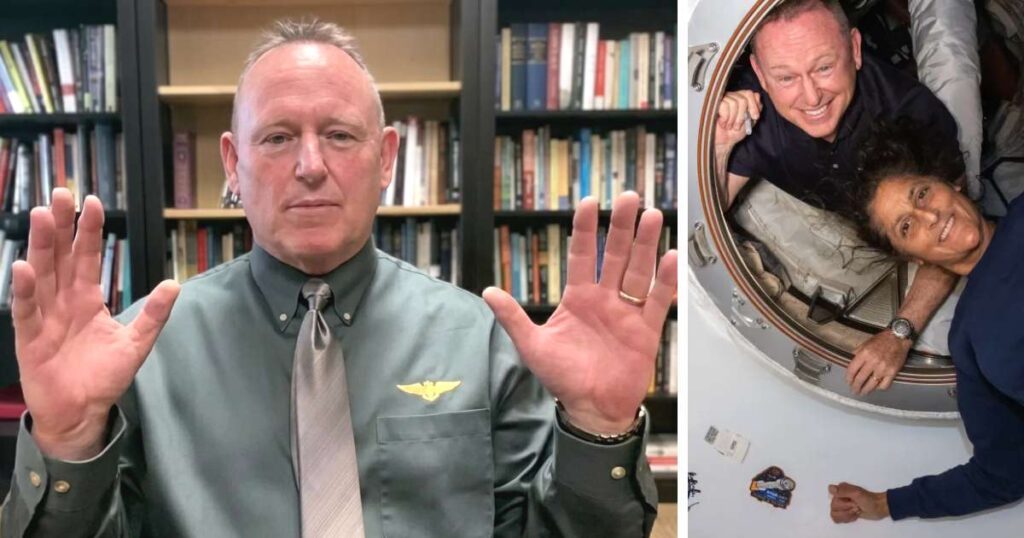
When Butch Wilmore returned to Earth after an extended stay aboard the International Space Station, viewers tuning into his national television interview might have expected stories of hardship and survival. Instead, the retired NASA astronaut delivered something unexpected: a clear proclamation of his Christian faith and how it sustained him through nearly 10 months in orbit.
The former astronaut’s appearance came after he and fellow crew member Suni Williams endured a mission that stretched far beyond its intended duration. Originally planned as a brief two-week assignment aboard Boeing’s Starliner spacecraft, technical malfunctions extended their stay to 286 days, turning what should have been a routine test flight into a months-long ordeal that captured international attention.
Faith as essential sustenance
During his interview with host Kayleigh McEnany, Wilmore explained how his Christian faith served as more than mere comfort during the prolonged mission. He described weekly participation in church services as a necessity rather than an optional activity.
“To tie into my church family was vital. It’s what makes me go. I would watch services every single week and it was invigorating,” Wilmore said. He characterized these remote connections as fellowship from a distance, acknowledging they couldn’t replicate physical presence but emphasizing their critical importance to his well-being.
A surprising perspective on adversity
McEnany referenced Wilmore’s book “Stuck in Space,” which she had been reading to her children the previous evening. She highlighted a passage where the astronaut stated that his faith, joy, and peace were so abundant that the unexpected extension of his space station mission barely qualified as a trial.
When asked to explain this seemingly incomprehensible viewpoint, Wilmore responded with theological clarity. “Let me summarize the Bible in one sentence. Before the foundation of the world, God the Father determined to present God the Son with redeemed humanity that would honor, worship and glorify Him for all eternity — and in that I find purpose,” he stated.
This eternal perspective, according to Wilmore, fundamentally altered how he experienced his circumstances. He described himself as “part of a love gift from the Father to the Son” and explained that this understanding provided him with unshakeable purpose regardless of external challenges.
A message for those facing difficulties
Wilmore drew a distinction between those who view earthly existence as their sole reality and believers who live with an eternal framework. He suggested that many people struggle because their hope is anchored solely in temporal circumstances.
When McEnany asked what message he would offer to people feeling trapped in their own situations, Wilmore delivered a straightforward answer: “Jesus Christ, there’s hope. It doesn’t mean your life is going to be painless. It doesn’t mean you’re not going to have trials and struggles. But in all of those there’s hope in the now because of Christ and there’s hope eternal hope through Jesus Christ our Lord.”
The astronaut’s testimony offered a striking example of someone using a high-profile platform not to highlight personal accomplishments, but to direct attention toward religious conviction. His 286 days aboard the space station became, in his telling, less a story of technical mishap and human endurance than a demonstration of how spiritual belief can reshape one’s response to unexpected hardship.