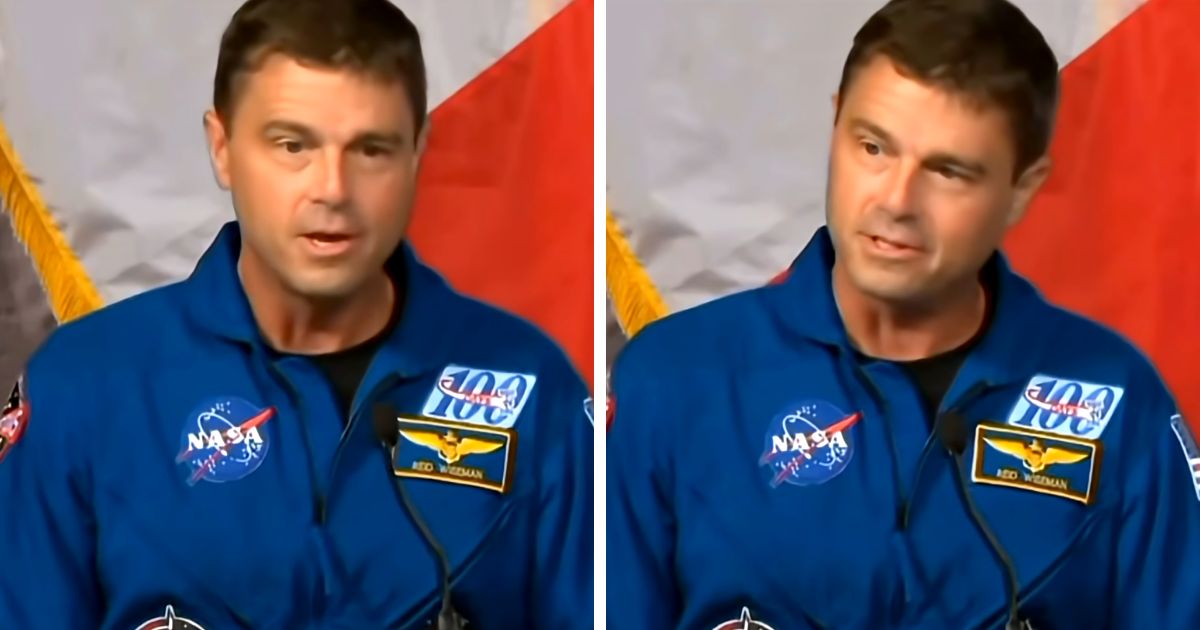
The vastness of space has a way of transforming even the most stoic individuals, as NASA Artemis II Commander Reid Wiseman discovered during his recent return from humanity’s first crewed lunar flyby in over 50 years. Despite describing himself as someone who is “not really a religious person,” Wiseman experienced an overwhelming emotional response that he couldn’t fully comprehend through his usual frame of reference.
During a press conference held at Johnson Space Center in Houston, Texas, on Thursday, April 16th, 2026, Wiseman and his fellow crew members reflected on their extraordinary journey beyond Earth’s orbit. The commander revealed that upon landing, he struggled to process the magnitude of what he had witnessed in space.

An unexpected emotional moment
“There was just no other avenue for me to explain anything or to experience anything,” Wiseman explained to reporters. “So I asked for the chaplain on the Navy ship to just come visit us for a minute. And when that man walked in, I’d never met him before in my life, but I saw the cross on his collar and I broke down in tears.”
The commander also described witnessing a celestial phenomenon that defied human comprehension. When the sun moved behind the moon during their journey, Wiseman turned to fellow astronaut Victor Glover with a startling observation. “I don’t think humanity has evolved to the point of being able to comprehend what we’re looking at right now because it was otherworldly,” he recalled saying.
A spiritual perspective from space
Mission pilot Victor Glover, who openly identifies as a person of faith, offered his own profound reflections during an Easter Sunday interview with CBS News conducted while still in space. His perspective on Earth’s uniqueness resonated with the enormity of their journey.
“We’re in a spaceship really far from Earth, but you’re on a spaceship called Earth that was created to give us a place to live in the universe,” Glover told viewers.
He continued with observations about humanity’s place in the cosmos: “You are special in all of this emptiness. This is a whole bunch of nothing, this thing we call the universe. You have this oasis, this beautiful place that we get to exist together.”
Glover concluded his Easter message with a unifying call to action that transcended religious boundaries. “Whether you celebrate it or not, whether you believe in God or not … this is an opportunity for us to remember where we are, who we are and that we are the same thing and that we got to get through this together,” he said.
The Artemis II mission, which lasted slightly more than a week, represents a crucial milestone in NASA’s ambitious plan to establish a sustained presence on the lunar surface and eventually send humans to Mars. The next phase, Artemis III, is currently scheduled for 2028 and will mark humanity’s return to walking on the moon’s surface for the first time since the Apollo program ended in the 1970s.
WATCH: NASA Astronaut Shares Powerful Moment After Space Mission