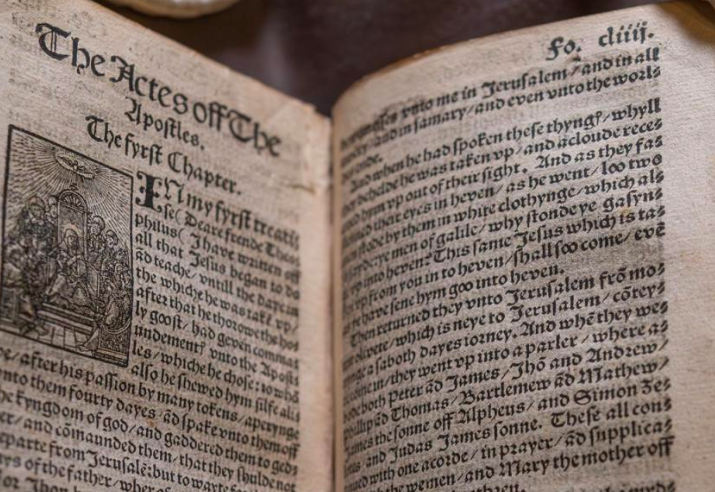
On a historic journey through time, England celebrates a pivotal milestone in religious and literary history—the 500th anniversary of the first printed New Testament in English. This event not only marks a significant anniversary but also highlights the enduring impact of William Tyndale’s groundbreaking translation efforts.
Commemorating 500 Years
In 1526, William Tyndale published the New Testament in English, a landmark achievement as it was the first translation from Greek to English and the first to be printed. Prior to Tyndale’s work, the Bible was available in a fourteenth-century English version translated from Latin by Wycliffe, but it was labor-intensive as each copy was crafted by hand. The language had evolved significantly, making Wycliffe’s text as foreign to Tyndale’s English as Chaucer’s English is to Shakespeare’s.
Back in 1526, England was under the reign of Henry VIII and the Catholic Church dominated religious life. English translations of the Bible were illegal, and people risked severe punishment for possessing such texts. Copies had to be smuggled into the country, a stark contrast to today’s easy access to Bibles in bookstores.
The Reformation and Tyndale’s Mission
William Tyndale, born around 1490 in Gloucestershire, was an Oxford-educated priest. He completed his studies just before Martin Luther ignited the Reformation in 1517 by challenging the Catholic Church. Inspired by Erasmus’s 1516 publication of a Greek-Latin New Testament, Tyndale embarked on a mission to make the scriptures accessible to English speakers.
Tyndale was motivated by the widespread ignorance of the Bible among the general population and clergy, which was steeped more in ritual than faith. He aspired to change this by translating the New Testament into English. John Foxe recounts Tyndale telling a priest, “I will cause the boy who driveth the plough to know more of the Scriptures than thou dost.”
Struggles and Triumphs in Translation
Due to a law from 1407, translating the Bible required a bishop’s approval. Tyndale sought permission from Cuthbert Tunstall, Bishop of London, but was denied, likely due to fears of insurrection similar to the Peasants’ Revolt. Undeterred, Tyndale relocated to Europe, where he could pursue his translation work without restriction.
In Wittenberg, Tyndale likely studied under Philipp Melanchthon and drew inspiration from Luther. By 1525, with assistance in Cologne, he printed the New Testament in English. After facing opposition, he fled to Worms, where he successfully completed the work.
The Legacy of Tyndale’s New Testament
In 1526, Tyndale’s translation was published as “The Newe Testamente,” with copies smuggled into England. Despite efforts to seize and burn them, few copies survived; only three are known today. The British Library holds one, purchased for over a million pounds in 1994, while other copies exist in Stuttgart and at St Paul’s Cathedral.
Tyndale’s translation profoundly influenced English language and literature, with many phrases becoming common parlance. His work contributed significantly to the King James Version and continues to resonate in modern translations like the Revised Standard Version.
Exhibitions and Celebrations
St Paul’s Cathedral currently displays one of the rare copies, and the Stuttgart copy will return to Worms for an exhibition. Additional displays are happening at Tewkesbury Abbey, Scarborough, and forthcoming at Oxford and the Faith Museum in Bishop Auckland. The Tyndale Society is actively involved in organizing conferences and events, including a major conference in Antwerp planned for 2025.
Events and Pilgrimages
Commemorative events are unfolding nationwide, from special church services to engaging talks. The Tyndale Society, founded in 1995, has been pivotal in these celebrations, offering resources and speakers to mark the anniversary. Their activities are detailed on their website.
For those interested in historical pilgrimages, trails such as the Gloucestershire Tyndale Trail and the London Tyndale Trail offer a journey through Tyndale’s footsteps. Adventurous participants can even follow the River Rhine from Cologne to Worms.
Online Resources and Community Engagement
The Tyndale Society hosts monthly “Tyndale Talk” sessions online, accessible via Eventbrite and their YouTube channel. Those interested in the anniversary can find more details and event support on the Tyndale Society website or join their Facebook group.
This article was originally written by www.christiantoday.com