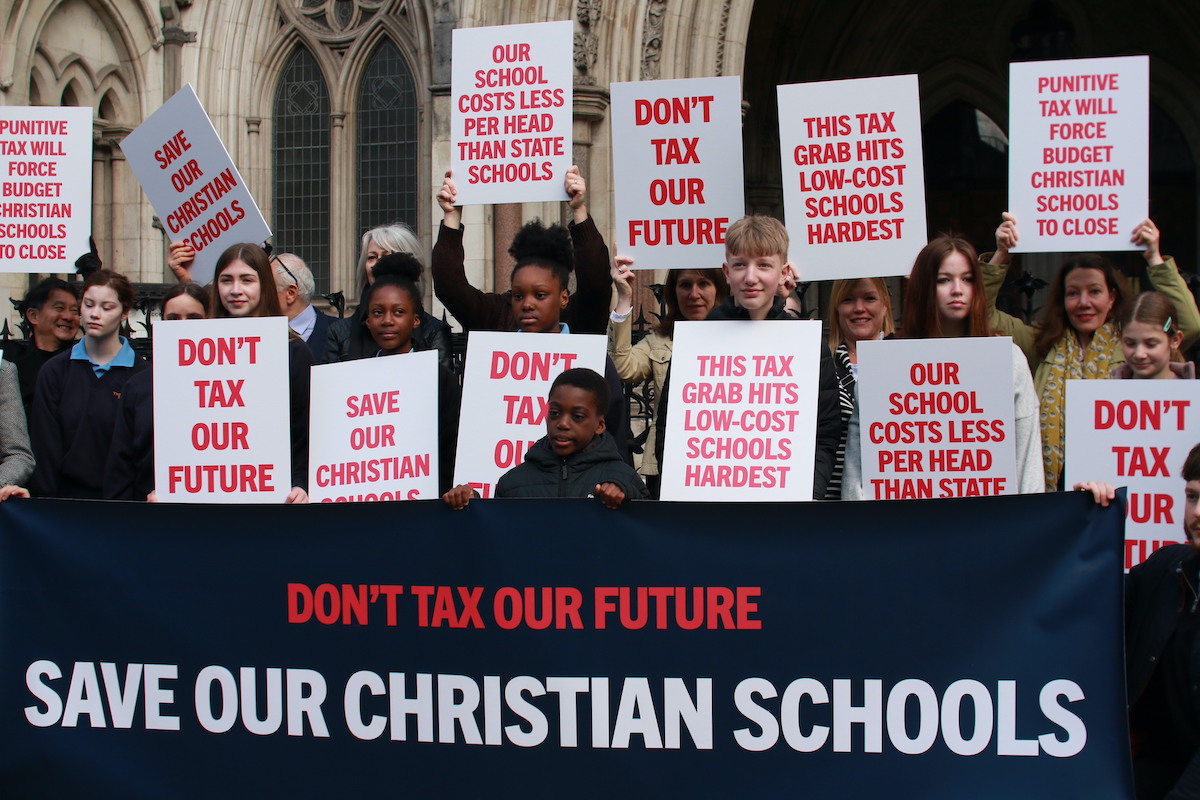
(Photo: Christian Legal Centre)
The introduction of VAT on private school fees by the Labour government has sparked a significant legal battle, as Christian schools across the nation challenge its impact. As the Court of Appeal deliberates on this issue, a gathering of parents, teachers, and pupils at the Royal Courts of Justice highlights the widespread concern over the policy’s consequences.
This VAT policy has been linked to the closure of numerous private educational institutions, particularly affecting smaller and budget-conscious Christian schools. An example of this is the closure of a historic cathedral choir school that had been in operation for 850 years, Exeter Cathedral School, which cited “unavoidable financial pressures” as its reason for shutting down. Other closures include Kilgraston, Scotland’s only independent Catholic school for girls.
Headteachers and families from Christian schools nationwide have launched an appeal against the tax policy, backed by the Christian Legal Centre (CLC). The CLC claims that over 100 private schools have been forced to close due to the tax, affecting around 17,000 students.
The appeal argues that the tax disproportionately affects low-cost Christian schools serving underprivileged communities, families seeking faith-based education, and children with Special Educational Needs (SEND).
Stephen White, a parent affected by the policy, expressed the dilemma faced by families: “This policy forces families like mine into an impossible choice. We live simply so we can send our children to a school shaped by our faith. Labour has created a caricature of wealthy private schools, that’s not our reality. We are ordinary, hardworking families and this tax threatens to take away our children’s education overnight.”
Andrea Williams, chief executive of the CLC, criticized the policy as an “ideological overreach” by the Labour government. She stated, “Education is not the sole responsibility of the state, nor should the state interfere in the rightful role of families. By imposing a direct tax on education, something no UK or Western government has ever done, the government is deliberately narrowing parental choice and forcing families into decisions they would not otherwise make.”
Williams further argued that the case transcends tax issues, raising questions about state interference in family responsibilities and parental freedoms. She emphasized, “This case is about more than tax. It is about whether the state should be allowed to crowd out family responsibility and conscience, creating conditions in which parents effectively have no choice but to submit to a single, state-approved model of education. It is about the fundamental freedom of parents to educate their children in accordance with their faith and deeply held beliefs.”
This article was originally written by www.christiantoday.com