Changing Dynamics: Is the U.S. a Liberal Democracy or Something Else?
In recent years, political analysts have been questioning the nature of the political system in the United States. Some argue that America no longer fits the mold of a liberal democracy, suggesting it has transitioned to a “competitive authoritarianism” model, a term gaining traction in political discourse.
The concept of competitive authoritarianism was introduced by Harvard’s Steven Levitsky and University of Toronto’s Lucan Way in 2002. It describes a system where democratic institutions exist, and elections are held, but the ruling party manipulates these systems to maintain power. Levitsky explained on NPR’s 1A that such governments use state mechanisms as both a weapon against opponents and a shield for allies.
Levitsky cites President Trump’s pardoning of individuals convicted in the January 6, 2021 Capitol assault as an example of this strategy. The term itself was unexpectedly applied to the U.S., surprising its creators, who initially used it for countries like Serbia, Kenya, and Peru.
Interestingly, the term “competitive authoritarianism” was coined almost accidentally. Originally named “Contested Autocracy,” a mislabeling by Harvard Professor Timothy Colton led to the more apt title. Since President Trump’s election, the term has seen a surge in interest, appearing in numerous publications worldwide.
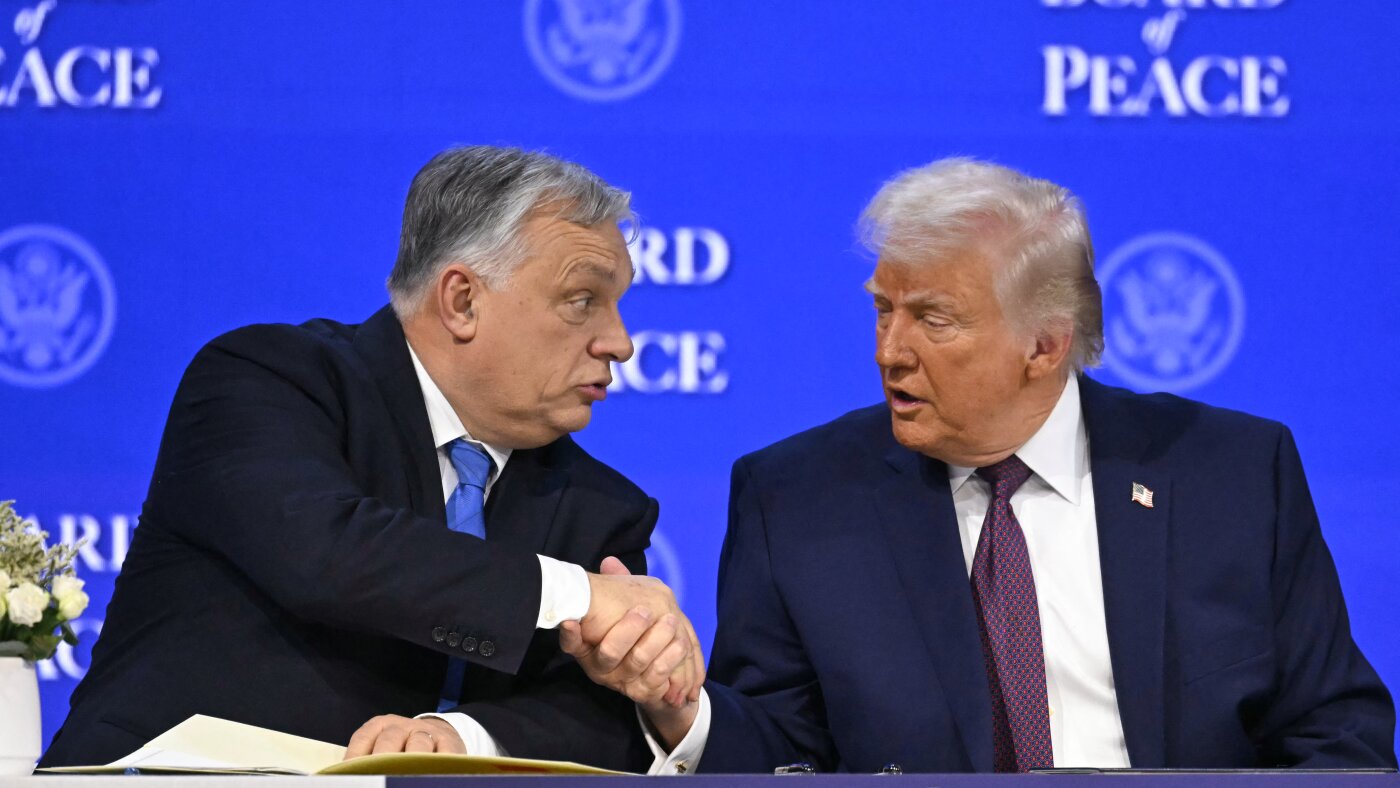
Hungary’s then-Prime Minister Viktor Orban shakes hands with President Trump At the “Board of Peace” meeting during the World Economic Forum annual meeting in Davos on January 22. Fabrice Coffrini/AFP via Getty Images
President Trump, on the other hand, has denied being an autocrat, asserting, “I don’t like a dictator. I’m not a dictator.” Despite his claims, parallels are drawn between his actions and those of leaders like Hungary’s Viktor Orbán and Turkey’s Recep Tayyip Erdogan, who have been known to utilize governmental powers to suppress opposition.
While the term competitive authoritarianism is gaining traction, some scholars maintain that the U.S. remains a democracy. They highlight the continued presence of opposition voices, such as late-night host Jimmy Kimmel, and ongoing protests both online and on the streets.
It’s also important to note that competitive authoritarianism does not guarantee indefinite rule. Viktor Orbán, once seen as a master of this political strategy, was recently ousted by a unified opposition due to economic struggles and corruption.