Financial Incentives Drive Local Police Cooperation with ICE in Florida and Texas
In recent months, the collaboration between local law enforcement and U.S. Immigration and Customs Enforcement (ICE) has reached new heights, fueled by significant financial incentives. This initiative has sparked discussions about the impact of monetary rewards on immigration enforcement strategies.
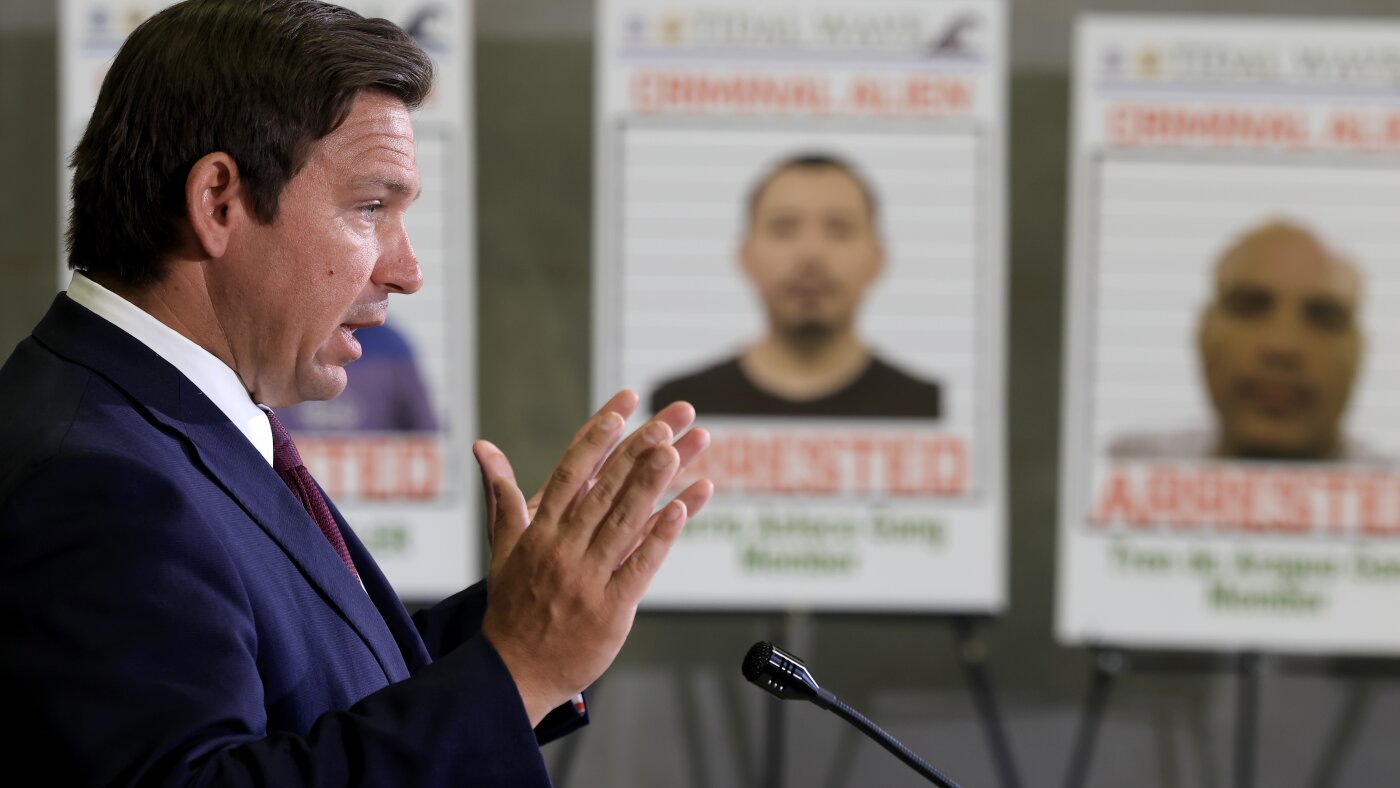
Florida Gov. Ron DeSantis speaks during a press conference in front of posters of people that law enforcement arrested, held at the ICE Enforcement and Removal Operations office on May 1, 2025 in Miramar, Fla. Florida has issued its own financial incentives to encourage more local police cooperation with ICE.
Joe Raedle/Getty Images North America
In March, Florida Chief Financial Officer Blaise Ingoglia distributed substantial financial awards to local law enforcement agencies. These funds, part of a $250 million state pool, are intended to bolster local police cooperation with ICE. During the event, Ingoglia expressed pride in rewarding sheriffs for their efforts in ensuring community safety and aiding in the deportation of criminal illegal aliens.
Substantial sums went to various sheriff offices: Okaloosa County received approximately $100,000, while Escambia County, Santa Rosa County, and Franklin County were awarded nearly $1 million, over $280,000, and nearly $50,000, respectively. These funds were given to counties that joined the federal 287(g) program, empowering local police to apprehend undocumented immigrants, a role traditionally held by federal officers.
ICE’s Financial Commitments to Local Police
On a national scale, the Department of Homeland Security (DHS) is providing $100,000 for new vehicles and additional equipment to law enforcement agencies participating in the program. The DHS also promises to reimburse salaries and benefits of officers involved, with potential bonuses for successful identification of undocumented individuals, akin to a bounty hunter system.
A recent report by FWD.us, a criminal justice and immigration reform advocacy group, suggests that if DHS fulfills its promises, the total could reach as high as $2 billion in 2026.
Although the 287(g) program has existed for decades, Naureen Shah, director of government affairs for immigration at the ACLU, remarks that the financial incentives are unprecedented. “We’ve never seen this financial incentive scheme exist in any way with this program, and Congress never intended for ICE to be swooping in to these local jurisdictions and offering them money in exchange to participate,” Shah stated.
ICE describes the program as a force multiplier. Since the Trump administration “supercharged” it, the number of partnerships has grown from 135 to over 1,700.
Allocation and Use of Funds
Both Florida and Texas have started offering their own grants, leading to tens of millions of dollars awarded to local departments, with both states mandating sheriff participation in the 287(g) program. In Florida, state records indicate plans for spending the funds on equipment like body armor and license plate readers.
DHS emphasizes the importance of these partnerships for its immigration strategy, though it has not detailed the exact financial awards. However, ICE announced nearly $40 million in September to Florida police agencies for vehicles and equipment.
Felicity Rose from FWD.us warns that this funding could exceed the largest federal grants to local police, such as COPS and JAG-Byrne funds. “It’s very, very concerning that there’s so little transparency in this money,” Rose remarked.
Law Enforcement Perspectives
NPR’s outreach to various police and sheriff’s departments revealed limited responses regarding their participation and received funds. However, records from six agencies provide insight.
The Smith County Sheriff’s Office in Texas received over $340,000 for new equipment, including a Chevy Silverado. Florida’s Fort Walton Beach police chief Robert Bage confirmed $150,000 from ICE for a vehicle and equipment, with state approval for nearly $300,000 in bonuses and an AI software platform.
Bage stated, “In Florida, we’re required to cooperate with immigration officials. So if we can leverage our cooperation and get a greater benefit out of it, we are going to take the greater benefit from leveraging our cooperation.”
Santa Rosa County Sheriff’s Office in Florida secured nearly half a million dollars for a new vehicle and equipment like a fingerprint scanner and Apple AirPods for real-time Spanish translation.
Marion County Sheriff Billy Woods emphasized the fiscal responsibility of utilizing federal funds instead of local taxpayer money for program participation.
While law enforcement leaders assert their actions do not target undocumented individuals specifically, immigrant advocates express concerns over potential racial profiling and the revival of the 287(g) program under Trump. The ACLU has documented cases of perceived racial profiling in jurisdictions with federal agreements, a concern exacerbated by the financial incentives.
Jaclyn Diaz contributed reporting.
This article was originally written by www.npr.org