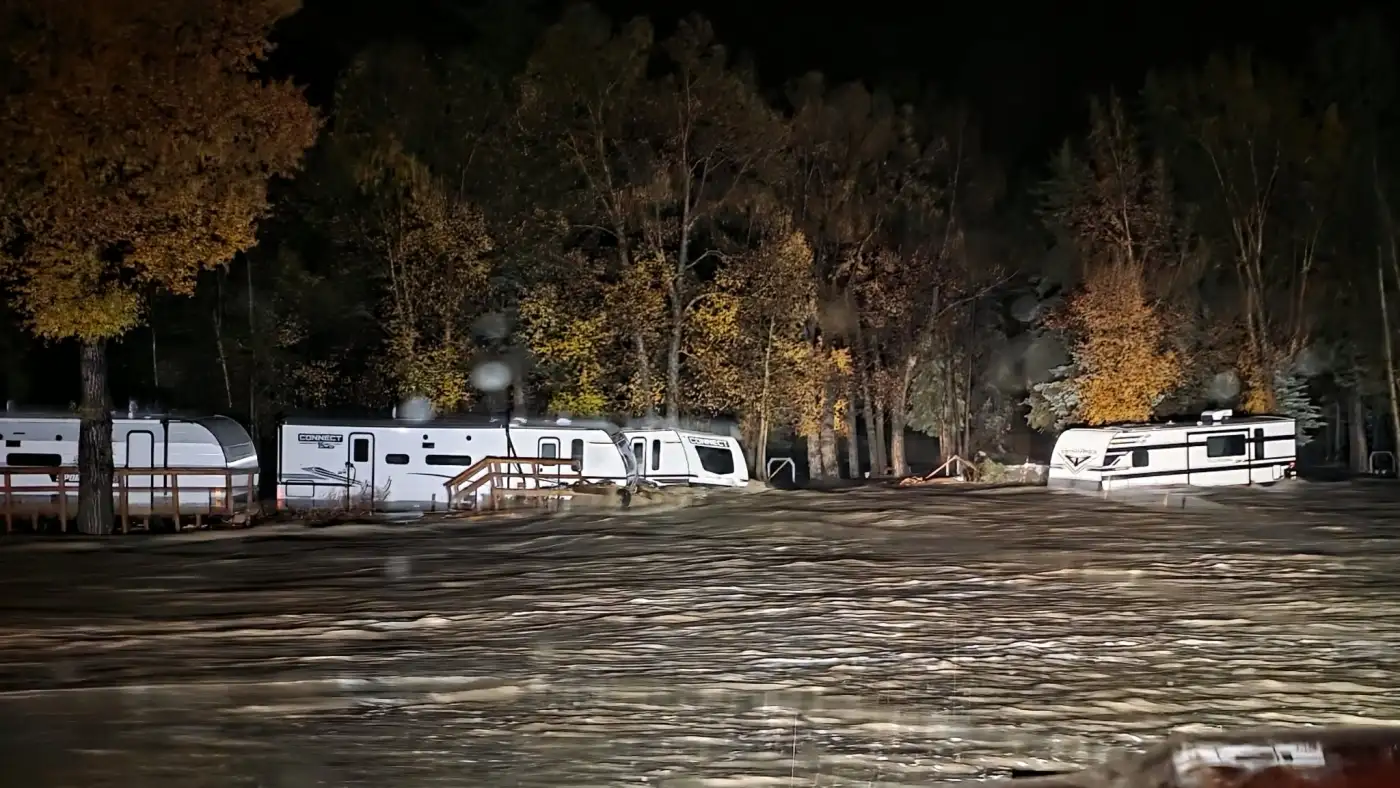
Floodwaters Ravage Southwestern U.S., Forcing Evacuations and Emergency Responses
As light clouds drifted across the sky in San Juan County, New Mexico, Devin Neeley, the county’s public information officer for emergency management, described the scene as “surreal.” Despite the calm appearance, historic levels of brown floodwaters swept through low-lying areas, inundating homes and forcing sewage into the San Juan River.
Emergency responders engaged in rescues, retrieving residents from rooftops as floodwaters surged. Under an emergency declaration, evacuations were ordered for vulnerable neighborhoods on Thursday.
“These are communities that have beautiful riverfront places to live,” Neeley commented, “And unfortunately, that’s a problem today.”
Thick, Brown Floodwaters
Intense rainfall battered the Four Corners region, encompassing New Mexico, Colorado, Utah, and Arizona, starting on Wednesday. The deluge led to severe flooding, road closures, and mandatory evacuations across these states.
Utah’s Governor Spencer Cox expressed his concern on X, stating, “Our hearts are with the families whose homes and livelihoods have been impacted.” In response to the flooding in Hurricane, Utah, the city issued an emergency declaration on Thursday.
In Farmington, New Mexico, Police Chief Steve Hebbe emphasized at a press conference that “this is singular and this is real.” Fortunately, no fatalities have been reported.
Colorado Governor Jared Polis declared disaster emergencies for 11 counties and mobilized the National Guard to assist with rescue operations in southwest Colorado.
The Navajo Nation police department reported rescuing seven families, totaling 30 people, from flooded homes. Similarly, the Hopi Tribe in northeastern Arizona declared a state of emergency due to extensive damage to infrastructure.
A Record Amount of Rainfall
The region’s mountainous topography makes it prone to flooding. Recent severe weather saw the remnants of Hurricane Trudy evolve into a low-pressure system, dumping significant rainfall. Southwest Colorado and southeast Utah recorded rainfall between two to six inches, resulting in the flooding of small creeks, streams, and rivers.
Kris Sanders from the National Weather Service noted, “Those rainfall amounts are records in themselves,” highlighting the unusual nature of the event, though similar storms occurred last year.
With thunderstorm watches continuing, Daniel Swain, a climate scientist, attributed the severe weather to record-warm waters off the West Coast, intensified by a strong El Niño event and a marine heat wave.
Swain remarked, “That is exactly what we’ve seen,” as the prediction of extreme precipitation events materialized. Neeley and his community remain vigilant, bracing for potential further impacts over the weekend.
This article was originally written by www.npr.org