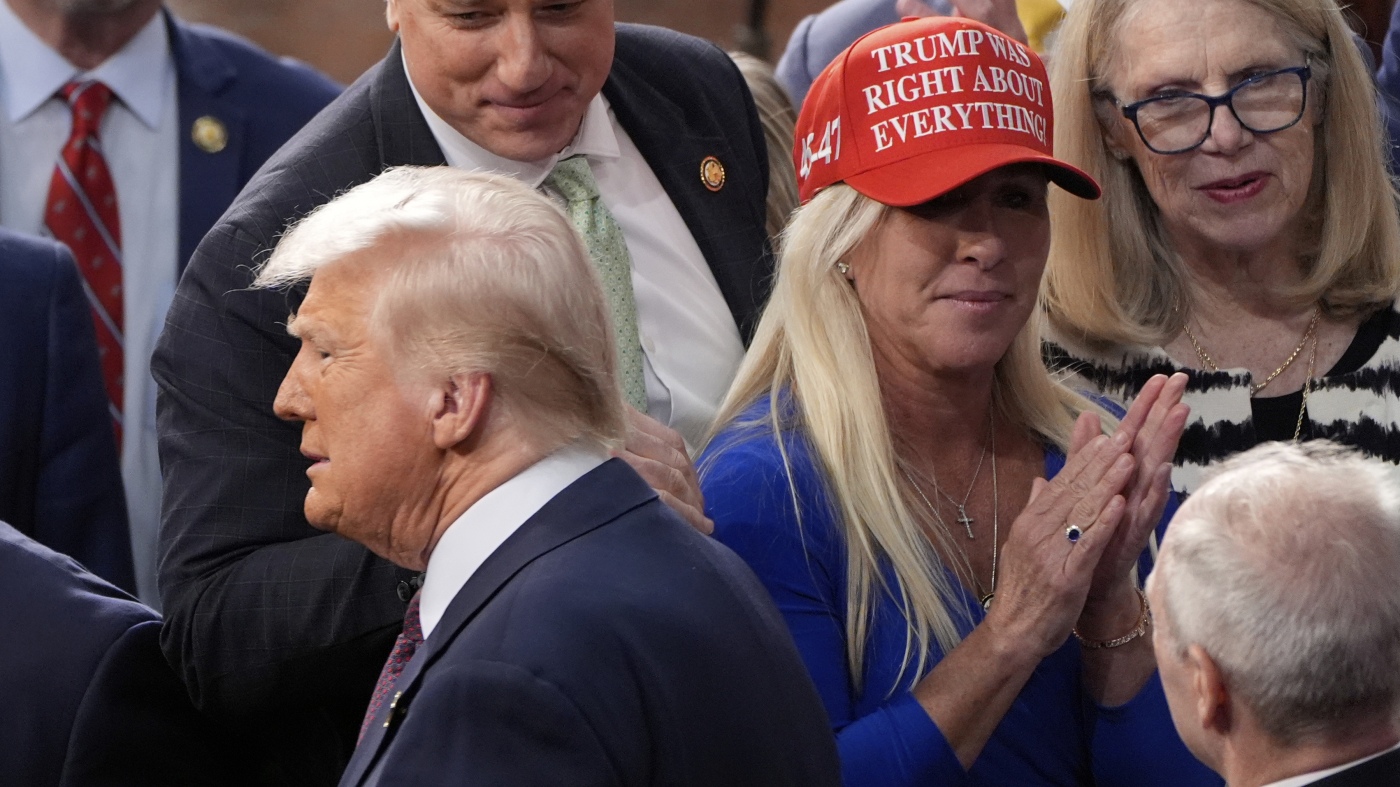
President Trump arrives after being greeted by Rep. Marjorie Taylor Greene, R-Ga., to address a joint session of Congress at the Capitol in Washington on March 4. Alex Brandon/AP
Recent tensions have emerged between Rep. Marjorie Taylor Greene, R-Ga., and President Donald Trump, spotlighting a potential schism within the Republican Party. Greene, a previously staunch supporter of Trump, has sharply criticized his foreign policy, labeling it as contrary to “America first” principles. She also expressed concern that Trump’s recent comments could endanger her safety. This exchange of criticisms raises questions about Trump’s dominance over the GOP.
Trump intensified the conflict by revoking his endorsement of Greene, branding her as “Wacky” and suggesting her criticism stemmed from his lack of support for her future political aspirations. This was followed by another social media post where he labeled her a “traitor.”
In response, Greene told CNN’s State of The Union that such a label is “extremely wrong” and could lead to radicalization against her. Reflecting on past actions, Greene apologized for her own role in “toxic politics,” acknowledging it as detrimental to the nation.
Greene also took issue with Trump’s stance on the H-1B visa program, arguing that it contradicts “America first” ideals. She voiced a desire for Trump to prioritize domestic concerns over international engagements, urging for Air Force One to “stay home.”
The division between Greene and Trump highlights a growing rift in the GOP. Greene attributed part of the fallout to disputes over the release of documents related to Jeffrey Epstein, though she believes Trump is not implicated in these files. The House is expected to vote on releasing these documents soon, following a push from Reps. Ro Khanna, D-Calif., and Thomas Massie, R-Ky.
On ABC News, Massie cautioned his colleagues against blocking the document release, warning that such a decision would tarnish their political legacies. “In 2030, he’s not going to be the president, and you will have voted to protect pedophiles,” Massie stated, emphasizing the long-term impact of their votes.