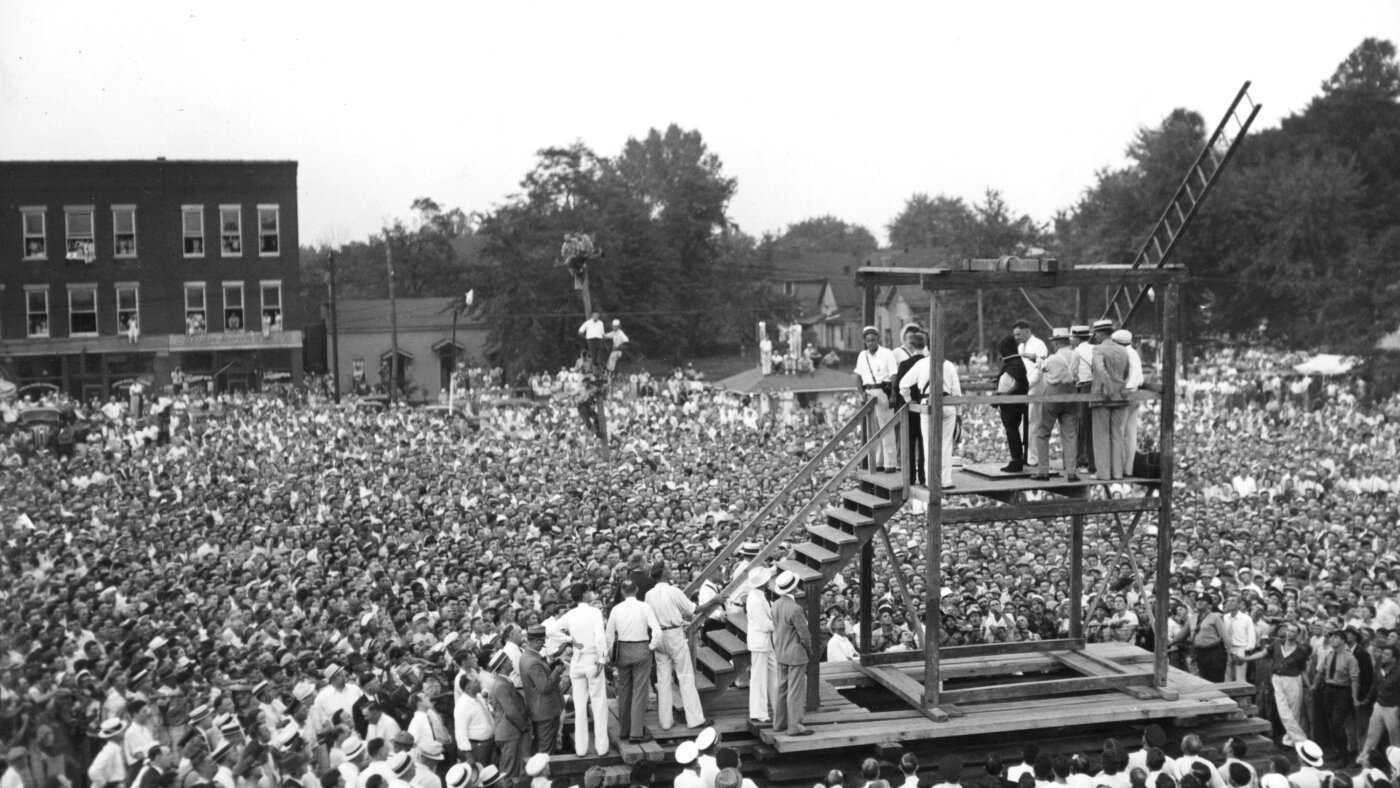
A huge crowd gathers to witness the public hanging of Rainey Bethea in 1936 in Owensboro, Kentucky. Public outrage over the spectacle made Bethea’s death the last high-profile public execution in the United States. The Pentagon wants to livestream the firing squad execution of the Fort Hood shooter.
Getty Images/Hulton Archive
hide caption
Getty Images/Hulton Archive
The Pentagon has announced plans to livestream the execution of Nidal Hasan, the former Army psychiatrist responsible for the 2009 mass shooting at Fort Hood, Texas, that resulted in 13 fatalities and 32 injuries.
Since his conviction and death sentence in 2013, Hasan, now 56, has been on military death row. Recently, the Pentagon disclosed that President Trump had sanctioned Hasan’s execution by firing squad, marking the first such military execution since World War II (source).
Scheduled for December 3 at Fort Hood, where the 2009 shooting occurred, Hasan’s execution will be publicly accessible via livestream, according to Defense Secretary Pete Hegseth, who emphasized the importance of transparency for public awareness.
“We’ll make sure that people are able to watch it, that it’s public, because people need to understand that there’s serious consequences for these types of things,” Hegseth stated in an interview with Real America’s Voice.
While the Pentagon has confirmed the livestreaming plan, legal experts have noted potential hurdles, such as possible appeals from Hasan or challenges from external organizations that could delay or prevent the execution.
Professor Michael Radelet from the University of Colorado Boulder, an expert on capital punishment, expressed doubts about the execution’s broadcast, highlighting Hegseth’s controversial nature as a possible complicating factor.
Should the execution proceed as planned, it would be the first public execution in the U.S. in nearly a century and the first to be broadcasted live.
Robin Maher, executive director of the Death Penalty Information Center, commented that public executions are typically conducted by authoritarian regimes to exert control, questioning the historical precedent for livestreaming a U.S. military execution.
The last high-profile public execution in the U.S. was 90 years ago
In 1936, Rainey Bethea’s execution in Owensboro, Kentucky, marked the last high-profile public execution in the United States. Approximately 20,000 people gathered to witness the hanging, creating a festive atmosphere that included sales of sandwiches and soft drinks (source).
The event sparked a public backlash leading Kentucky to ban public executions two years later, shifting executions to more private settings. The Oklahoma City bomber Timothy McVeigh’s 2001 execution via closed-circuit telecast was the closest the U.S. has come to a public execution since.
According to Radelet, public executions have declined due to their perceived ineffectiveness as a deterrent and concerns that botched executions could erode support for the death penalty.
As executions became less visible, they were often conducted at night with limited media access, a trend Maher attributes to the desire to avoid the spectacle and discomfort associated with public executions.
The recent botched execution of Christa Pike in Tennessee has reignited discussions on capital punishment, with experts like Radelet suggesting that a livestreamed firing squad execution could further diminish public support.
“It’s like getting rid of the guillotine — when it’s gone, it’s gone,” Radelet stated, emphasizing the public’s shift away from visible executions.
Justin Mazzola of Amnesty International USA criticized the decision to livestream Hasan’s execution, calling it a “display of cruelty” that highlights the broken nature of the U.S. death penalty system.

Defense Secretary Pete Hegseth speaks at a Maryland shipyard this week. His plan for livestreaming the execution of the Fort Hood shooter has been met with criticism and calls for reconsideration.
Stephanie Scarbrough/AP
hide caption
Stephanie Scarbrough/AP
Leaders call for Hegseth to reverse course
Hegseth’s announcement has sparked immediate controversy and calls for reversal. Vice President Vance voiced his disapproval, stating, “If it’s ultimately livestreamed, I’m not going to be watching it” (source).
Archbishop Paul S. Coakley of the U.S. Conference of Catholic Bishops released a statement condemning the public execution as a “barbaric promotion of a culture of death” that could undermine the nation’s moral fabric.
Sen. Thom Tillis, R-N.C., supported Hasan’s death sentence but criticized the livestream as “beyond disgusting,” equating public executions with practices in oppressive regimes.
Sen. Chris Murphy, D-Conn., compared Hegseth’s plan to “mimicking ISIS executions,” calling them “medieval” regardless of public opinion on the death penalty.
Top Democrats on the House and Senate Armed Services committees condemned the Pentagon’s plan as a distraction from Hegseth’s leadership failures. Sen. Jack Reed, D-R.I., described it as a “gift to anti-American terrorist recruiters” and urged reconsideration.
Sen. Patty Murray, D-Wash., also called for revocation of the decision, asserting that livestreaming a man’s death should not be condoned by the nation.
This article was originally written by www.npr.org