
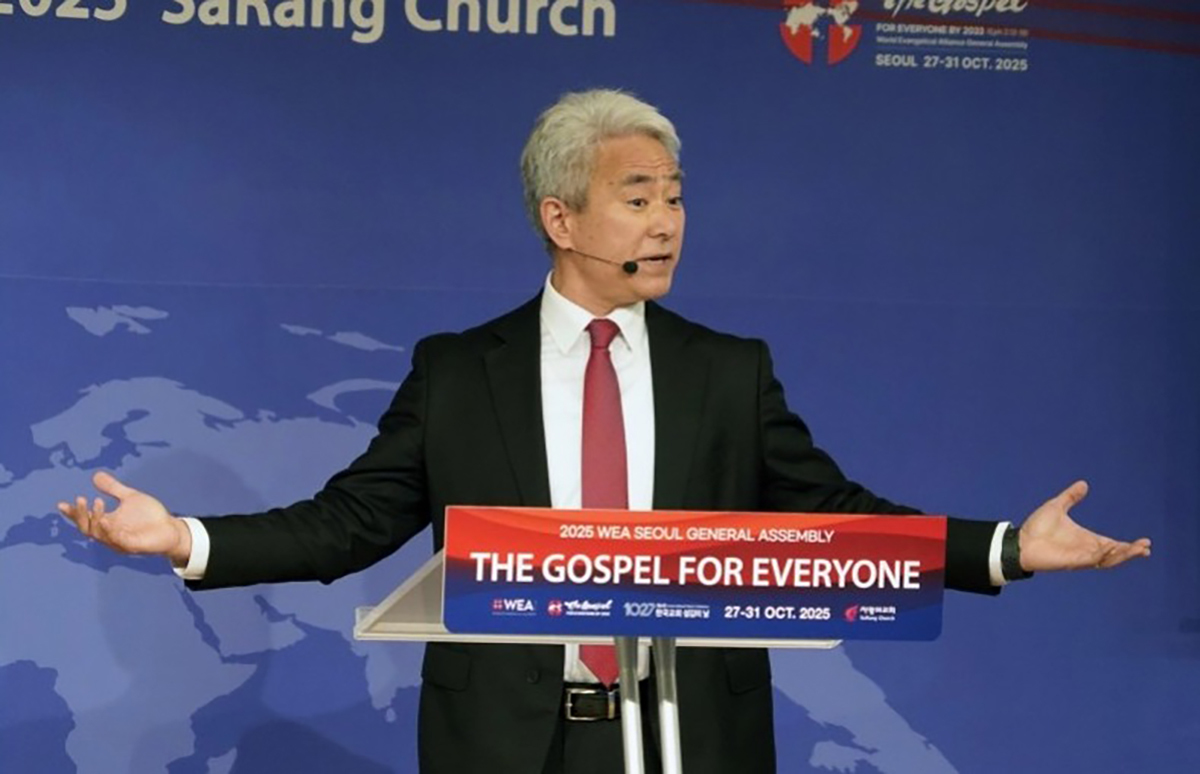
Reverend Walter Kim Advocates for Gospel Reconciliation at WEA Assembly
In a heartfelt message delivered during the World Evangelical Alliance (WEA) General Assembly in Seoul, South Korea, Reverend Walter Kim, president of the United States’ National Association of Evangelicals, shared personal insights about the Gospel’s power to reconcile amid global unrest.
Reflecting on a life-changing moment 21 years ago when his daughter Naomi was born with severe health issues, Kim recounted a profound prayer at her incubator. “I was in the hospital, sitting next to her incubator as she was connected to tubes,” he recalled. “I couldn’t touch her. In the early weeks of life, I merely touched the plastic that separated us and prayed that God would fill her lungs and pulse blood through her veins.” His daughter’s middle name, Joy, was inspired by Nehemiah 8:10: “The joy of the Lord is your strength.”
Kim emphasized that her journey symbolizes the Gospel’s response to sin with peace and reconciliation. He compared modern times to the unstable first-century world of the Gospel’s origin, marked by the Roman Empire’s vast migrations and rebellions. “This is our time as well,” he declared. “Religious pluralism, urbanization, mass migration, economic upheaval, multiculturalism, breakdown of old worldviews — you name it. The Gospel must be proclaimed in tumultuous times.”
He articulated that humanity’s paramount issue is sin, which results in alienation from God, others, and oneself. Quoting Romans 7, he said, “The good that I want to do, I don’t do, but I do the very evil that I don’t want to do.” Kim further explained that Christ’s sacrificial death represents ultimate reconciliation: “God rescues us,” he said. “God responds to this problem of sin that separates and shatters and shames us with the reconciling peace of Christ.”
To illustrate the transformative power of the Gospel, Kim referenced the Apostle Paul’s teachings about the “dividing wall of hostility.” He noted that the Gospel demolishes these barriers, forming a unified Church where believers belong to God and each other.
Kim highlighted the Gospel’s essence as peace and peacemaking, emphasizing its universal application across social, political, familial, and architectural metaphors in Scripture. He argued, “If we are to have a Gospel for everyone, we need a Gospel for everything. The Gospel should touch every aspect of society — individuals and institutions, personal and public, spiritual and social.”
Sharing experiences from Malawi, Kim described how churches, despite denominational differences, have collaborated in Muslim-majority regions through education and community services, demonstrating reconciliation in action. Highlighting a personal story, he recalled, “There were 80 children there, most of them Muslim children, memorizing ‘Jesus loves me, this I know.’”
Reverend Kim closed by reiterating the inclusive nature of God’s kingdom: “Every person has a place at the table of God. Every person has a call to be on mission. There is none too great and none too small, not abled or disabled, that in the great economy of God cannot be redeemed.”
This article was originally published at Christian Daily International
This article was originally written by www.christianpost.com




