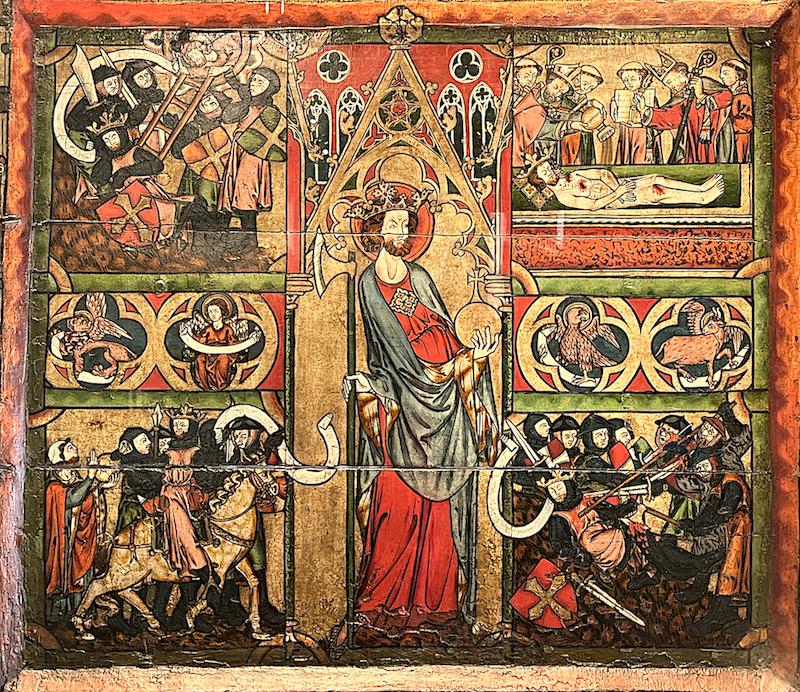
(Photo: Rev Ian Faulds)
St Olaf’s Day, celebrated on 29 July, honors Norway’s patron saint, but who was this notable figure, and what legacy did he leave behind? This exploration delves into his life and enduring influence.
Christianity’s Roots in Norway
Christianity was first introduced to Norway in AD 995 by Olav Tryggvason on the island of Moster in Vestland. This marked the construction of Norway’s inaugural church. Despite this, many Norwegians continued to adhere to Norse mythology, worshipping gods like Odin and Thor. The millennium of this pivotal event was celebrated in 1995 at Moster.
Olaf Haraldsson: From Raider to Ruler
Born into royalty, Olaf Haraldsson, the son of King Harald Grenske, was a descendant of Harald Fairhair, Norway’s first king. His early years were marked by Viking raids across Europe, including a notable attack on London in 1009. Olaf’s participation in the sacking of Canterbury in 1011 may have influenced his later conversion to Christianity.
Conversion and Return
In 1013, Olaf found himself in Normandy, a region with strong Viking ties, where he was converted to Christianity and baptized in Rouen. His newfound faith led him to assist England’s Christian King Ethelred in battles against the Danes. A dream prompted his return to Norway in 1015, where he aimed to unify the country under Christian rule.
Establishing Christian Laws
After securing his rule at the Battle of Nesjar in 1016, King Olaf II established a Christian law code at a synod in Moster in 1024. This code, influenced by English laws, reformed several Norse customs and marked the foundation of Norway’s Church legislation. The millennium of these laws was celebrated in June 2024.
The Battle of Stiklestad and Sainthood
Olaf’s efforts to consolidate power led to significant opposition, resulting in his exile in 1028. His attempt to reclaim the throne ended with his death at the Battle of Stiklestad on 29 July 1030. Olaf’s martyrdom led to reports of miracles, and he was canonized by Bishop Grimkell in 1031. His sainthood was recognized by Pope Alexander III in 1164.
Legacy of St Olaf
St Olaf became a symbol of Norwegian pride and independence. His influence extended beyond Norway, with over 300 churches dedicated to him across Europe. In the British Isles, his name appears in various forms, such as Olaf, Olav, or Olave. Notably, St Olave’s Church in York, founded in 1055, was the first dedicated to him.
Pilgrimage and Cultural Celebrations
Nidaros Cathedral in Trondheim, built over Olaf’s burial site, remains a major pilgrimage destination. St Olav’s Way, a pilgrimage route from Oslo to Trondheim, is akin to the Camino de Santiago. The annual celebration of St Olaf’s Day, or Olsok, features cultural and religious events, with major gatherings in Trondheim and Stiklestad.
Honoring St Olaf Globally
Norwegian emigrants brought Olaf’s legacy to North America, establishing churches in his name. In London, St Olave’s Church on Hart Street and the Norwegian church in Rotherhithe, consecrated to St Olav, reflect his enduring influence. The Royal Norwegian Order of St Olav, founded in 1847, honors distinguished service to Norway.
Preserving History
The tales of St Olaf and other Scandinavian royals are chronicled in the Norse sagas of the Heimskringla. Norwegian footballer Erling Haaland recently donated a copy to a local library, ensuring these stories endure for future generations. Plans are underway to commemorate the millennium of St Olaf’s death in 2030.
This article was originally written by www.christiantoday.com